











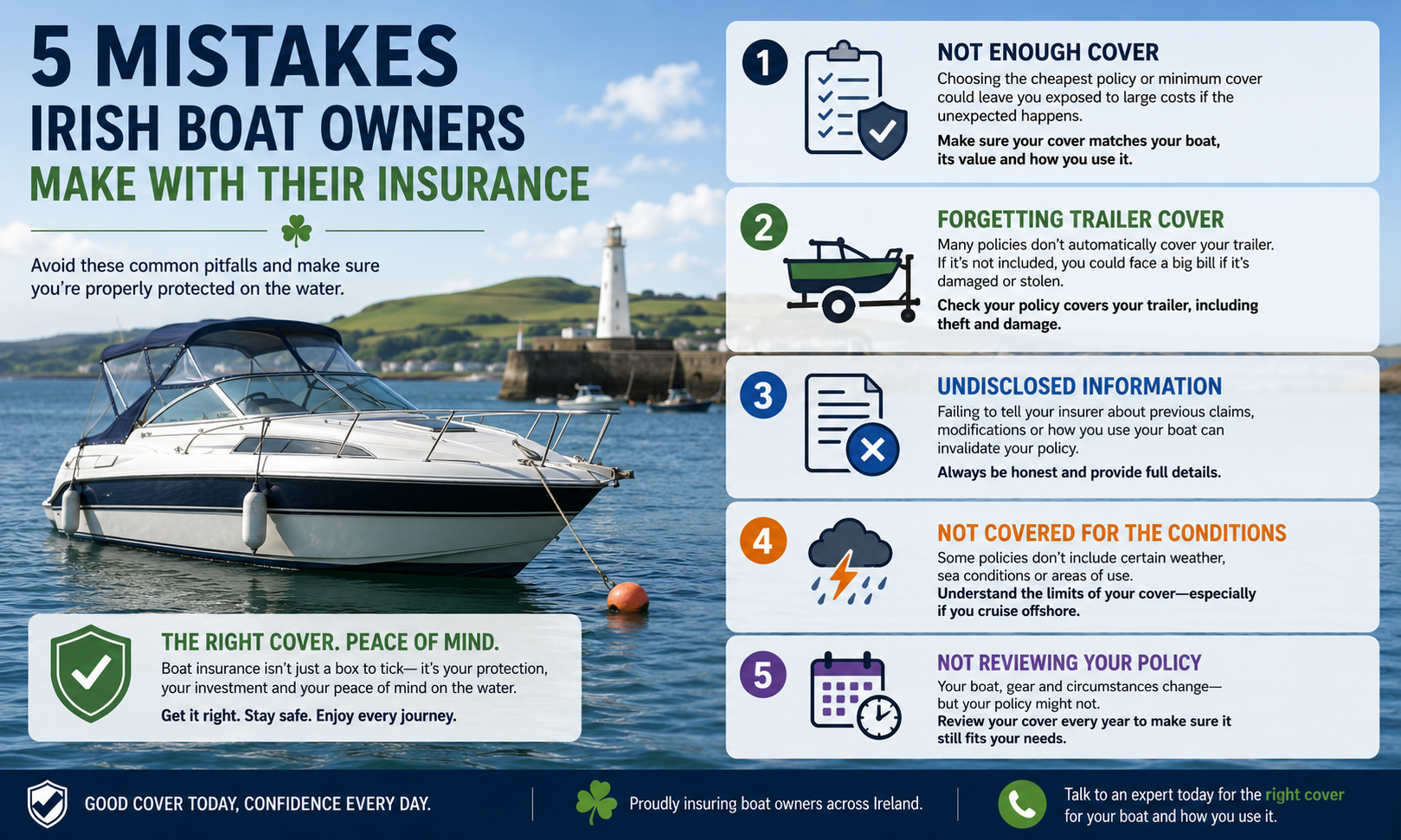


Owning a boat in Ireland comes with its own particular joys and headaches — unpredictable weather, exposed moorings, and a coastline that can turn from calm to challenging within hours. Amid all this, insurance is one area where many boat owners unintentionally leave themselves exposed. Whether you own a small RIB, a dinghy for weekend racing, or a larger sailing vessel, getting your cover wrong can be costly.
Here are five common mistakes Irish boat owners make with their insurance — and how to avoid them.
1. Assuming All Boat Insurance Ireland Policies Are the Same
One of the biggest misconceptions is that boat insurance Ireland policies are more or less interchangeable. In reality, cover varies significantly between providers, and the differences often only become apparent at claim time.
Some policies only cover damage while the boat is in the water, excluding storage, transport, or maintenance periods. Others cap third-party liability at levels that wouldn't come close to covering a serious incident in a busy harbour or marina. Before choosing boat insurance Ireland cover, it's worth comparing:
What to Check Before You Buy
- Whether cover applies year-round, including winter storage
- Third-party liability limits (particularly important given Ireland's busy leisure marinas)
- Whether racing, chartering, or instructional use is included
- Geographic limits — some policies restrict cover to Irish and UK waters only
Taking the time to read the policy wording rather than just the summary can save a lot of frustration later.
2. Underinsuring RIBs and Fast Powerboats
RIBs are hugely popular around the Irish coast, from Cork to Donegal, thanks to their versatility for fishing, watersports, and general leisure use. But RIB boat insurance is frequently underestimated in terms of both value and risk.
A common error is insuring a RIB based on its original purchase price rather than its current replacement value, especially once outboard engines, electronics, and trailers are factored in. Engines in particular can represent a large share of a RIB's overall value, and not all rib insurance policies automatically include full cover for outboard motors — some treat them as a separate, optional add-on.
Getting RIB Insurance Right
When arranging rib boat insurance, make sure the policy reflects:
- The combined value of hull, engine(s), and trailer
- Cover for towing and transport, not just time on the water
- Theft protection, since RIBs and outboards are a known target due to their portability
Given how frequently RIBs are launched, retrieved, and trailered between locations, rib insurance needs to account for risks beyond simply being at sea.
3. Overlooking Dinghy Insurance Entirely
Dinghies are often seen as low-value, low-risk boats, which leads many owners to skip dedicated cover altogether or assume they're covered under a general home or contents policy. This is rarely the case, and it's one of the more avoidable gaps in Irish boat ownership.
Dinghy insurance matters just as much for a training dinghy at a local sailing club as it does for a competitive racing class. Damage during transport, storage yard incidents, and theft from clubhouses or slipways are all common claims scenarios that a standard household policy typically won't touch.
Why Dedicated Cover Matters
Purpose-built dinghy insurance typically includes:
- Cover for spars, sails, and rigging, which are expensive to replace
- Protection during club storage and racing events
- Liability cover for collisions during races or club sailing
Given how many Irish sailing clubs require proof of insurance for members using club facilities or entering events, having proper dinghy insurance in place isn't just good practice — it's often a prerequisite for getting on the water at all.
4. Choosing Insurance Sailing Dinghy Cover Without Considering Racing Use
For owners who race, insurance sailing dinghy cover deserves particular attention. Many standard leisure policies exclude racing altogether, or only offer limited cover for organised events. Given how active Irish dinghy racing is — from club-level Sunday racing to national and international regattas — this is a mistake that can leave owners without protection exactly when incidents are most likely to happen.
Collisions on a start line, capsizes in gusty conditions, and damage during mark roundings are all realistic scenarios in competitive sailing. If your insurance sailing dinghy policy doesn't explicitly state that racing is covered, assume it isn't.
Questions to Ask Your Insurer
- Is racing cover included as standard, or as an add-on?
- Does cover extend to regattas outside Ireland, if you travel to compete?
- Are sails and rigging covered for racing-related damage, not just cruising use?
Clarifying this upfront avoids an unpleasant surprise after an on-the-water incident during a race.
5. Renewing Without Reviewing the Policy
Perhaps the most common mistake across all boat types is simply renewing boat insurance Ireland policies year after year without reviewing them. Circumstances change — a new engine, an upgraded trailer, a change in how often the boat is used, or a move to a new marina or club — and policies rarely adjust automatically to reflect this.
Auto-renewal is convenient, but it can mean paying for cover that no longer matches the boat's actual value or use case. It can also mean missing out on improved terms elsewhere, since the boat insurance Ireland market does shift over time in terms of pricing and available cover.
A Simple Annual Habit
Before renewing, take a few minutes to:
- Confirm the insured value still matches the boat's current worth
- Check if usage patterns have changed (more racing, chartering, or towing, for example)
- Compare at least one alternative quote to benchmark value
This small habit can be the difference between adequate cover and a shortfall at the worst possible moment.
Final Thoughts
Whether you're insuring a RIB, a dinghy, or a full sailing yacht, the details matter more than the headline premium. Taking time to properly review rib boat insurance, dinghy insurance, or insurance sailing dinghy terms — rather than assuming standard boat insurance Ireland cover will do the job — is one of the simplest ways to protect both your boat and your peace of mind on the water.
If you're due a renewal or have recently changed how you use your boat, now is a good time to review your policy properly rather than letting it roll over unchecked.





Add Comment