













The Active Fire Safety Market is becoming increasingly important as governments, businesses, infrastructure developers, and energy operators place greater emphasis on fire prevention, rapid detection, emergency response, and asset protection. Rising urbanization, stricter fire safety regulations, expanding commercial infrastructure, and the rapid deployment of battery energy storage systems are creating new opportunities for active fire safety technologies.
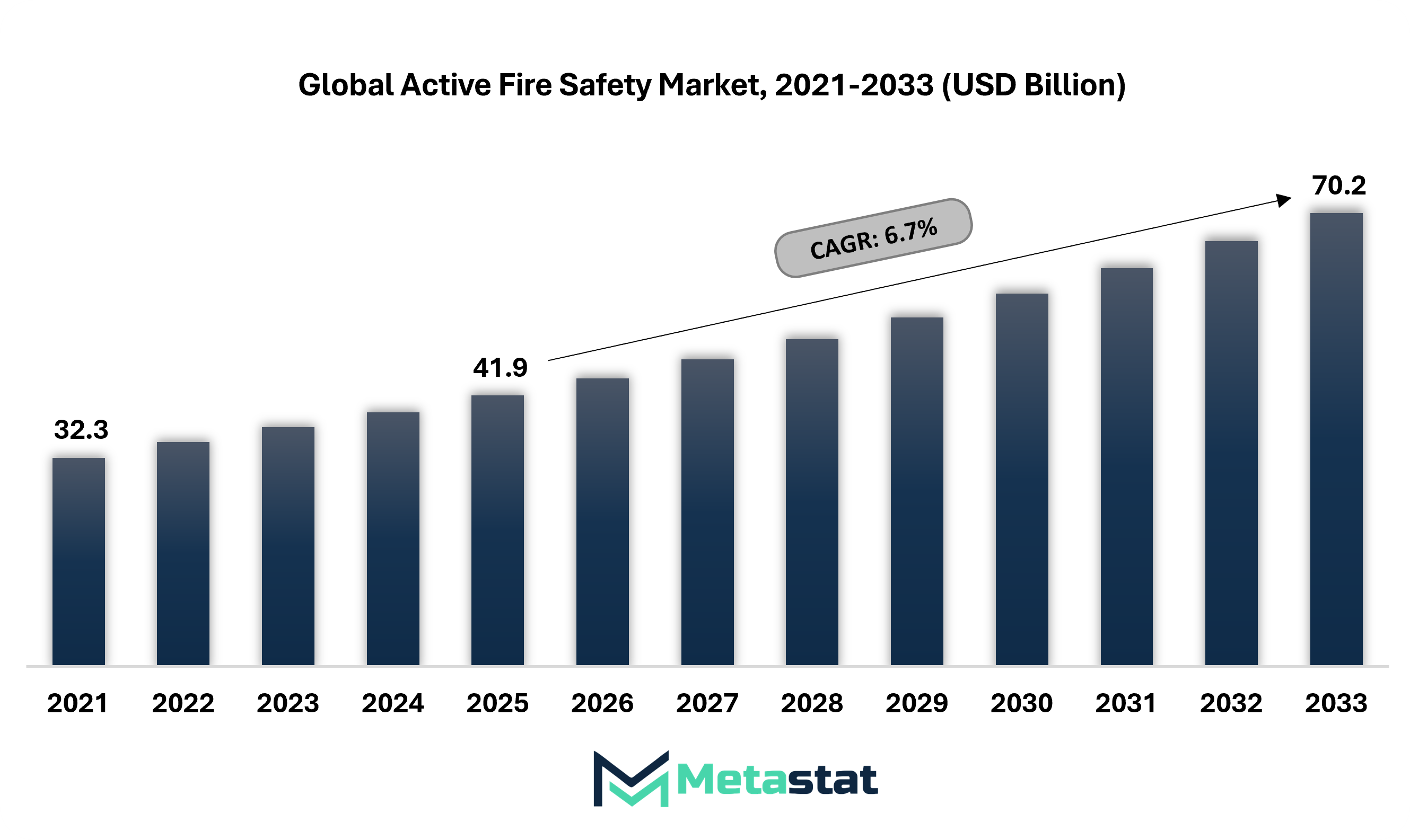
According to the latest analysis from Metastat Insight, the global Active Fire Safety Market was valued at USD 41.9 billion in 2025 and is projected to reach USD 70.2 billion by 2033, expanding at a CAGR of 6.7% from 2026 to 2033. The market is estimated at USD 44.6 billion in 2026.
Active Fire Safety Market Overview
Active fire safety refers to systems and technologies that actively detect, notify, control, or suppress fire incidents. Unlike passive protection measures, active systems are designed to respond when a fire or hazardous condition is detected.
The market includes fire detection systems, fire suppression systems, integrated fire and gas monitoring panels, alarm and emergency communication systems, and battery-specific fire safety solutions.
The increasing complexity of modern buildings and industrial facilities is encouraging end users to adopt connected and automated protection technologies. Data centers, manufacturing plants, high-rise buildings, commercial properties, energy infrastructure, and battery storage facilities are among the key application areas.
The market is also benefiting from the integration of IoT sensors, building management systems, remote monitoring, analytics, and predictive maintenance. These technologies can improve detection accuracy, response coordination, and lifecycle management.
Active Fire Safety Market Size and Forecast
The global market is expected to demonstrate steady expansion during the forecast period.
| Year | Market Size |
|---|---|
| 2025 | USD 41.9 Billion |
| 2026 | USD 44.6 Billion |
| 2033 | USD 70.2 Billion |
| CAGR, 2026–2033 | 6.7% |
The market's growth reflects increasing investment in fire detection and suppression infrastructure, modernization of aging systems, regulatory compliance requirements, and the emergence of new fire safety challenges associated with battery energy storage.
Key Market Growth Drivers
Stricter Fire Safety Regulations
Governments and regulatory bodies are strengthening fire safety requirements for commercial buildings, industrial facilities, high-rise properties, and critical infrastructure. Stricter codes and evolving insurance requirements are encouraging property owners to upgrade older fire protection systems.
ESG-related risk management is also contributing to investment in safety infrastructure. Businesses increasingly view fire protection as part of broader operational resilience and asset-risk management strategies.
Expansion of Battery Energy Storage Systems
The rapid adoption of battery energy storage systems is creating a significant new opportunity for active fire safety providers. High energy density and the possibility of thermal runaway create specialized fire protection requirements.
Utility-scale battery installations, commercial and industrial storage facilities, residential battery systems, and microgrids increasingly require dedicated detection, monitoring, and suppression solutions.
The utility-scale battery energy storage segment is projected to reach USD 37.7 billion by 2033, growing at a CAGR of 7.1% during the forecast period.
Growing Adoption of Smart Fire Safety Systems
Digital technologies are transforming conventional fire protection systems. IoT-enabled sensors, remote monitoring platforms, analytics, and building management system integration can provide faster detection and more coordinated emergency responses.
Connected systems can also support remote diagnostics, automated testing, predictive maintenance, and continuous compliance monitoring.
Increasing Construction of Commercial and High-Rise Buildings
Rapid urban development is increasing demand for sophisticated fire protection infrastructure. Commercial buildings, residential towers, hotels, hospitals, shopping centers, and transportation facilities require integrated systems capable of detecting and responding to fire events quickly.
Active Fire Safety Market Trends
AI, IoT, and Intelligent Detection
Fire safety systems are increasingly moving toward intelligent, connected architectures. Advanced sensors can monitor smoke, heat, gas, and environmental conditions, while analytics can help identify abnormal patterns and potentially reduce nuisance alarms.
Predictive Maintenance
Instead of relying entirely on scheduled maintenance, connected fire safety platforms can monitor system performance and identify potential equipment issues. Predictive maintenance can help reduce downtime and improve system reliability.
Integration With Building Management Systems
Integration with building management systems allows fire detection, alarms, ventilation, access control, emergency communications, and other building functions to operate as part of a coordinated safety ecosystem.
Battery-Specific Fire Protection
Battery storage is creating demand for specialized detection and suppression technologies designed around thermal runaway risks and the characteristics of lithium-ion and emerging battery chemistries.
Compliance-as-a-Service
A growing opportunity exists for service-based business models involving remote system testing, automated compliance reporting, diagnostics, and predictive maintenance. Such models can create recurring revenue while helping customers manage increasingly complex regulatory requirements.
Active Fire Safety Market Segmentation
By Type
The market is segmented into:
- Fire Detection Systems
- Fire Suppression Systems
- Integrated Fire & Gas Monitoring Panels
- Alarm & Emergency Communication Systems
- Battery-Specific Fire Safety Solutions
Fire Detection Systems
Fire detection systems represent the leading type segment. The segment was valued at USD 24.9 billion in 2026 and is projected to reach USD 38.9 billion by 2033, growing at a CAGR of 6.6%.
Increasing deployment of smoke, heat, and gas detection technologies across commercial buildings, industrial facilities, electrical infrastructure, and battery storage installations is supporting segment growth.
Fire Suppression Systems
The fire suppression systems segment is projected to increase from USD 10.4 billion in 2026 to USD 16.2 billion by 2033, representing a CAGR of 6.5%.
Water mist, aerosol, and inert gas-based technologies are expected to gain attention where rapid response and minimized equipment damage are important considerations.
Integrated Fire and Gas Monitoring Panels
This segment is projected to grow from USD 4.4 billion in 2026 to USD 6.7 billion by 2033.
Integrated panels can provide centralized monitoring and improve coordination between fire detection, gas monitoring, alarms, and emergency response systems.
Alarm and Emergency Communication Systems
The segment is forecast to grow from USD 1.9 billion in 2026 to USD 3.5 billion by 2033, achieving a CAGR of 9.2%.
The increasing focus on rapid evacuation, emergency communication, network resilience, and real-time alerts is expected to support adoption.
Battery-Specific Fire Safety Solutions
Battery-specific solutions are expected to grow from USD 3.0 billion in 2026 to USD 4.9 billion by 2033, at a CAGR of 7.3%.
The segment is being driven by the growing deployment of energy storage infrastructure and the need to address thermal runaway and other battery-related fire risks.
By Battery-Specific Fire Safety Application
The market includes:
- Utility-Scale Battery Energy Storage Systems
- Commercial & Industrial Battery Storage Installations
- Residential Battery Storage Units
- Microgrid & Off-Grid Battery Storage
- Other Renewable Energy Integration Applications
Commercial and industrial storage installations are projected to reach USD 18.7 billion by 2033, while residential battery storage units are expected to reach USD 4.0 billion. Microgrid and off-grid applications are projected to reach USD 6.9 billion by 2033.
Regional Analysis
The Active Fire Safety Market spans North America, Europe, Asia-Pacific, South America, and the Middle East & Africa.
North America
North America represented approximately 25% of the market in 2025, with the United States leading the region. The regional market is projected to reach USD 15.9 billion by 2033.
Stringent safety requirements, infrastructure modernization, smart building investment, and energy storage deployment are supporting market development.
Asia-Pacific
Asia-Pacific presents significant growth potential as urbanization, industrialization, infrastructure development, and energy storage deployment continue to expand. Increasing awareness of life-safety compliance and investment in modern fire protection technologies are expected to create additional opportunities.
Europe
Europe's market is supported by established fire safety regulations, modernization of commercial infrastructure, and growing emphasis on building safety and operational resilience.
Middle East & Africa
Infrastructure development, commercial construction, industrial expansion, and modernization of fire safety standards are expected to support demand, although adoption rates vary considerably between countries.
South America
South America represents an emerging opportunity as commercial and industrial infrastructure develops and organizations increasingly prioritize fire safety compliance and asset protection.
Market Restraints and Challenges
Despite positive growth prospects, several challenges could limit market expansion.
High upfront costs remain a major barrier, particularly for small and medium-sized organizations. Retrofitting older buildings can require significant modifications to electrical, structural, and communication infrastructure.
Another challenge involves maintenance requirements and skilled labor shortages. Active fire protection systems require regular inspection, testing, calibration, and maintenance to remain reliable.
False alarms can also create operational disruptions and increase lifecycle costs. Manufacturers are therefore focusing on improved sensor accuracy and intelligent analytics to minimize nuisance alarms.
Opportunities in the Active Fire Safety Market
One of the strongest opportunities lies in the combination of connected fire detection, automated suppression, analytics, and remote monitoring.
Service providers can develop recurring-revenue models around:
- Remote system testing
- Predictive maintenance
- Automated compliance reporting
- Cloud-based monitoring
- Digital fire safety audits
- AI-assisted anomaly detection
- Battery storage safety monitoring
- Lifecycle fire protection management
The retrofit market also presents substantial potential because aging commercial and industrial buildings require modernization to meet evolving safety requirements.
Read Report Insights: https://metastatinsight.com/report/active-fire-safety-market
Competitive Landscape
The global market includes established fire protection and industrial technology companies such as Johnson Controls, Siemens AG, Honeywell International Inc., Kidde-Fenwal, Minimax Fire Solutions International, Fike Corporation, Firetrace International, Saval, SFFECO Global, Hochiki America, Fireaway, SEVO Systems, and The Protectowire Company.
Competition is increasingly focused on intelligent detection, specialized suppression technologies, integration capabilities, system reliability, and lifecycle services.
Future Outlook
The future of the Active Fire Safety Market will increasingly center on intelligent, connected, and proactive protection rather than standalone alarms or suppression equipment.
Digital twins, predictive analytics, remote diagnostics, continuous compliance monitoring, and automated emergency response could become important components of next-generation fire protection architectures. These capabilities can help organizations move from reactive fire response toward proactive risk management.
Battery energy storage is likely to remain a particularly important growth area. As energy storage capacity expands, fire safety providers will need to develop solutions capable of identifying thermal events earlier, limiting fire propagation, and supporting safe facility operations.
Conclusion
The Active Fire Safety Market is positioned for sustained growth as regulatory requirements, urban development, infrastructure modernization, and battery energy storage expansion increase demand for advanced fire protection technologies.
With the market projected to rise from USD 41.9 billion in 2025 to USD 70.2 billion by 2033 at a CAGR of 6.7%, opportunities are emerging across detection, suppression, emergency communications, connected monitoring, and battery-specific fire safety solutions.
Companies that combine reliable hardware with IoT connectivity, analytics, remote monitoring, predictive maintenance, and compliance services are likely to be well positioned as the industry shifts toward intelligent and lifecycle-oriented fire safety.





Add Comment