











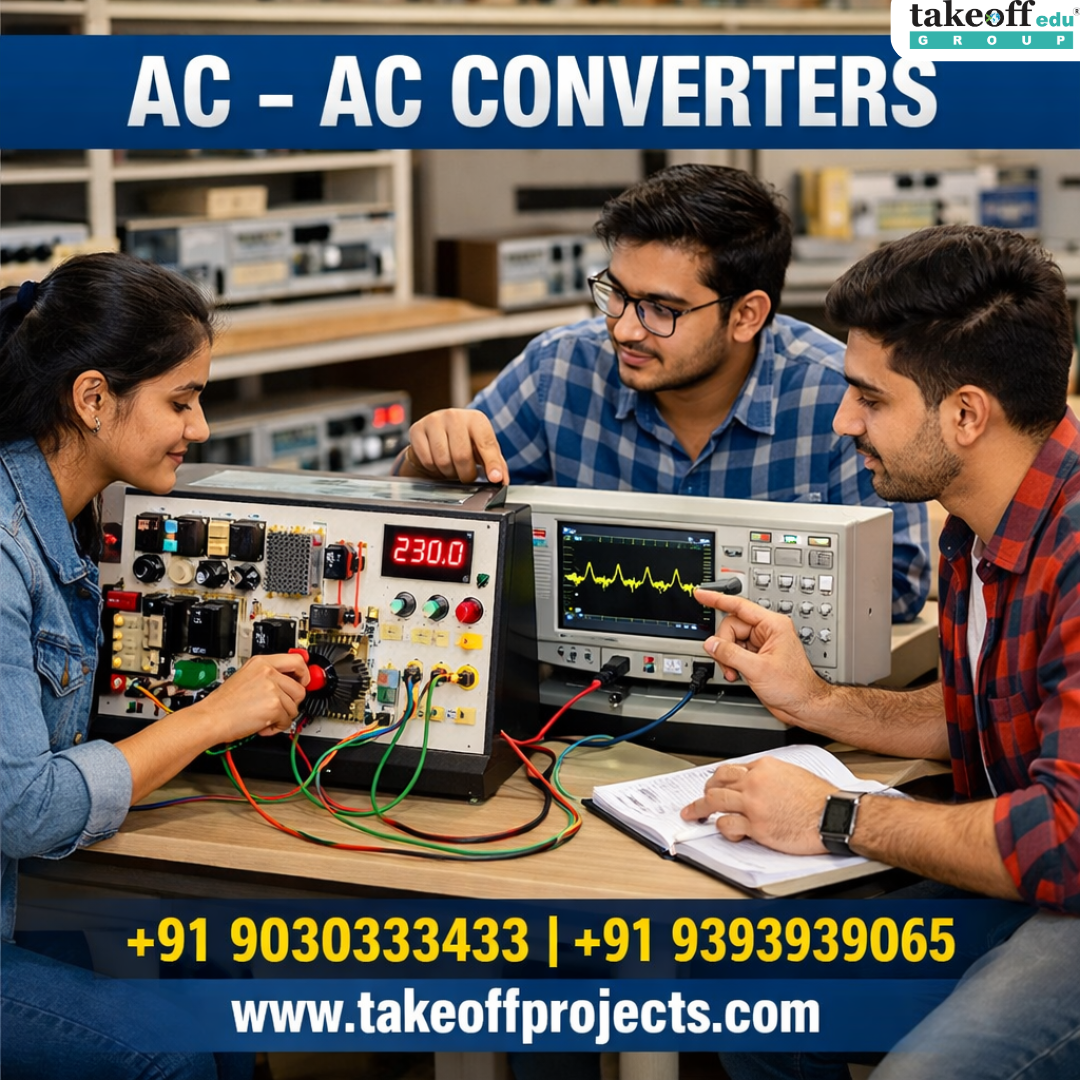


AC–AC converters play a vital role in modern power electronics by enabling the conversion of alternating current (AC) from one voltage, frequency, or phase level to another. These converters are widely used in applications such as motor speed control power regulation, industrial automation and renewable energy systems.

Information About AC–AC Converters
AC–AC converters are devices that convert AC power directly from one form to another without converting it into DC. These converters are essential for controlling voltage, frequency, and power in electrical systems.
They are mainly used in:
- Speed control of AC motors
- Voltage regulation systems
- Industrial heating and lighting control
- Renewable energy applications
Students working on these projects gain hands-on experience in power electronics, switching techniques, and system design.
Working Principle of AC–AC Converters
AC–AC converters operate by controlling the input AC waveform using power semiconductor devices such as thyristors, TRIACs, or IGBTs.
Basic working includes:
- Controlling the firing angle of switching devices
- Modifying the RMS value of output voltage
- Adjusting frequency (in advanced converters like cycloconverters)
This process allows efficient control of power delivered to the load without significant energy loss.
Types of AC–AC Converters
- AC Voltage Controllers – Control output voltage without changing frequency
- Cycloconverters – Convert AC power to a different frequency directly
- Matrix Converters – Advanced converters providing variable voltage and frequency
- Phase Angle Controllers – Used in light dimmers and motor speed control
Key Areas in AC–AC Converter Projects
- Power Semiconductor Devices – Thyristors, TRIACs, MOSFETs
- Control Techniques – Phase angle control, PWM methods
- Harmonic Analysis – Reducing distortion in output waveform
- Thermal Management – Heat dissipation in power devices
- Industrial Applications – Motor drives and automation systems
- Energy Efficiency – Optimizing power usage
Trending AC–AC Converter Project Ideas
- Single Phase AC Voltage Controller using TRIAC
- Three Phase AC Voltage Controller for Induction Motor
- Cycloconverter-Based Speed Control of AC Motor
- PWM-Based AC Voltage Regulator
These projects are highly useful in industries and help students build strong technical expertise in power electronics.
AC–AC Converter Project Services
Professional project support helps students successfully complete their academic projects with better understanding and performance.
Services Offered
- Latest project topic selection based on industry trends
- Complete documentation (Abstract, Reports, IEEE papers)
- Simulation support (MATLAB, Simulink, etc.)
- Hardware design and implementation guidance
These services ensure quality project development and help students achieve academic excellence.
Conclusion
AC–AC converter projects are essential for understanding modern power control techniques and electrical system optimization. For engineering students, working on these projects enhances practical skills and opens career opportunities in industries like automation, manufacturing, and energy systems.





Add Comment