











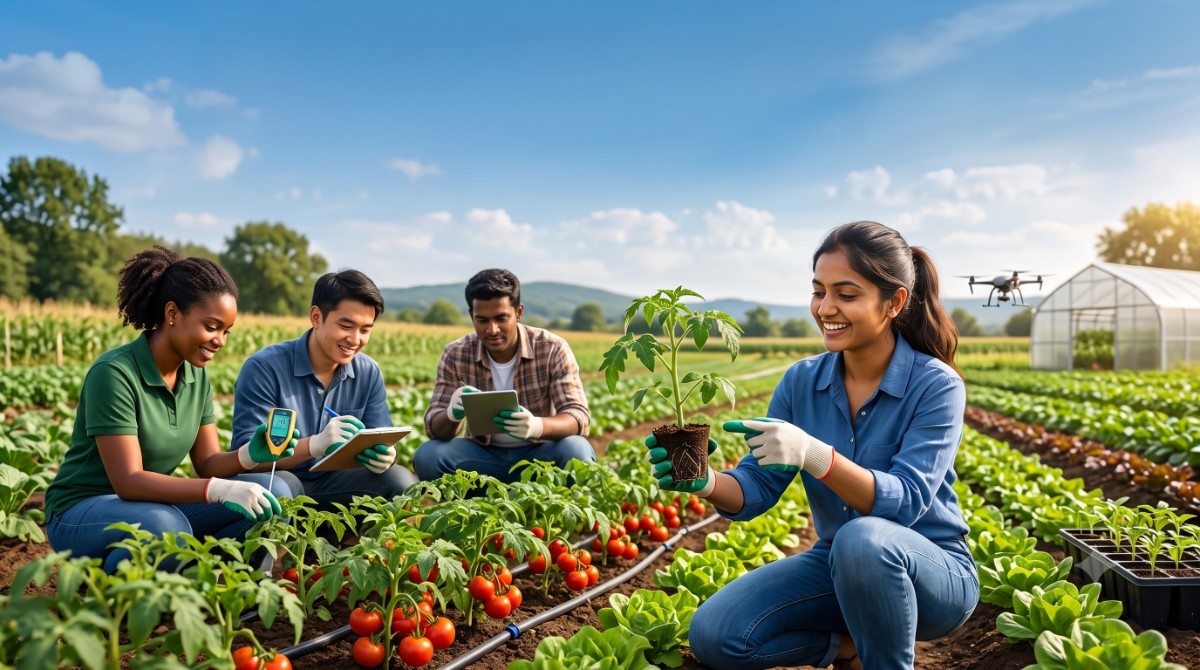


Agriculture is a dynamic field, evolving every day with technological advancements and new developments. Farmers and agricultural experts are not only required to understand the intricacies of crop production but also analyze, interpret, troubleshoot and use advanced technologies to increase the yield and make the most of it.
For a student studying B.Sc.(Hons)Agriculture, besides theoretical aspects, it is important to gain and hone certain practical and professional skills to secure a bright future. These skills can make a student job ready and enable them to excel in their careers in the fields of agricultural business, government, research, agri-tech, and entrepreneurial endeavors.
Why Are Skills Important For Students?
With the rise in technology and new developments in the agricultural sector, it is important to understand what skills are required by employers and what skills would make a student stand out from the rest.
Here are the top 10 skills that every student must acquire before they graduate:
1. Comprehensive Knowledge on Crop Production
Every aspiring farmer or agricultural specialist must have an in-depth understanding of crop production and management practices.
Students must understand all about crop production, including understanding the types of cultivation, seeds, fertilizer, irrigation, weed management, harvesting, and post-harvest technologies. These form the foundation for any agricultural career.
2. Soil and Water Management Skills
Soil is the main foundation of any crop, and students must have a thorough knowledge of soil management practices.
Students must understand the importance of soil testing and its interpretations, and learn how to implement soil management practices.
Similarly, it is also important to understand water management practices like irrigation and water use efficiency.
3. Technological Advancements in Agriculture
Agriculture has seen a number of technological developments over recent decades, and it is important for students to keep themselves updated.
Students must know about location-based farming using GPS
- drones,
- geographic information systems,
- agricultural farm management information systems,
- precision agriculture,
- and various other modern technologies used in farming.
4. Analytical Skills for Efficient Farming
Agriculture has entered the era of the big data revolution. The data generated from weather forecasts, sensors, and satellite imagery must be analyzed to make crucial decisions for efficient farming.
Students must understand how to analyze agricultural data, interpret weather systems, evaluate crop growth, etc. Basic analytical skills are now a must-have for agricultural careers in government, private, as well as research sectors.
5. Pest and Disease Management Skills
Crop pests and diseases account for the biggest threat to crop production. Managing pests and diseases require a scientific approach.
Students must learn about integrated pest management, biological pest control, diagnosis and identification of crop pests and diseases, and the rational use of pesticides and other crop protection measures.
6. Communication skills
Communication is an extremely important skill, and it goes a long way in determining the success of any professional, including farmers and agricultural specialists.
Students must have effective communication skills to explain and understand different ideas related to agriculture. It will also help them in teaching, learning, and working efficiently.
7. Agribusiness and Entrepreneurship Know-How
Students with a degree in agriculture have a wide range of options, including working in the field of agribusiness.
Therefore, it is important for students to learn about agricultural marketing, farm management, farm accounting, and agribusiness management.
8. Sustainable Farming Practices
It is essential for students to gain knowledge about sustainable farming practices like organic farming, climate-smart agriculture, crop rotations, and conservation, etc.
This would contribute towards making them responsible citizens who can engage in environmentally safe and economically viable practices of farming.
9. Research-Based Farming Activities
Most agricultural issues require a research-based approach and it is important for students to understand, interpret, analyze and use scientific research for analyzing agricultural situations.
In addition to helping students secure better job opportunities, research activities will also help students gain in-depth knowledge and insight on various agricultural practices.
10. Leadership and Teamwork
Agriculture requires a collaborative approach, and students can benefit greatly by gaining leadership and teamwork skills.
These skills can help students plan, lead and guide agricultural activities, manage farms and farm workers, and lead various agricultural projects. Leadership skills also open up opportunities for students to work in government agencies, agri-tech companies, and NGOs.
The Importance of Practical Learning
Apart from theoretical knowledge, students must gain adequate practical knowledge to become proficient in their careers.
Field visits, laboratory work, internships, demonstrations, and research are important ways by which students can gain practical skills. Kumaraguru Institute of Agriculture offers quality education to its students by enabling them to gain practical skills along with theoretical knowledge.
Careers in Agriculture for Students With Technical And Professional Skills
There are plenty of job opportunities for students with technical and professional expertise in agriculture. A student can explore various career options, including
- Agricultural Officer,
- Agri-business Executive,
- Precision Agriculture Specialist,
- Agricultural Research Assistant,
- Soil and Crop Consultant,
- Seed Production Executive,
- Farm Manager,
- Agricultural Technologist,
- Agricultural Extension Officer,
- Entrepreneur, etc.
Conclusion
Agriculture is a field where one must constantly upgrade their skills to keep pace with the ever-changing scenario.
Having a degree in B.Sc (Hons) Agriculture is one thing, and having the right set of skills and knowledge to get ahead in this field is another.
Along with academic knowledge, students must also strive to gain technical expertise in various areas of agriculture, including crop production, livestock, sericulture, agroforestry, horticulture, poultry, and apiculture, besides gaining digital skills and management-related expertise.
In addition to theoretical knowledge, practical knowledge is also extremely important to become proficient in agricultural practices. Thus, it is important for students to gain both practical and theoretical knowledge to secure a bright future.
Kumaraguru Institute of Agriculture is committed to providing quality practical knowledge to its students, thereby enabling them to gain proficiency and confidence to excel in their careers.





Add Comment