











Federal Reserve Interest Rate Decision: What It Means for Inflation, Markets, and Your Money
Twelve people meet in a room in Washington, D.C. roughly every six weeks. What they decide moves mortgage rates, credit card bills, stock prices, and the dollar in your wallet — often within minutes of the announcement.
Quick Answer
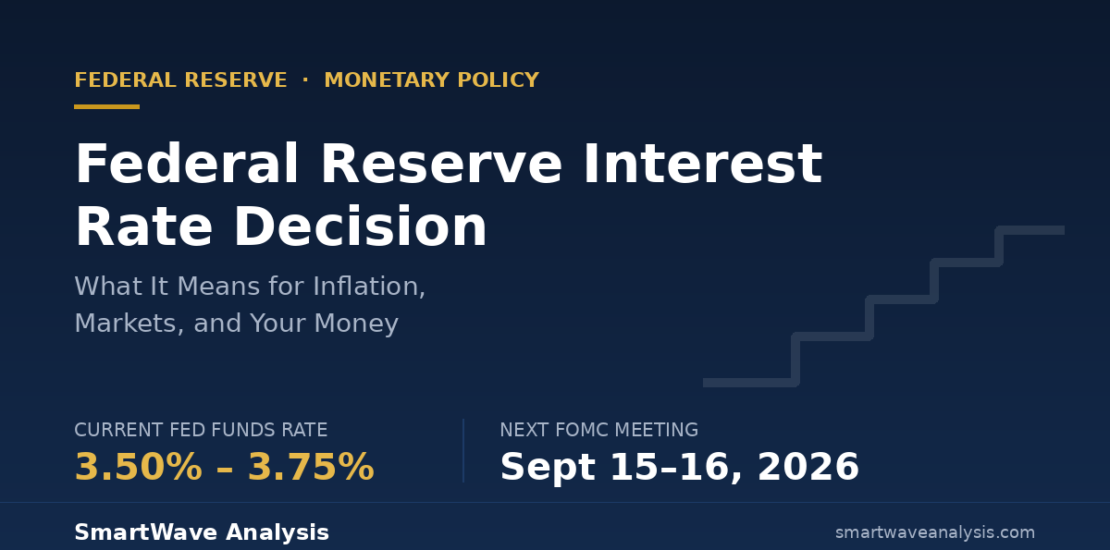
The Federal Reserve is holding its benchmark interest rate at 3.50%–3.75% as of August 2026, unchanged since earlier this year. Inflation remains above the Fed's 2% target, which is the main reason officials haven't cut rates. The next decision lands September 15–16, with Jackson Hole speeches in between that traders will watch closely for hints on what comes next.
What the Federal Reserve Actually Does
The Federal Reserve is the central bank of the United States. Congress created it in 1913 and gave it two jobs, known as the dual mandate: keep prices stable and support maximum employment.
Those two goals don't always pull in the same direction. Cooling inflation often means slowing the economy, which can cost jobs. Balancing that trade-off is the Fed's core job.
The tool it uses most is the federal funds rate — the rate banks charge each other for overnight loans. That one number sets the tone for mortgages, auto loans, credit cards, and savings yields across the entire economy.
The group that actually votes on this rate is the Federal Open Market Committee (FOMC): seven Federal Reserve Board members plus five regional Reserve Bank presidents on a rotating basis. They meet eight times a year.
How a Rate Decision Gets Made
Each meeting runs on a familiar rhythm. Committee members review weeks of data — inflation readings, jobs numbers, spending trends — and debate whether current policy is too tight, too loose, or about right.
Four meetings a year (usually March, June, September, and December) include an updated "dot plot," a chart showing where each member expects rates to land over the next few years. These meetings tend to move markets more, since they offer the clearest forward guidance.
At 2:00 p.m. Eastern on the second day, the Fed releases a short statement announcing a hike, a cut, or a hold. Thirty minutes later, the Chair holds a press conference — often the moment markets react hardest, since a single phrase can shift rate expectations for months.
Why the Fed Watches More Than One Inflation Number
Financial headlines usually lead with one inflation figure. The Fed actually weighs several, because each measures something slightly different.
| Measure | What It Tracks | Why It Matters |
|---|---|---|
| CPI | Prices of a fixed basket of consumer goods and services | Released monthly, gets the most media attention |
| Core CPI | CPI minus food and energy | Strips out short-term noise for a cleaner inflation read |
| PPI | Wholesale prices businesses charge each other | Often signals where CPI is headed a month or two later |
| Core PCE | The Fed's preferred inflation gauge | Broader coverage, different weighting than CPI, used for the 2% target |
As of the latest readings, headline CPI sits at 3.4% year-over-year with core CPI at 2.5%, while core PCE — the number the Fed actually targets — is running around 3.3%. Both are above the Fed's 2% goal, which explains why rates haven't moved.
Where Policy Stands Right Now
The Fed held its rate at 3.50%–3.75% at its July 2026 meeting, continuing a pause that's lasted most of the year. Unlike a unanimous vote in June, three members dissented in July in favor of a quarter-point hike — a sign of growing disagreement inside the committee.
This was also the first meeting under new Fed Chair Kevin Warsh, sworn in during May 2026. Early signals point to a more hawkish communication style than his predecessor, even as some officials push for easing given signs the labor market is softening.
The core tension: inflation is cooling more slowly than the Fed wants, but keeping rates high for longer carries its own economic costs.
Rate Hike vs. Rate Cut vs. Rate Hold: What It Means for Your Money
A rate hike raises borrowing costs across the board. Mortgages, auto loans, and credit card rates tend to climb, which is designed to slow spending and cool inflation.
A rate cut lowers borrowing costs, which tends to encourage spending and support stock valuations, but can reignite inflation if done too fast.
A rate hold — the current stance — keeps things as they are while officials wait for more data. It's the most common outcome across a full year of meetings.
For your own finances, this shows up directly: credit card APRs and savings account yields both track the fed funds rate closely, so a hold generally means neither is moving much in either direction soon.
How Rate Decisions Move Bond Yields and the Broader Market
The fed funds rate directly sets short-term borrowing costs, but its effect on longer-term Treasury yields (the return investors demand for lending the government money over many years) works mostly through expectations.
When the Fed signals rates will stay higher for longer, longer-dated yields tend to rise as investors demand more compensation. When cuts look likely, yields often fall in anticipation, sometimes well before the Fed actually acts.
This relationship between short- and long-term rates forms the yield curve, a widely watched gauge of financial conditions. Traders price in the Fed's next move ahead of time using futures contracts tied to the fed funds rate — which is why markets sometimes react more to a shift in the odds of a future cut than to an actual policy announcement.
For traders tracking how this plays out across specific instruments in real time, Smart Wave Analysis has a detailed breakdown of the Fed's current rate decision and what's coming at the next FOMC meeting.
What's Coming Next: Jackson Hole and the September Meeting
Two events will shape the Fed's path before year-end.
The Jackson Hole Economic Policy Symposium runs August 27–29, 2026. Chair Warsh delivers his first keynote there as Fed head on August 28 — a speech markets will parse closely, since past Jackson Hole remarks have moved prices sharply within a single session.
The next FOMC meeting follows September 15–16, and unlike July, it includes an updated dot plot and economic projections. With the August CPI report landing September 11, just days before the meeting, this stretch is shaping up as one of the more consequential windows of the year for rate watchers.
Frequently Asked Questions
What is the current federal funds rate?
As of the July 2026 FOMC meeting, the target range is 3.50% to 3.75%, unchanged since the Fed's pause earlier in the year.
When is the next Fed meeting?
The next FOMC meeting is September 15–16, 2026, and will include an updated dot plot.
Does the Fed care more about CPI or PCE? The Fed's official target is based on core PCE. CPI gets more media coverage because it's released earlier each month, but PCE is what officials weigh most in their own decisions.
What happens to mortgage rates when the Fed cuts? Mortgage rates track longer-term Treasury yields and investor expectations rather than the fed funds rate directly. A sustained cutting cycle generally puts downward pressure on mortgage rates over time.
Why does inflation matter beyond just rising prices?
Persistent inflation erodes purchasing power and adds uncertainty to household budgeting and business investment. The Fed's 2% target reflects a level seen as consistent with steady, predictable growth.
What is forward guidance?
It's the Fed's communication about its likely future policy path, delivered through statements, press conferences, and speeches. The Fed uses it deliberately to shape market expectations between actual rate decisions.
Bottom Line
The Fed is holding rates steady while inflation stays above target and the labor market shows early signs of softening. Jackson Hole and the September meeting are the next two checkpoints worth watching, and both could shift how markets price future rate moves. Nothing here says which way to position — that call depends on your own read of the data as it comes in.
Disclaimer: This article is for informational and educational purposes only and does not constitute financial advice. Interest rate and inflation data are subject to revision; confirm current figures via the Federal Reserve, Bureau of Labor Statistics, and Bureau of Economic Analysis before making financial decisions.





Add Comment