










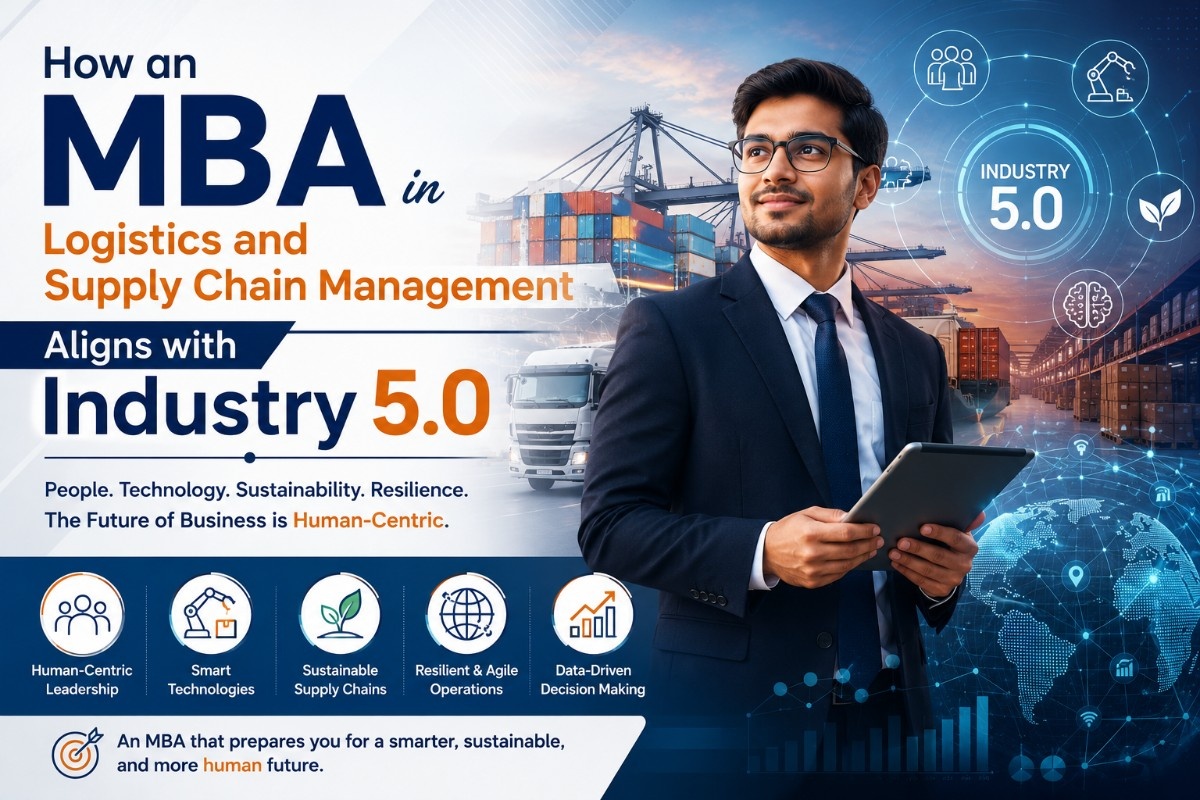


- Industry 5.0 is transforming logistics by combining advanced technologies with human expertise to create smarter and more sustainable supply chains.
- An MBA in Logistics and Supply Chain Management equips students with the knowledge to manage AI-driven operations, automation, and data-informed decision-making.
- Businesses are increasingly seeking supply chain professionals who can balance innovation, operational efficiency, and customer-centric strategies.
- Industry-focused MBA programs help graduates develop the leadership and technical skills needed to thrive in the next generation of global logistics.
The logistics and supply chain sector is undergoing a significant transformation with the rise of Industry 5.0. Unlike Industry 4.0, which focused primarily on automation and digital technologies, Industry 5.0 emphasizes collaboration between humans and intelligent technologies to create more efficient, resilient, and sustainable business operations. This shift is redefining the role of supply chain professionals and increasing the demand for leaders who can combine technological expertise with strategic decision-making.
An MBA in Logistics and Supply Chain Management prepares students to meet these evolving industry expectations. By integrating management principles with emerging technologies and real-world business practices, the program develops professionals who can lead modern supply chains in an increasingly digital economy.
Understanding Industry 5.0
Industry 5.0 builds on the technological advancements of Industry 4.0 while placing greater emphasis on human creativity, sustainability, and resilience. It encourages organizations to use technologies such as Artificial Intelligence (AI), robotics, the Internet of Things (IoT), blockchain, and advanced analytics to support—not replace—human expertise.
The key objectives of Industry 5.0 include:
- Human-centric operations
- Sustainable business practices
- Resilient supply chains
- Intelligent automation
- Data-driven decision-making
For logistics organizations, this means creating supply chains that are not only faster and more efficient but also adaptable to changing market conditions and customer expectations.
Why Industry 5.0 Matters for Logistics and Supply Chain Management
Global supply chains have become increasingly complex due to expanding international trade, e-commerce growth, changing consumer demands, and unexpected disruptions. Businesses now require professionals who can manage digital supply networks while maintaining operational flexibility.
Industry 5.0 enables organizations to:
- Improve supply chain visibility
- Optimize inventory management
- Enhance warehouse automation
- Predict demand more accurately
- Strengthen supplier collaboration
- Improve customer satisfaction
- Support sustainable logistics practices
These capabilities have become essential for businesses operating in manufacturing, retail, healthcare, automotive, e-commerce, and global trade.
How an MBA in Logistics and Supply Chain Management Supports Industry 5.0
1. Building Digital Supply Chain Expertise
Modern MBA programs introduce students to technologies that drive today's logistics industry. Graduates learn how digital platforms improve planning, procurement, inventory control, transportation, and warehouse operations.
Key learning areas include:
- Supply Chain Analytics
- Enterprise Resource Planning (ERP)
- Warehouse Management Systems (WMS)
- Transportation Management Systems (TMS)
- Business Intelligence tools such as Power BI and Tableau
These technologies help future managers make informed business decisions based on real-time data.
2. Understanding Artificial Intelligence and Automation
Artificial Intelligence is transforming supply chain operations by improving forecasting, route optimization, demand planning, and inventory management.
MBA students gain insights into how AI supports:
- Predictive demand forecasting
- Automated inventory replenishment
- Smart warehouse operations
- Intelligent transportation planning
- Customer service optimization
Understanding these technologies prepares graduates to lead digital transformation initiatives within organizations.
3. Strengthening Data-Driven Decision-Making
Industry 5.0 relies heavily on data to improve operational efficiency. MBA students develop analytical skills that help them interpret business information and identify opportunities for improvement.
They learn to:
- Analyze supply chain performance
- Measure operational efficiency
- Reduce logistics costs
- Improve forecasting accuracy
- Monitor key performance indicators (KPIs)
These analytical capabilities are increasingly valued by employers across industries.
4. Developing Leadership for Technology-Driven Organizations
Technology alone cannot transform businesses without effective leadership. MBA programs focus on developing professionals who can manage teams, lead organizational change, and implement innovative business strategies.
Leadership skills include:
- Strategic planning
- Cross-functional collaboration
- Change management
- Communication
- Problem-solving
- Decision-making under uncertainty
These competencies help graduates manage both people and technology effectively.
5. Supporting Sustainable Supply Chains
Sustainability is a central pillar of Industry 5.0. Organizations are expected to reduce waste, lower carbon emissions, improve resource utilization, and adopt environmentally responsible practices throughout their supply chains.
MBA students explore topics such as:
- Green logistics
- Circular supply chains
- Sustainable procurement
- Energy-efficient transportation
- ESG (Environmental, Social, and Governance) practices
This knowledge enables graduates to contribute to long-term business sustainability while meeting regulatory and customer expectations.
6. Preparing for Global Supply Chain Challenges
Industry 5.0 emphasizes resilience alongside efficiency. Businesses must be prepared to respond to disruptions caused by geopolitical events, natural disasters, supplier shortages, and changing market conditions.
MBA graduates learn strategies for:
- Supply chain risk management
- Business continuity planning
- Supplier diversification
- Global sourcing
- Demand variability management
These skills help organizations maintain stable operations even during periods of uncertainty.
Career Opportunities in the Industry 5.0 Era
Graduates with an MBA in Logistics and Supply Chain Management are well-positioned for roles such as:
- Supply Chain Manager
- Logistics Manager
- Operations Manager
- Procurement Manager
- Warehouse Manager
- Demand Planning Manager
- Inventory Control Manager
- Supply Chain Analyst
- Distribution Manager
- Global Sourcing Specialist
- Business Process Consultant
Professionals with expertise in digital supply chain management and Industry 5.0 technologies are increasingly sought after across manufacturing, retail, e-commerce, healthcare, automotive, and third-party logistics sectors.
How KCT Business School Prepares Future Supply Chain Leaders
KCT Business School's MBA in Logistics and Supply Chain Management is designed to align with the evolving needs of modern industries. The curriculum combines management fundamentals with practical exposure to digital technologies, analytics, and contemporary supply chain practices. Through industry interactions, internships, case studies, live projects, and training in tools such as ERP, Power BI, and Tableau, students gain hands-on experience that prepares them for technology-driven logistics environments.
This industry-oriented approach enables graduates to develop the strategic, analytical, and leadership capabilities required to succeed in the Industry 5.0 landscape.
Conclusion
Industry 5.0 is redefining how supply chains operate by integrating advanced technologies with human expertise to create smarter, more resilient, and sustainable business ecosystems. As organizations continue to embrace digital transformation, the demand for professionals who can manage technology, lead teams, and make strategic decisions will continue to grow.
An MBA in Logistics and Supply Chain Management provides the knowledge, technical exposure, and leadership skills needed to thrive in this evolving landscape. Graduates who understand Industry 5.0 principles will be well-equipped to drive innovation, improve operational performance, and build resilient supply chains that meet the demands of the future.





Add Comment