













In an age where most of our numeric calculations are performed for us by an abundance of available technologies, it is hard to imagine how our brains handle arithmetic.
To most of us, school math was simply a set of symbolic rules; we would look at a number on the page, perform a certain algorithm in our head that converted that number into another, and write down the result. Someone who has seen an abacus-trained child perform calculations of a six-digit number in their head may have an entirely different view of our current approach to arithmetic.
This is not some sort of extraordinary talent or indication of higher intelligence; in fact, anyone can develop similar skills by engaging both sides of their brain in calculations.
In the following essay, I will explore the ways in which mental calculation can be used to stimulate both brain hemispheres, and the resulting benefits of such an endeavor.
The Nature of Your Everyday Calculation
In most cases, math as we know it is a product of the left hemisphere of the brain.
This part of the brain is primarily responsible for logic, analysis, linear thinking, and sequential processing. When performing standard paper calculations, most of us engage this part of the brain to execute an algorithm written on the paper.
For instance, when calculating $47 + 88$, we first recognize the numbers and the operation needed (addition). Our brain processes the numbers as text/language symbols, and proceeds to perform a specific set of operations needed to add them together (adding the numbers in ones, tenths, hundreds, adding the resulting tenths and ones, etc.), remembering the intermediate values in verbal working memory. Verbal working memory is a subunit of short-term verbal memory, and as such has very limited capacity. This is why mental calculation of large numbers is so challenging – one needs to hold a lot of information in verbal memory while calculating, which is very taxing.
Abacus Training Enters the Scene
When training children to perform calculations mentally, abacus methods train them to first perform calculations on a physical abacus (a calculating tool that resembles a rectangular frame with beads attached to it). As the student progresses, the frame becomes increasingly imaginary. At the highest levels, the abacus is no longer physically present. This level of skill is referred to as Anzan.
What makes these methods so effective is that, upon a deeper inspection, the calculation process uses parts of the brain associated with visual processing.
When using an abacus (real or imaginary), the brain processes the numbers as visual objects. The left part of the brain still holds responsibility for executing the mathematical operations (analysis and logic), the right part is used to imagine the abacus, perform operations with it (spatial processing), and hold the resulting numbers as visual objects. This is why a lot of people who train their mental calculation abilities report that they “see the numbers in their head” while calculating.
The capacity to use both sides of the brain is what makes abacus-style calculations so powerful; instead of trying to hold numbers as text in one part of the brain (limited capacity verbal working memory), the visual parts of the brain can be utilized to form complex mental images related to the calculation, offloading a significant amount of processing power.
ALSO CHECK - Understanding the Science Behind Abacus Learning
Making the Two Sides of the Brain Work Together
The two sides of the brain are not completely independent, despite having different primary responsibilities. They are constantly communicating with each other through an extensive set of neural connections, the most important of which is the corpus callosum, a thick bundle of nerve fibers in the center of the brain that connects the two.
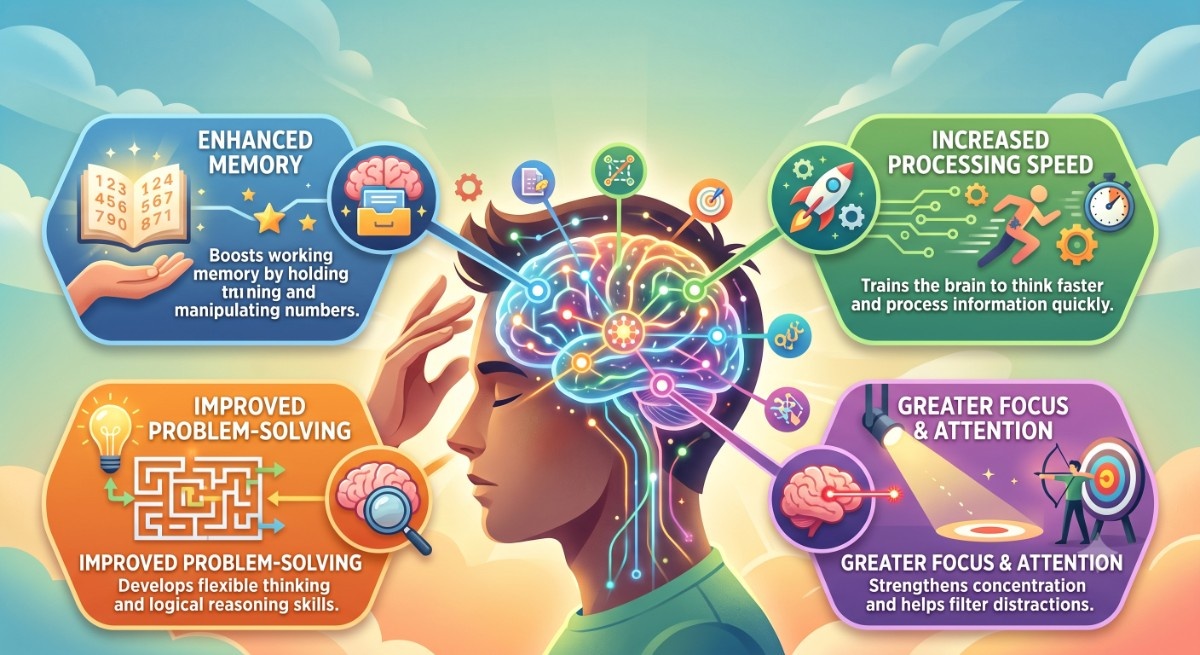
Studies of abacus-trained individuals show that the connections between the two hemispheres are strengthened through mental calculation training. These connections become stronger with practice, and as a result the mental calculation ability increases as well. Engaging both brain sides in calculations has enormous potential benefits for the mind, some of which include:
1. Greater working memory capacity
In abacus calculations, the working memory needs to hold an image of an abacus (which can take up a lot of spatial processing power). As a result, abacus students can usually perform significantly better on standard working memory tests than their peers.
2. Improved focus and control
When focusing on a mental image of the abacus, one cannot engage in any other complex activities. As a result, mental abacus students become experts at visual-spatial tasks, and their ability to focus is extremely high.
3. Reduction of stress and anxiety
High levels of anxiety are often associated with low working memory capacity. People whose working memory is easily overwhelmed may experience anxiety when attempting to perform mental calculations, or when presented with complex visual tasks. The enhanced working memory capacity and processing power of mentally abacus-trained individuals is often associated with reduced levels of anxiety.
ALSO CHECK - 10 Amazing Benefits of Abacus Classes for Your Child’s Brain Development
Summary
In the current age of technology and automatic calculation, it is difficult to think about arithmetic in terms of abacuses and manual calculations. It is natural to wonder whether the development of automatic calculation tools has rendered the old methods useless.
The truth is that we do not study arithmetic for its practical applications, because those are all handled by machines. We study arithmetic, and specifically mental calculation, for the benefits brought by the enhanced calculation ability, namely the capacity to utilize both sides of the brain, to perform complex calculations, and to develop a high level of working memory capacity.





Add Comment