








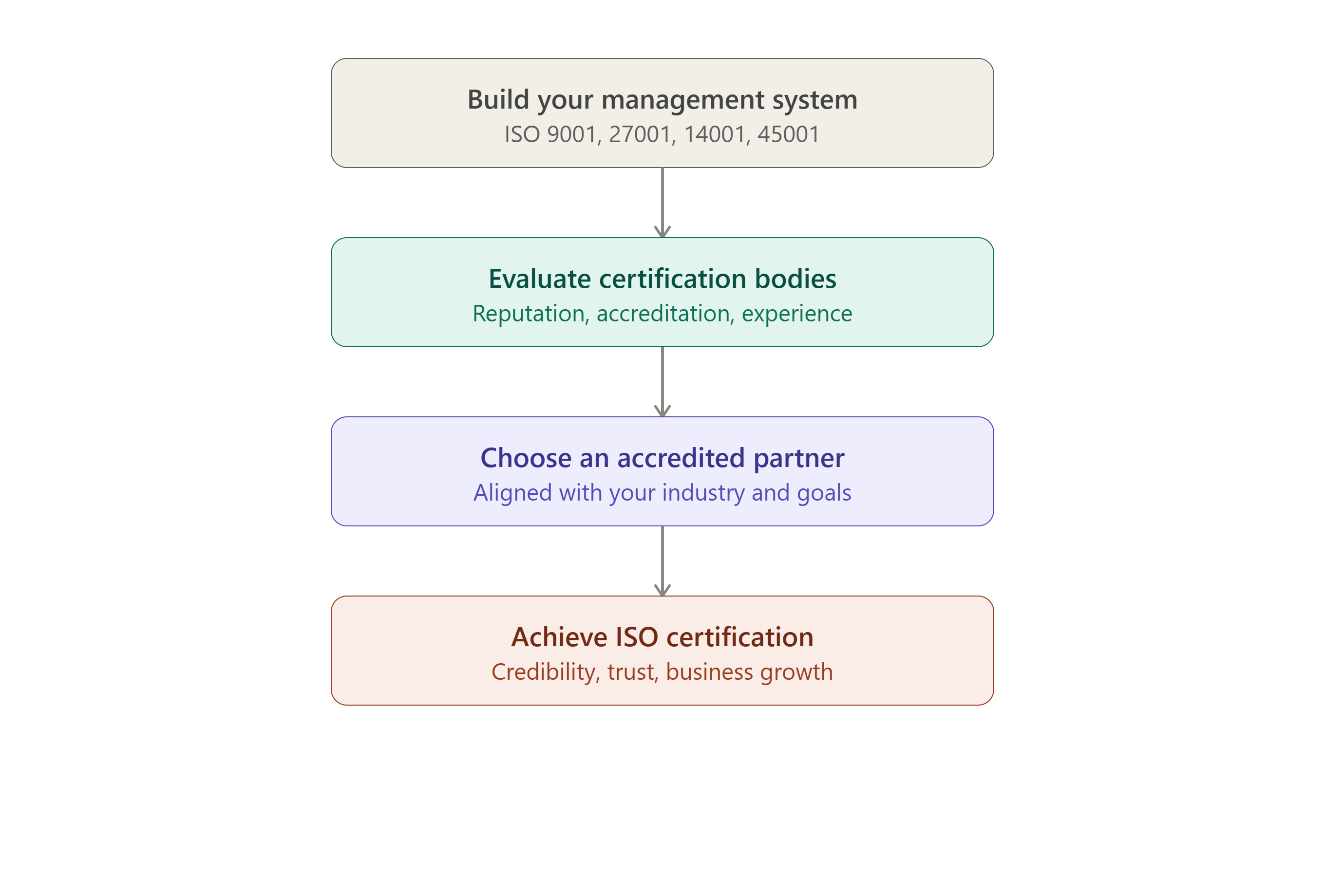


So your organization has finally built its management system — maybe it's ISO 9001 for quality, ISO 27001 for information security, ISO 14001 for the environment, or ISO 45001 for health and safety. Great work. But there's one more step standing between "we built it" and "we can prove it": getting certified.
And that means picking a certification body.
This sounds like a simple administrative task. It isn't. The ISO certification body you choose can shape how smoothly your audit goes, how much your certificate is actually worth to clients, and how much time and money you burn along the way. Here's what you need to know before you sign anything.
Why Certification Matters in the First Place
Certification is the process of proving, through an independent third party, that your organization actually follows the standard it says it follows. That third party is the certification body — a neutral outside auditor whose entire job is to check your work objectively.
Could you just certify yourself? Technically, sure. But ask yourself: would a client on the other side of the world trust a badge you gave yourself? Probably not. In a global market where buyers can't fly in to inspect your operations personally, independent, credible certification is often the only proof they'll accept.
Don't Shop for a Certification Body Like You're Buying Office Supplies
A lot of companies treat this decision purely as a price comparison — whoever quotes the lowest number wins. That's a mistake. Go cheap without doing your homework, and you might end up with a certifier that has:
- Little to no experience in your industry
- A shaky reputation
- Almost no recognition among the clients you're trying to impress
A good certification body should do more than rubber-stamp your compliance. The right partner adds real value to the relationship.
What to Actually Look For
There's no universal "best" certification body — the right fit depends on your industry, goals, and markets. But these factors matter for almost everyone:
Reputation If you plan to use your certificate for marketing (and you should), don't get it from a body known for handing out certificates with little scrutiny. A strong, credible reputation is worth far more than a slightly cheaper quote.
Accreditation Anyone can print a certificate. Not everyone is legally accredited to issue one that means anything. Always confirm the certification body is accredited — that is, officially licensed to certify — by a recognized accreditation authority.
Industry Specialization A certifier that's only ever audited manufacturing plants isn't the right choice for a bank. If the auditors don't understand your industry, you'll spend the whole audit explaining how your business works instead of getting useful feedback. You want a certifier who teaches you something — not the other way around.
Auditor Experience An inexperienced auditor might seem like an easier ride, but you'll likely miss valuable insights that a seasoned auditor would catch. Don't hesitate to ask for the auditor's background — their résumé, past clients, and industries audited.
Integrated Audits Implementing more than one standard — say, ISO 9001 alongside ISO 27001 or ISO 14001? Ask if your certification body can run an integrated audit instead of separate ones for each system. That means one audit, one schedule, and one bill instead of several — saving both time and money.
Flexibility If your certifier has to fly an auditor in from another continent, rescheduling becomes a nightmare the moment your timeline shifts. A certifier with local presence gives you far more flexibility if your project runs long or circumstances change.
Management System Maturity If you're working against a deadline, ask the certification body upfront what level of system maturity they expect before they'll certify you. Better to know now than to find out mid-audit.
Language An auditor who speaks your language — without needing a translator — will read your documentation more accurately and build a better working relationship with your team. It's a small detail that makes a real difference in audit quality.
How to Actually Go About Choosing One
Start by defining what your organization actually wants out of certification. Is it market credibility? Access to specific export markets? Client requirements? Your priorities should shape your shortlist.
Then, take these practical steps:
- Get quotes from at least two or three certification bodies. Don't settle on the first one you find.
- Ask what else they offer beyond the audit itself — guidance on scope, documentation support, ongoing advice.
- Check who your competitors and major clients use. Certifiers familiar with your sector often bring more useful insight.
- Compare quotes carefully. Make sure you're comparing apples to apples — are travel costs and documentation review included, or extra?
- Meet your shortlisted certifiers before deciding. A short conversation tells you a lot about whether they'll be a genuine partner or just a vendor.
And don't wait until the last minute — most organizations only start looking for a certification body after their management system is already built. Starting the search earlier gives you more room to compare and negotiate.
It's Your Choice — And Your Investment
Here's something a lot of businesses forget: you select and pay the certification body. Yes, they have to follow strict codes of conduct and report any nonconformities they find — that's the whole point of independent certification. But within that framework, a good certifier can still add real, tangible value to how your management system is perceived externally.
Choose carelessly, and you risk delays, failed audits, and wasted budget. Choose well, and certification becomes a genuine business asset — not just a document in a drawer.
Make the Right Choice the First Time — With Guardian Middle East
Selecting a certification body isn't a decision to rush. The wrong partner can cost you months of delays, failed audits, and a certificate that doesn't carry the weight you need it to.
That's where Guardian Middle East LLC comes in.
As the exclusive representative of Guardian Assessment UK Ltd. — a UK-based certification body accredited by the United Accreditation Foundation (UAF) and the International Accreditation Service (IAS, USA) — Guardian Middle East helps organizations across the region choose a certification partner that's credible, accredited, and genuinely aligned with their industry and goals.
Here's what you get working with Guardian Middle East:
- Guidance to select a trusted, properly accredited ISO certification body
- Fewer delays, less rework, and stronger audit outcomes
- Complete, audit-ready documentation prepared in advance
- Processes aligned with ISO requirements from day one
- Faster, smoother certification — done right the first time
And the support doesn't stop at certification:
- End-to-end audit preparation and coordination
- Expert guidance throughout certification body selection
- Continuous improvement support for long-term compliance
- Ongoing system maintenance to keep your certification current
Your certification body choice directly affects your credibility, your clients' trust, and your business growth. Don't leave it to chance — and don't risk it on the wrong partner.
👉 Get in touch with Guardian Middle East today and take the first confident step toward ISO certification.
📍 Located in Doha, Qatar | Serving the Middle East 📞 Mobile: +974 7770 2602 | +974 7213 7770 📧 Email: info@guardian.qa 🌐 Website: guardian.qa





Add Comment