











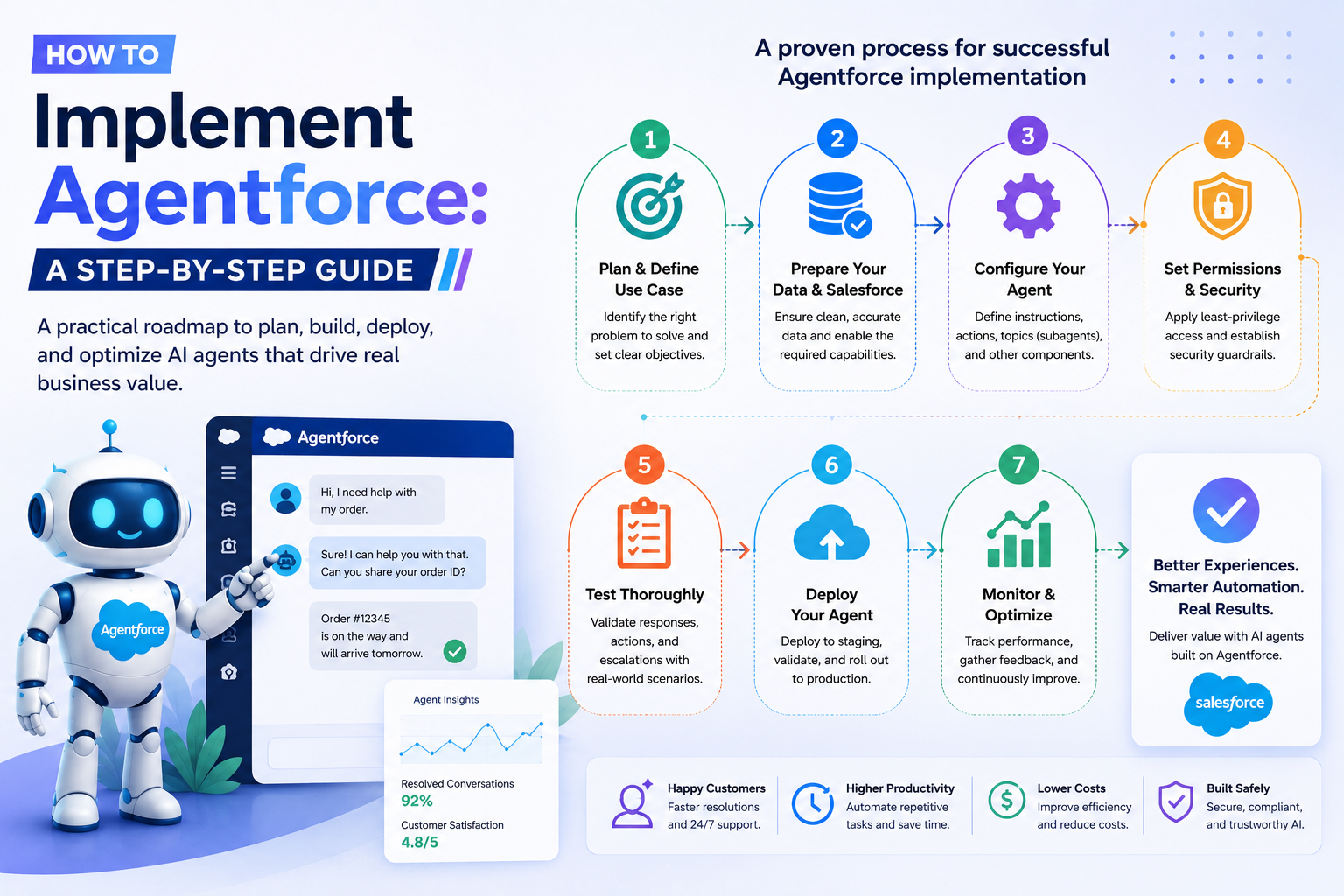


Agentforce can help businesses automate customer interactions, employee assistance, and repetitive Salesforce processes. But successful implementation requires more than simply enabling an AI agent. Businesses need to define the right use case, prepare their data, configure permissions, test the agent, and monitor its performance after launch. Salesforce's current implementation guidance follows a lifecycle of planning, setup, configuration, testing, deployment, and monitoring.
For businesses looking for implementation support, Concret.io's Agentforce services are one option to consider when evaluating providers. The right implementation approach will still depend on the organization's use case, data environment, security requirements, and internal capabilities.
What Should You Do Before Implementing Agentforce?
The first step is to define what you actually want the agent to accomplish.
Instead of starting with the technology, identify a specific business problem. For example, a service team might want to automate common customer questions, while a sales team may want assistance with lead qualification or account information.
Before building the agent, establish:
- The primary business objective
- The users or customers it will serve
- Tasks the agent should perform
- Data it needs to access
- Actions it should be allowed to take
- Situations that require human intervention
Salesforce recommends considering the user journey, technical requirements, data strategy, channels, escalation rules, and security controls during the planning stage.
How Do You Prepare Salesforce for Agentforce?
Once the use case is defined, the Salesforce environment needs to be prepared.
This can include enabling the required Agentforce capabilities, checking permissions, reviewing relevant Salesforce data, and determining which information the agent will use.
Data quality is particularly important. Inaccurate, incomplete, or outdated information can affect the quality of an agent's responses and actions. Salesforce recommends maintaining data quality and applying appropriate governance throughout an Agentforce implementation.
How Do You Configure an Agentforce Agent?
The next stage is configuring the agent around the selected use case.
Depending on the requirements, this can involve defining the agent's instructions, subagents, actions, prompts, flows, and other supporting components. Salesforce documentation notes that agent topics are now referred to as subagents as of April 2026, with no change to their functionality.
The configuration should clearly establish what the agent can and cannot do. Keeping the initial scope focused can make testing and troubleshooting easier.
How Should Agentforce Permissions and Security Be Managed?
Security should be considered during configuration rather than after the agent has been built.
The agent should receive only the permissions it needs to perform its intended tasks. Salesforce recommends applying least-privilege principles and regularly reviewing permissions and access controls.
Businesses should also establish clear rules for sensitive information, private actions, authentication, and situations where a conversation should be transferred to a human.
How Do You Test Agentforce Before Launch?
Testing is an essential part of the implementation process.
The agent should be tested against realistic customer or employee scenarios to determine whether it:
- Provides accurate responses
- Uses the correct data
- Performs actions correctly
- Handles unexpected requests
- Follows security rules
- Escalates appropriate situations to humans
Salesforce recommends validating agents before deployment and conducting end-to-end testing in a sandbox environment.
Human review is also useful for identifying responses or behaviors that automated testing may not catch.
How Do You Deploy Agentforce?
Once testing is complete, the agent can be prepared for deployment.
A typical deployment process involves configuring the required connections, validating the agent, testing the deployment environment, and then moving the necessary components to staging or production. Salesforce's deployment guidance also recommends checking licenses, permissions, agent users, flows, and related components before activation.
A phased rollout can be useful when implementing Agentforce for the first time. Starting with a limited audience or specific use case allows the business to gather feedback before expanding.
What Should You Monitor After Agentforce Goes Live?
Implementation does not end when the agent is deployed.
Businesses should monitor how the agent performs in real-world interactions and look for areas where it may need adjustment.
Useful areas to review include:
- Response accuracy
- Task completion
- Escalation rates
- User feedback
- Failed or incomplete actions
- Security and access activity
- Overall business outcomes
Salesforce recommends ongoing monitoring and improvement as part of the Agentforce development lifecycle.
How Can You Make an Agentforce Implementation Successful?
The most practical approach is to start with a clearly defined use case rather than attempting to automate an entire business process at once.
Focus on a process that is repetitive, measurable, and supported by reliable data. Establish clear boundaries for the agent, test it thoroughly, and provide a straightforward path to human assistance when needed.
Once the initial implementation is stable, additional use cases can be introduced based on actual results and user feedback.
Final Thoughts
Implementing Agentforce involves much more than configuring an AI agent. Businesses need to plan the use case, prepare their data, configure the agent, establish security controls, test thoroughly, deploy carefully, and continue monitoring performance.
A structured approach can help organizations introduce AI automation without unnecessarily complicating their Salesforce environment. Whether implementation is handled internally or with a provider such as Concretio's Agentforce services, the focus should remain on clear business outcomes, reliable data, appropriate security, and useful customer or employee experiences.





Add Comment