











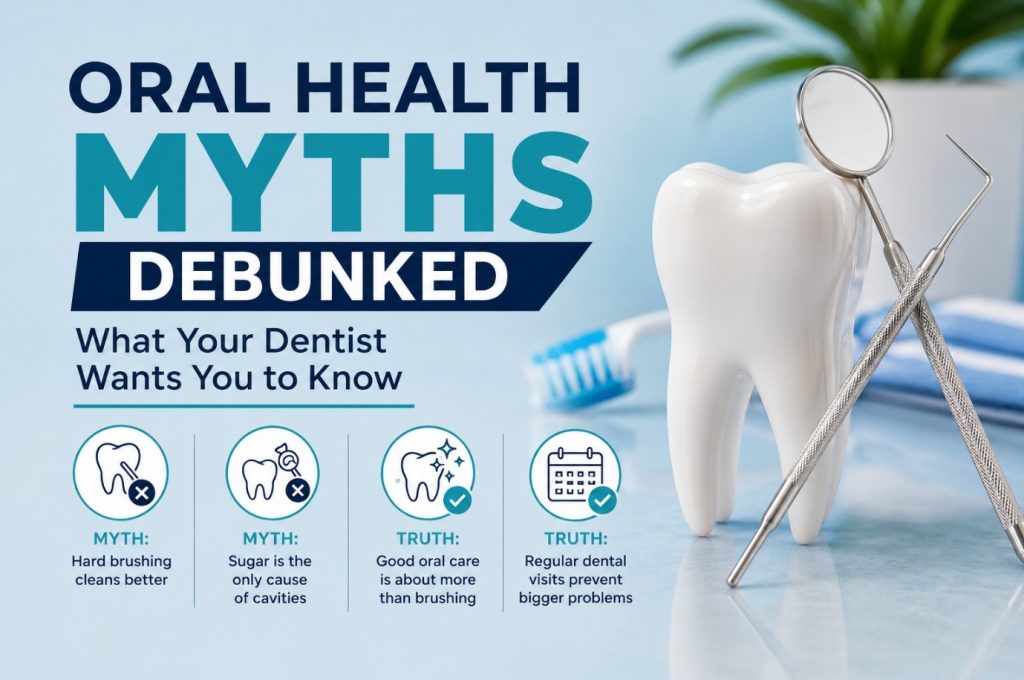

Oral health is one of the most myth-laden areas of medicine. From well-meaning advice passed down by grandparents to half-truths shared on social media, dental misconceptions are so widespread that they actively cause harm — keeping people from the dentist when they need to visit, convincing them that certain symptoms are normal when they are not, and reinforcing habits that accelerate the very dental problems they hoped to avoid.
At Dental Solutions Clinic in Indiranagar, Bangalore, our team of specialist dentists—led by Dr. Balasubramanya K.V. (MDS, Prosthodontist & Implantologist) and Dr. Ramya D.S. (MDS, Gold Medallist, Cosmetic & Laser Dentist)—regularly encounter patients whose dental health has been compromised by common misconceptions. This blog exists to correct them.
Here are 15 of the most persistent oral health myths, the facts behind them, and what you should actually be doing to protect your teeth and gums for life.
Why Dental Myths Can Harm Your Oral Health
Myth 1: “If my teeth don’t hurt, they’re fine.”
| ✓ THE FACT | Most serious dental problems are painless until they reach an advanced — and more expensive to treat — stage. |
This is perhaps the most damaging myth in dentistry. Tooth decay does not cause pain in its early stages. Gum disease is typically painless until it reaches an advanced stage. Even oral cancer — which claims thousands of lives annually — is often entirely asymptomatic in its early phases. Pain is a late-stage signal, not an early warning system. By the time a tooth hurts, the decay has often reached the pulp, the infection has spread, or the gum attachment has been significantly compromised. Regular dental check-ups every six months exist precisely because visual and radiographic examination detects problems before they become symptomatic—when treatment is simpler, faster, and less costly.
→ Book a routine check-up at Dental Solutions Clinic: dentalsolutionsclinic.com
Myth 2: “Brushing harder means cleaner teeth.”
| ✓ THE FACT | Hard brushing damages enamel and causes gum recession — the opposite of what you want. |
Dental plaque is a soft, sticky film. It does not require force to remove—it requires correct technique and consistency. Brushing too hard or using a hard-bristle toothbrush abrades the enamel surface progressively over time, causing irreversible enamel loss, tooth sensitivity, and gum recession. Once enamel is worn away, it does not regenerate. Gum recession, once established, exposes root surfaces that are more vulnerable to decay and sensitivity. The correct technique is to use a soft-bristled brush and gentle circular or modified Bass technique strokes at a 45-degree angle to the gumline for 2 minutes, twice daily.
→ Ask our team about the correct brushing technique at your next appointment.
Myth 3: “Sugar is the direct cause of tooth decay.”
| ✓ THE FACT | Bacteria cause tooth decay—sugar is their fuel source, not the direct cause. |
The relationship between sugar and cavities is more nuanced than most people realize. Sugar itself does not attack teeth. What happens is this: Streptococcus mutans and other bacteria in the mouth metabolize dietary sugars, producing acid as a byproduct. This acid demineralizes and erodes tooth enamel, creating cavities. This distinction matters because it changes the picture significantly. Frequency of sugar exposure is more damaging than quantity — sipping a sugary drink slowly over three hours is far worse for your teeth than consuming the same amount in one sitting. Acidic foods and drinks (without sugar) cause identical enamel erosion. And excellent oral hygiene — brushing and flossing to remove bacteria — can significantly mitigate the damage caused by moderate sugar consumption.
→ Concerned about tooth decay? Explore General Dentistry at dentalsolutionsclinic.com
Myth 4: “Root canal treatment is extremely painful.”
| ✓ THE FACT | Modern root canal treatment causes no more discomfort than a standard filling. |
Root canal treatment has an undeserved reputation as the most feared procedure in dentistry—a reputation built on experiences from decades past, before modern anesthesia, rotary endodontic systems, and single-visit techniques transformed the procedure entirely. Today, at Dental Solutions Clinic, root canal treatment is performed under local anesthesia, with modern rotary endodontic instruments and — where appropriate—laser-assisted techniques that reduce inflammation and improve accuracy. The procedure itself is painless. What patients experience before treatment—the toothache from infection or abscess — is the pain, not the treatment. After a root canal, most patients report feeling significantly better within 24–48 hours. The real pain is in delaying treatment and allowing infection to progress.
→ Learn about Laser-Assisted Root Canal Treatment:
Myth 5: “Bleeding gums are normal—they bleed because I’m brushing too hard.”
| ✓ THE FACT | Healthy gums do not bleed. Bleeding gums are the primary symptom of gum disease. |
This myth causes significant harm because it prevents patients from seeking treatment for gum disease at the stage when it is most reversible. Healthy, inflammation-free gum tissue does not bleed when brushed or flossed, regardless of pressure. Bleeding gums are a sign of gingivitis — the earliest stage of gum disease — caused by bacterial plaque accumulation at the gumline. Left untreated, gingivitis progresses to periodontitis: irreversible destruction of the bone and connective tissue that supports the teeth. Periodontitis is the leading cause of tooth loss in adults. If your gums bleed when you brush, floss, or even eat, book a periodontal assessment promptly. Gingivitis is entirely reversible with professional cleaning and improved home care.
→ Explore Periodontics and Gum Disease Treatment:
Myth 6: “Teeth whitening damages your enamel.”
| ✓ THE FACT | Professional teeth whitening, when performed correctly, does not damage enamel. |
The concern about whitening and enamel damage relates primarily to over-the-counter products used incorrectly, for too long, or too frequently. Professionally supervised whitening—whether in-clinic or using custom take-home trays from your dentist—uses safe concentrations of hydrogen peroxide or carbamide peroxide that oxidize stain molecules within the enamel without structurally damaging it. Temporary sensitivity during or after whitening is common; it resolves within 24–72 hours and does not indicate enamel damage. The key distinctions are professional products vs. unregulated over-the-counter products; correct protocol vs. overuse; and assessment by a dentist before whitening to identify any contraindications, such as exposed roots or active cavities.
→ Book professional Teeth Whitening:
Myth 7: “Children’s baby teeth don’t matter—they’ll fall out anyway.”
| ✓ THE FACT | Baby teeth are critically important for speech development, jaw growth, and guiding permanent teeth into the correct position. |
Primary (baby) teeth serve multiple essential functions that directly influence the long-term health of the permanent dentition. They maintain the space in the jaw for permanent teeth—when baby teeth are lost prematurely due to untreated decay, adjacent teeth shift into the space, causing crowding and misalignment in the permanent teeth. They are essential for normal speech and language development. They enable normal chewing and nutrition in the critical childhood growth years. And they give children confidence in their smile and comfort in social settings. Untreated decay in baby teeth causes pain and infection that affects sleep, eating, and concentration. Baby teeth should receive the same level of care as permanentchildren and children should have their first dental visit by age one.
→ Learn about Children’s Dentistry (Pedodontics):
Myth 8: “Braces are only for teenagers.”
| ✓ THE FACT | Modern orthodontic treatment is highly effective at any age—adults routinely undergo and complete orthodontic treatment. |
Orthodontic tooth movement is not age-limited. Teeth can be moved safely and effectively in adults because the biological mechanism — resorption and deposition of bone around the tooth root — remains functional throughout life. Adult orthodontics has grown dramatically as awareness of clear aligner systems (such as ClearPath and Invisalign) has removed the aesthetic barrier that previously deterred adults. Adults choosing orthodontic treatment typically achieve excellent results. The primary difference from adolescent treatment is that adult jawbones are no longer growing, which means certain skeletal discrepancies that can be managed with growth modification in children must be addressed surgically in adults. A consultation with an orthodontist will establish exactly what is achievable in your case.
→ Explore Orthodontics and ClearPath aligners:
Myth 9: “You only need to see a dentist when something goes wrong.”
| ✓ THE FACT | Regular six-monthly checkups prevent problems from developing—and save significantly on long-term dental costs. |
This is the myth that underpins virtually every preventable dental emergency. A professional dental examination serves purposes that no amount of excellent home care can replicate. X-rays reveal decay between teeth before it becomes visible or symptomatic. Clinical examination detects early gum disease, recession, cracked teeth, and signs of oral cancer. Professional scaling removes calculus (tartar) that cannot be removed by brushing. And the dentist-patient relationship means your dentist understands your individual risk profile — your diet, your habits, your medical history — and can tailor prevention advice accordingly. Catching a small cavity costs a fraction of treating a tooth that has been allowed to decay to the root. Detecting gingivitis early prevents the irreversible bone loss of periodontitis.
→ Book your six-monthly check-up at Dental Solutions Clinic:
Myth 10: “Aspirin placed directly on a tooth relieves a toothache.”
| ✓ THE FACT | Placing aspirin directly on gum tissue causes aspirin burns — a painful chemical injury. |
This is a surprisingly persistent home remedy that causes genuine harm. Aspirin is an acid (acetylsalicylic acid). When held against soft tissue for any length of time, it causes a chm that whitens and ulcerates the gum tissue. It does not penetrate the tooth or reach the nerve, so it provides no meaningful pain relief while causing a secondary injury. The only safe and effective approach to a toothache is swallowing an appropriate dose of over-the-counter pain relief (ibuprofen is generally more effective for dental pain than paracetamol due to its anti-inflammatory action) and booking an urgent dental appointment. A toothache is always a signal that something needs professional attention.
→ Experiencing a toothache? Book an urgent appointment:
Myth 11: “Dental X-rays are dangerous due to radiation.”
| ✓ THE FACT | Modern dental X-rays expose patients to less radiation than a short flight or a day of natural background radiation. |
Radiation anxiety around dental X-rays is common but disproportionate to the actual risk. Modern digital dental X-ray equipment exposes patients to extremely small doses of radiation—a full-mouth series of X-rays delivers approximately 0.005 millisieverts (mSv) of radiation. For context, a chest X-ray delivers 0.1 mSv; a transatlantic flight delivers approximately 0.08 mSv; and natural background radiation exposure in India averages around 2.4 mSv per year. Lead aprons and thyroid collars further reduce exposure. Dental X-rays are an essential diagnostic tool that detects decay between teeth, bone loss, impacted teeth, abscesses, and root anatomy that cannot be seen clinically. The risk of not having necessary X-rays—missed diagnosis and delayed treatment—vastly exceeds the negligible radiation risk.
→ Our clinic uses digital X-rays for precision diagnosis at minimal exposure.
Myth 12: “Gum disease only affects your mouth.”
| ✓ THE FACT | Periodontal disease is linked to systemic conditions such as diabetes, heart disease and poor pregnancy outcomes. |
One of the most important but least communicated areas of modern dentistry is the relationship between oral health and systemic health. Periodontal (gum) disease is a chronic infection caused by bacteria. This will permit bacteria and inflammatory mediators to enter into the blood stream and contribute to systemic inflammation . Research has established associations between periodontitis and cardiovascular disease (with some studies suggesting periodontal bacteria in arterial plaque); Type 2 diabetes (a bidirectional relationship—diabetes increases susceptibility to gum disease, and gum disease worsens blood sugar control); premature birth and low birth weight; and respiratory conditions. Treating gum disease has been shown in multiple studies to improve diabetic control and cardiovascular markers. The mouth is not separate from the rest of the body — it is a window into systemic health.
→ Periodontics at Dental Solutions Clinic:
Myth 13: “Dental veneers look fake and obvious.”
| ✓ THE FACT | Modern porcelain veneers, placed by an experienced specialist, are indistinguishable from natural teeth. |
The era of blocky, opaque, unnaturally white veneers belongs firmly in the past. Modern porcelain veneers—particularly those planned using Digital Smile Design (DSD) protocols and crafted from high-quality ceramics — closely mimic the translucency, texture, and light-reflective properties of natural tooth enamel. The skill of the specialist placing the veneers, the quality of the laboratory work, and the precision of shade matching determine whether the veneers look natural oDrrtificial. Dr. Ramya DS at Dental Solutions Clinic is certified in Digital Smile Desithat usesotocol that uses digital planning and patient-specific mock-ups to ensure the final result is precisely what the patient has approved before any tooth preparation begins.
→ Explore Cosmetic Dentistry and Veneers:
Myth 14: “Charcoal toothpaste whitens teeth effectively.”
| ✓ THE FACT | Activated charcoal toothpastes are abrasive, lack fluoride, and have no evidence of safe or effective whitening. |
Activated charcoal toothpastes have achieved remarkable popularity through social media marketing, but the clinical evidence does not support their use. Charcoal is highly abrasive — regular use can wear away enamel and cause surface roughening that paradoxically traps stains more easily over time. Most charcoal toothpastes do not contain fluoride—removing the single most important ingredient for cavity prevention. Any whitening effect is likely the result of surface abrasion rather than genuine whitening chemistry. The British Dental Association, the American Dental Association, and dentists globally have raised concerns about charcoal toothpaste safety. If you want to whiten your teeth safely and effectively, speak to your dentist — not your social media feed.
→ Interested in safe teeth whitening? Ask our team: dentalsolutionsclinic.com
Myth 15: “Dental implants are painful and risky.”
| ✓ THE FACT | Dental implant surgery, when performed by a trained implantologist, is well-tolerated and has a long-term success rate exceeding 95%. |
Dental implant surgery is one of the most predictable and well-researched procedures in dentistry. Performed anesthesia and implantation, and an implant is typically no more uncomfortable than a tooth extraction—the area is numb and postoperative discomfort is manageable with standard over-the-counter pain relief for most patients. The long-term success rate for dental implants placed in healthy bone exceeds 95% at ten years. The factors that influence success — smoking, uncontrolled diabetes, poor oral hygiene — are identifiable and addressable before surgery. Dr. Balasubramanya K.V. at Dental Solutions Clinic is a specialist prosthodontist and implantologist with extensive experience in implant placement and restoration. A proper pre-implant assessment determines candidacy and mitigates risk.
→ Learn about Dental Implants at Dental Solutions Clinic: dentalsolutionsclinic.com
Quick Reference: 15 Oral Health Myths vs Facts
| The Myth | The Fact |
| No pain = no problem | Most dental disease is painless until it is advanced |
| Harder brushing = cleaner teeth | Hard brushing damages enamel and causes recession |
| Sugar directly causes decay | Bacteria cause decay; sugar is their fuel |
| Root canals are extremely painful | Modern RCT is painless—like having a filling |
| Bleeding gums are from brushing too hard | Bleeding gums signal gum disease — see a dentist |
| Whitening damages enamel | Professional whitening is safe when done correctly |
| Baby teeth don’t matter | Baby teeth are essential for development and spacing |
| Braces are only for teenagers | Adults achieve excellent orthodontic results at any age |
| Only see a dentist when something’s wrong | Six-monthly check-ups prevent problems before they develop |
| Aspirin on gum relieves a toothaches. | Aspirin causes burns—take it orally and see a dentist |
| Dental X-rays are dangerous | Dental X-ray radiation is negligible — less than a short flight |
| Gum disease only affects the mouth | Linked to heart disease, diabetes, and pregnancy complications |
| Veneers look fake | Modern veneers are indistinguishable from natural teeth |
| Charcoal toothpaste whitens teeth | Abrasive and fluoride-free—no evidence of safe whitening |
| Implants are painful and risky | 95%+ long-term success rate; procedure is well-tolerated |
What Evidence-Based Oral Health Actually Looks Like
Now that the myths are out of the way, here is what the dental profession’s best evidence actually recommends:
- Brush twice daily for two full minutes using a soft-bristled toothbrush and fluoride toothpaste (1,000–1,450 ppm fluoride for adults)
- Floss once daily—flossing removes plaque from surfaces that no toothbrush can reach, regardless of brushing technique
- Visit your dentist every six months for a check-up and professional scale and polish
- Reduce the frequency of sugar and acid exposure—it is how often you consume them, not just how much
- Drink fluoridated water where available, or use fluoride mouthwash if your cavity risk is elevated
- Do not smoke or use tobacco in any form—tobacco is the single most significant preventable risk factor for gum disease and oral cancer
- Wear a custom night guard if you grind your teeth at night—bruxism is a leading cause of enamel damage and tooth fracture
- See a dentist if you notice any unusual sore, patch, or swelling in the mouth that does not resolve within two weeks—early oral cancer detection saves lives





Add Comment