












A solar plant doesn't suddenly stop performing one morning. That's not how it works.
Most performance losses happen quietly. A little dust today. A loose connection next month. A faulty string that goes unnoticed for weeks. Before long, a plant that should be generating strong returns starts producing less energy than expected.
Think about it this way. If a 1 MW solar plant loses just 5% of its annual generation, the financial impact can easily run into several lakhs every year. And the frustrating part? Many of these losses are preventable.
That's why a structured solar energy plant maintenance strategy matters. Not because maintenance is exciting, but because it protects the investment you've already made.
Most Plant Owners Focus on Installation and Forget Everything After
Honestly, this is probably the most underestimated part of the solar industry.
Businesses spend months comparing panels, inverters, and EPC contractors. Then the plant goes live, and maintenance becomes an afterthought.
A manufacturing facility in Mundra, for example, may install a rooftop solar system expecting lower electricity bills for the next 25 years. But without regular inspections, dirt accumulation, damaged connectors, and inverter faults can gradually reduce production.
This is where solar operations and maintenance becomes part of the business strategy rather than a routine service. The goal isn't simply fixing problems. The goal is preventing them.
Start with Real-Time Performance Tracking
Here's the thing: if you don't know how your plant is performing today, you won't know when something goes wrong tomorrow.
Many businesses now use solar project monitoring services to track generation data, inverter status, and fault alerts in real time.
A monitoring system can quickly identify:
- Underperforming strings
- Inverter communication failures
- Sudden drops in generation
- Grid connectivity issues
- Abnormal voltage readings
A ceramic manufacturing unit in Kutch recently discovered that one inverter had been operating below capacity for nearly three weeks. Without monitoring, that issue might have remained unnoticed until the monthly energy report arrived.
And by then, the lost generation would already be gone.
Dirt Is More Expensive Than Most People Think
Many people assume solar panels clean themselves whenever it rains.
That's simply not true.
In regions such as Bhuj, Mundra, and other parts of Kutch, dust accumulation can become a serious problem. Semi-arid conditions often leave a visible layer of dirt across panel surfaces, reducing sunlight absorption.
Regular solar panel maintenance and repair should include:
- Surface cleaning
- Crack inspections
- Junction box checks
- Connector inspections
- Thermal hotspot identification
Even a small amount of soiling can affect production across an entire array.
And when hundreds or thousands of modules are involved, those small losses add up quickly.
Commercial Systems Need More Attention Than Residential Ones
A residential rooftop system and a 2 MW industrial plant are completely different animals.
Most businesses require dedicated commercial solar panel maintenance because larger systems involve more equipment, longer cable runs, transformers, protection devices, and monitoring infrastructure.
A food processing facility operating multiple shifts may rely heavily on solar generation during peak production hours. If a fault occurs during those periods, operational costs rise immediately.
Routine maintenance schedules help identify issues before they begin affecting business operations. Not glamorous. Very valuable.
Don't Ignore Inverters and Electrical Components
Everyone talks about panels. Few people talk about electrical systems. Yet many generation losses originate from inverter issues, loose terminations, damaged cables, or protection equipment failures.
A proper solar panel operation and maintenance program includes electrical inspections at regular intervals.
Technicians should review:
- DC cable integrity
- AC panel connections
- Earthing systems
- Surge protection devices
- Inverter operating parameters
I've seen plants where a simple loose terminal caused repeated tripping events for months because nobody checked the electrical side thoroughly.
That shouldn't happen.
Why Local Conditions Change Everything
What works in Pune may not work in Kutch. That's reality. Strong winds, dust storms, high temperatures, and coastal corrosion create maintenance challenges that many standard maintenance schedules fail to address.
For businesses investing in solar energy plant maintenance in Kutch, location-specific planning becomes essential.
Salt processing facilities near coastal zones often face faster corrosion rates. Logistics parks near ports deal with dust and airborne particles. Manufacturing plants may encounter additional contamination from industrial activity. Local conditions always win. Maintenance plans should respect that.
Choosing the Right Service Partner Matters More Than Price
Let's be honest. Many businesses choose maintenance contractors based purely on cost. Then they discover the contractor visits only when something breaks.
Reliable solar operations and maintenance services involve scheduled inspections, reporting, performance analysis, cleaning coordination, and preventive maintenance planning. The cheapest contract often becomes the most expensive one later.
- Ask for performance reports
- Ask about response times
- Ask how faults are tracked
Those questions reveal far more than a pricing sheet.
What Good Maintenance Looks Like Year After Year
The best-performing plants follow a simple principle: consistency.
Experienced solar operations and maintenance companies don't wait for failures. They monitor trends, identify risks, and address minor issues before they become expensive repairs.
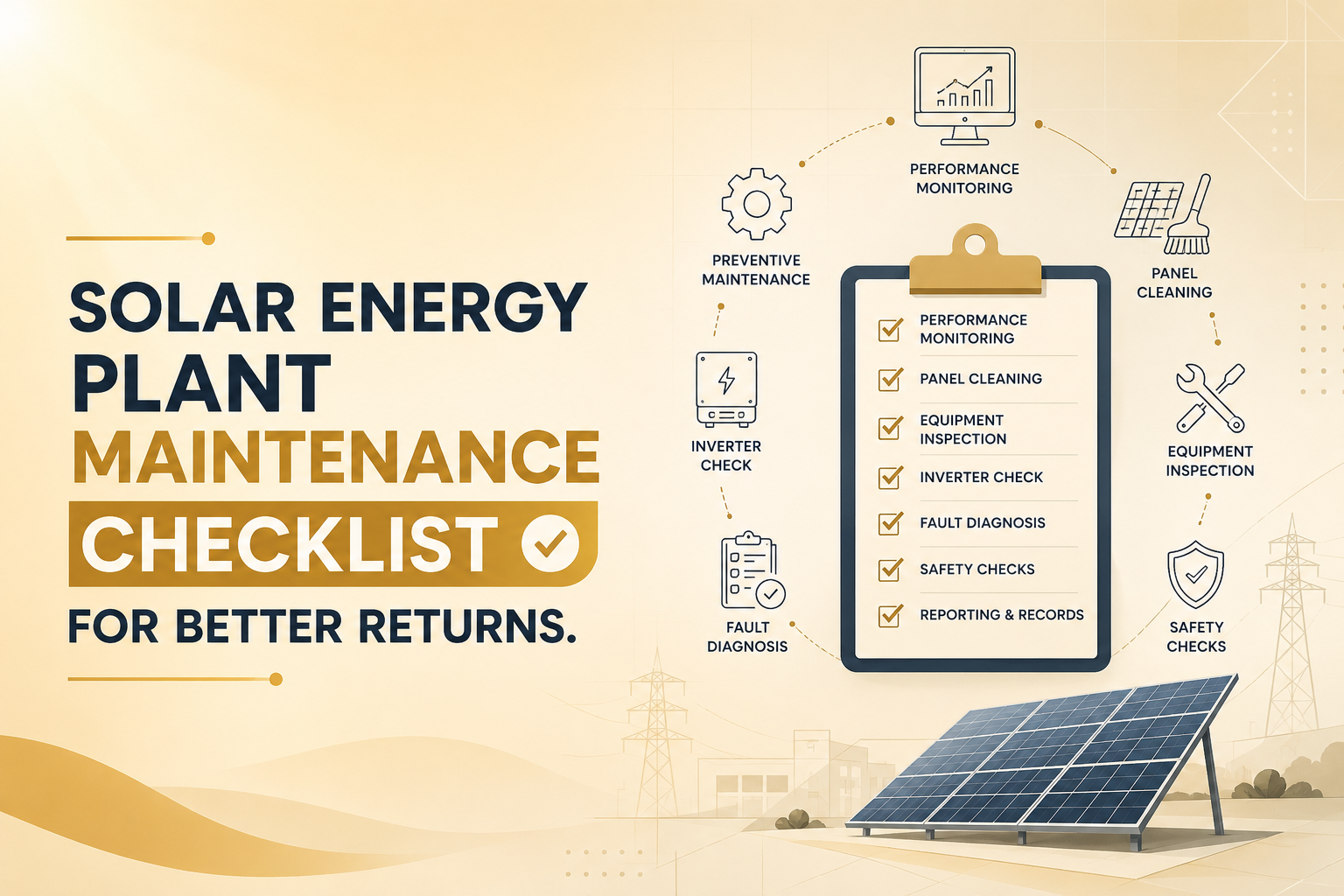
A practical annual maintenance checklist should include:
- Module cleaning schedule
- Thermal imaging inspections
- Inverter servicing
- Earthing verification
- Protection system testing
- Cable health assessment
- Generation performance review
- Safety audits
None of these tasks are complicated individually. Together, they protect revenue for decades.
Conclusion
Solar plants are long-term assets. But long-term returns depend on what happens after commissioning, not just during installation.
A disciplined maintenance approach helps businesses reduce energy losses, improve system availability, and avoid costly repairs. Whether you're operating a factory rooftop system in Bhuj or a utility-scale installation elsewhere, regular inspections and performance reviews remain critical.
At White Desert, we believe solar success isn't measured on commissioning day. It's measured year after year through consistent performance, reliable generation, and smart maintenance decisions that keep solar investments working as intended.
Frequently Asked Questions
1. Why use solar project monitoring services after installation?
Solar project monitoring services track performance, identify faults early, and help reduce generation losses before they affect business returns.
2. How often is solar panel maintenance and repair required?
Solar panel maintenance and repair is commonly scheduled quarterly, though dusty locations may require more frequent inspections and cleaning.
3. Why is commercial solar panel maintenance different?
Commercial solar panel maintenance involves larger systems, additional electrical equipment, and more detailed inspections than residential installations.
4. What do solar operations and maintenance companies provide?
Solar operations and maintenance companies provide inspections, cleaning schedules, performance reporting, and fault management support.
5. Why is solar operations and maintenance important?
Solar operations and maintenance helps reduce downtime, improve energy production, and protect long-term financial returns.
6. What is included in solar panel operation and maintenance?
Solar panel operation and maintenance includes cleaning, electrical checks, thermal inspections, and generation performance reviews.
7. Why is solar energy plant maintenance in Kutch unique?
Solar energy plant maintenance in Kutch addresses dust accumulation, high temperatures, strong winds, and coastal corrosion challenges.
8. What are solar operations and maintenance services?
Solar operations and maintenance services include preventive inspections, performance monitoring, fault diagnosis, and maintenance planning.
9. Can monitoring reduce maintenance costs?
Yes. Solar project monitoring services help identify issues early, reducing repair costs and limiting generation losses.
10. How do maintenance activities improve ROI?
Regular solar panel maintenance and repair, along with solar operations and maintenance services, help maintain energy output and improve returns.





Add Comment