










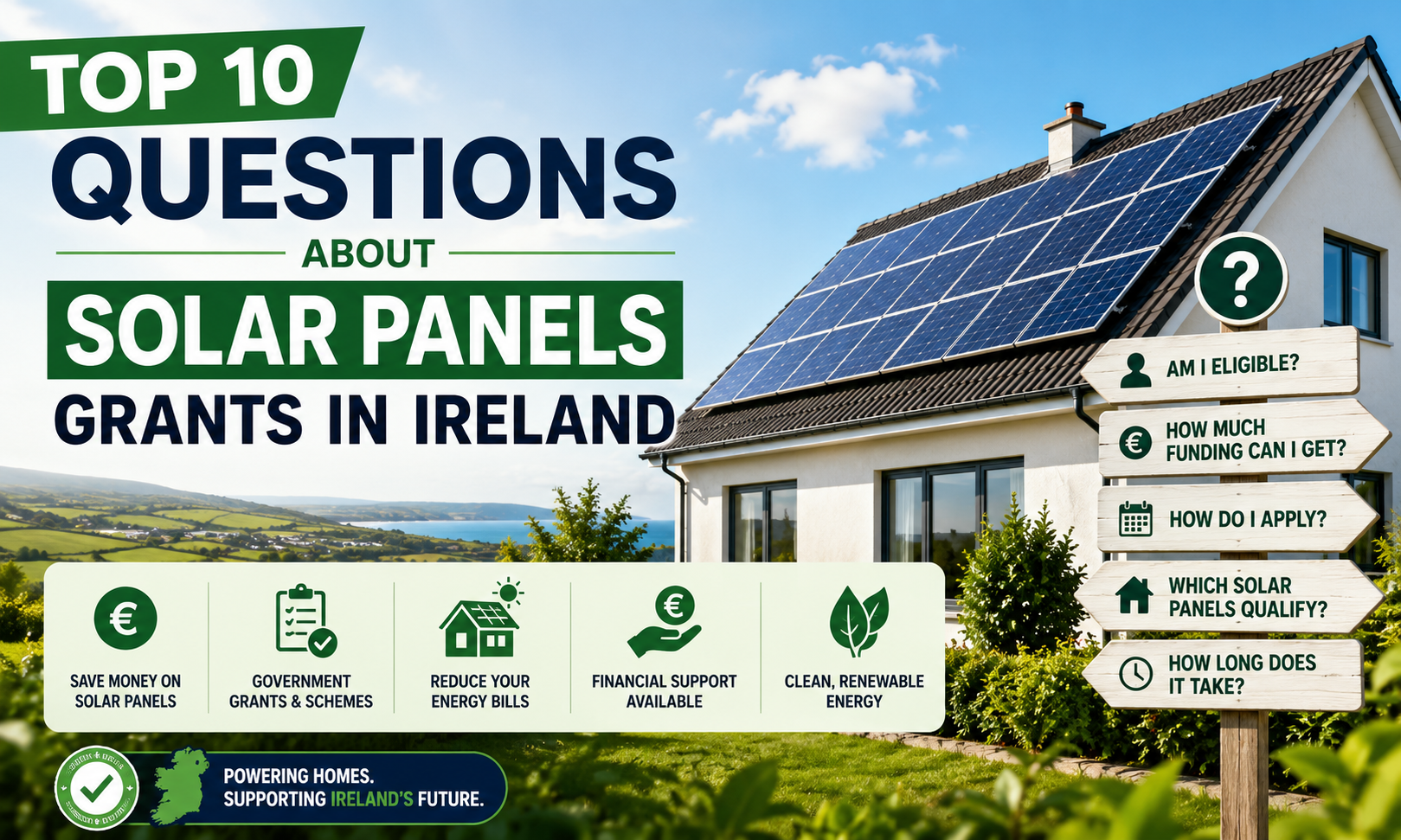

Thinking about going solar but not sure how the financial support works? You're not alone. Solar panels grants are one of the most talked-about topics among Irish homeowners right now, and for good reason: with electricity prices still high and government support holding steady, 2026 has become one of the best years yet to make the switch.
Below, we've answered the ten questions we hear most often about grants for solar panels Ireland offers homeowners, farmers, and businesses alike.
1. Are solar panels grants still available in Ireland?
Yes. The Sustainable Energy Authority of Ireland (SEAI) continues to offer solar panels grants through its Solar Electricity Grant scheme. In June 2026, Minister for Climate, Energy and the Environment Darragh O'Brien confirmed the rooftop solar grant would remain in place for the lifetime of the current government, removing much of the uncertainty homeowners faced about future cuts.
2. How much is the solar panel grant worth?
The maximum residential grant is €1,800, calculated as €700 per kWp for the first 2kWp and €200 per kWp for the next 2kWp. Systems of 4kWp or larger receive the full amount. This rate has held steady into 2026, the first year it hasn't been reduced since the scheme began.
Quick breakdown
First 2kWp: €700 per kWp
Next 2kWp: €200 per kWp
Maximum grant: €1,800
3. Who is eligible for grants for solar panels in Ireland?
To qualify, your home generally needs to have been built and occupied before 31 December 2020, and you must not have previously claimed a solar PV grant at the same MPRN. Both homeowners and private landlords can apply. There's no means test, so eligibility is based on the property rather than your income.
4. Can I apply for the grant after installation is complete?
No. This is one of the most common mistakes people make. You must apply and receive grant approval (a Letter of Offer) from SEAI before any installation work begins. Installing first and applying afterwards will disqualify you.
5. Does the grant cover battery storage?
Not for residential solar panels grants. The battery storage grant was removed in February 2022 following the introduction of the Clean Export Guarantee (CEG) scheme, which now pays homeowners for electricity they export back to the grid instead.
6. Do I need a registered installer to claim the grant?
Yes. Solar PV installation must be carried out by an SEAI-registered installer to qualify for solar panels grants. Choosing a registered company also ensures your system meets the required regulatory and safety standards.
7. Are there grants for farms and businesses too?
Absolutely. Farmers can access TAMS 3 grants, offering 60% grant aid up to a €90,000 investment ceiling, with batteries included for agricultural systems. Non-domestic and commercial properties can apply for the Microgen grant, worth up to €162,600 depending on system size, supporting installations up to 1,000kWp.
8. How much can I save with a solar grant?
Savings depend on your system size and household usage, but a typical 4kWp residential system can save over €500 a year on electricity bills. Combined with the €1,800 grant and Ireland's 0% VAT rate on solar installations, payback periods of five to seven years are common.
9. Will the solar panel grant be reduced in future years?
It's hard to say with certainty. The scheme was originally scheduled to taper down by around €300 a year before ending in 2029, but that reduction has now been paused twice, including the June 2026 commitment to hold the grant steady. Even so, no level of support is guaranteed indefinitely, so applying sooner rather than later is generally the safer financial move.
Why timing matters
Locking in the current grant level protects you from the uncertainty of future budget decisions, and you start benefiting from lower electricity bills immediately rather than waiting.
10. What's the process for claiming a solar panel grant?
It typically follows four steps: choose an SEAI-registered installer, submit your application and receive grant approval, complete the installation, and finally arrange a post-works BER assessment before submitting your documents to claim the payment.
Final Thoughts
Solar panels grants remain one of the most effective ways to bring down the cost of going solar in Ireland, and recent government commitments mean 2026 offers more certainty than homeowners have had in years. Whether you're a homeowner, farmer, or business owner, understanding how grants for solar panels Ireland provides can help you plan your installation with confidence and make the most of the support available while it lasts.
For a full breakdown of current grant amounts, eligibility criteria, and the application process, LVP Renewables' guide to grants for solar panels in Ireland is a useful next stop.





Add Comment