











In the rapidly evolving economic landscape of the Middle East—driven by Qatar’s National Vision 2030 and Saudi Arabia’s Vision 2030—the demand for operational excellence has never been higher. For businesses in Doha and beyond, an ISO certification is often the "passport" to international trade and large-scale government tenders.
However, not all certificates are created equal. The market is increasingly saturated with "unaccredited" or "self-proclaimed" certification bodies. To the untrained eye, the certificates look identical, but the difference in value is monumental.
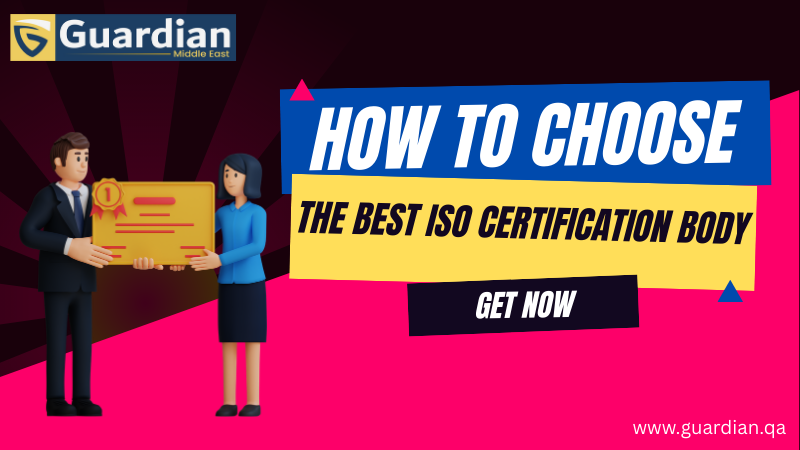
This comprehensive guide explores why choosing an accredited ISO certification body—like Guardian Middle East LLC through Guardian Assessment Pvt. Ltd.—is the only viable path for businesses seeking genuine growth, risk mitigation, and global credibility.

1. Understanding the Hierarchy of Trust: What is Accreditation?
To understand the value of an accredited certificate, one must understand the relationship between three distinct entities:
- The Organization (You): The business seeking to implement a management system (e.g., ISO 9001).
- The Certification Body (CB): The entity that audits you and issues the certificate (e.g., Guardian Assessment).
- The Accreditation Body (AB): The "auditor of the auditors." This is a government-appointed or internationally recognized body (like IAS in the USA or UAF) that verifies the Certification Body is competent, impartial, and follows ISO/IEC 17021-1 standards.
Choosing an accredited CB means you are choosing a provider that has been verified by a higher authority. Without accreditation, a certificate is merely a piece of paper with no external validation of the audit’s quality.
2. Global Recognition and the IAF Multilateral Arrangement (MLA)
The primary reason to choose an accredited body is global portability. Most reputable accreditation bodies are members of the International Accreditation Forum (IAF).
Through the IAF Multilateral Recognition Arrangement (MLA), member countries recognize each other’s accreditations as equivalent.
- The Benefit: If your ISO 9001 certificate is issued by a body accredited by IAS (USA), it is recognized not just in Qatar, but in the UK, Germany, Singapore, and over 100 other countries.
- The Risk of Unaccredited Certificates: An unaccredited certificate often fails to meet the "equivalence" test. If you attempt to export goods or bid for a project in Europe or America, your "local-only" or "unaccredited" certificate may be rejected, forcing you to undergo the entire audit process again at a massive cost.
3. Meeting Regulatory and Tender Requirements in Qatar
In the State of Qatar, the regulatory environment is becoming increasingly stringent. Under Regulation 363/2018, the Qatar General Organization for Standardization (QS) oversees the integrity of certification services.
Most government entities (including Ashghal, QatarEnergy, and various ministries) specifically mandate that ISO certificates must be accredited by an IAF-recognized body.
- Tender Disqualification: Submitting an unaccredited certificate in a high-stakes tender is one of the fastest ways to be disqualified.
- Compliance Assurance: Accredited bodies ensure that your management system actually meets the legal requirements of the country, reducing the risk of fines, work stoppages, or legal liabilities.
4. The Shield of Impartiality and Integrity
A core requirement for accreditation is impartiality. Unaccredited bodies often provide both "consultancy" (telling you what to do) and "certification" (grading their own work). This is a massive conflict of interest.
Accredited bodies like Guardian Middle East LLC must maintain a strict "firewall" between training and auditing.
- Objective Audits: When an accredited auditor visits your site, their goal is to find objective evidence of compliance.
- No Shortcuts: Accreditation ensures that the audit duration is calculated based on international rules (IAF MD5). Unaccredited bodies may offer "1-day certifications," which are red flags for lack of depth and zero value-add.
5. Risk Mitigation and Business Resilience
An ISO certification should be more than a marketing tool; it should be a risk management framework.
- Identifying Gaps: The rigors of an accredited audit force your organization to look at its weaknesses. Whether it’s data security (ISO 27001) or occupational health (ISO 45001), the audit identifies "non-conformities" that could lead to disasters if left unchecked.
- Supply Chain Trust: Large corporations only partner with vendors who can prove their resilience. An accredited certificate provides "Peace of Mind" to your stakeholders, ensuring that your processes are audited by competent professionals who understand industry-specific risks.
6. Digital Verifiability: The IAF CertSearch Advantage
One of the newest and most powerful tools in the fight against "fake" certifications is IAF CertSearch. This is the global database where all accredited certificates are logged.
When you choose an accredited body like Guardian Assessment, your certificate is uploaded to this portal.
- Real-time Validation: A potential client in London or New York can enter your company name or certificate number and instantly see that your ISO 9001 status is "Active."
- Combatting Fraud: Unaccredited certificates cannot be listed on IAF CertSearch. This digital "Gold Standard" of verification is becoming the default requirement for international procurement.
7. Operational Excellence and Continuous Improvement
The philosophy of ISO is Plan-Do-Check-Act (PDCA). Accredited certification bodies are required to conduct annual "Surveillance Audits."
This ensures that:
- Your management system doesn't gather dust on a shelf.
- Your staff remains committed to quality.
- Your business evolves with changing market conditions.
The feedback provided during an accredited audit is a form of high-level business consulting. It offers insights into how your processes compare to global best practices, driving efficiency and reducing waste.
8. Financial Gains: ROI of Accreditation
While unaccredited "fast-track" certificates might seem cheaper in the short term, they are a poor investment.
- Avoid Re-Auditing Costs: If a major client rejects your unaccredited certificate, you lose the initial fee and must pay for a new, accredited audit.
- Efficiency Savings: The process improvements mandated by an accredited QMS (Quality Management System) typically lead to reduced operational costs, lower error rates, and higher customer retention—directly impacting your bottom line.
9. Sector-Specific Criticality (Healthcare, Oil & Gas, Construction)
In certain sectors, the choice of an accredited body is a matter of life and safety.
- Healthcare (ISO 9001/ISO 13485): Inaccurate processes can lead to patient risk. Accreditation ensures the highest level of clinical quality management.
- Construction (ISO 45001/ISO 14001): Safety is paramount. Accredited audits ensure that site safety protocols are not just documented, but effectively implemented.
- Food Safety (ISO 22000): Ensuring the integrity of the food supply chain requires a level of scrutiny that only an accredited body can provide.
Conclusion: Partnering for the Future
Choosing an ISO certification body is one of the most important strategic decisions your leadership team will make. It is an investment in your brand’s reputation and your organization's future.
By choosing Guardian Middle East LLC, you gain the advantage of local expertise combined with the global weight of UAF and IAS (USA) accreditation. Our commitment to the highest standards of conformity assessment ensures that your certification is not just a badge, but a cornerstone of your business success.
Ready to elevate your organization? Ensure your path to excellence is paved with trust. Choose accredited. Choose Guardian.





Add Comment