











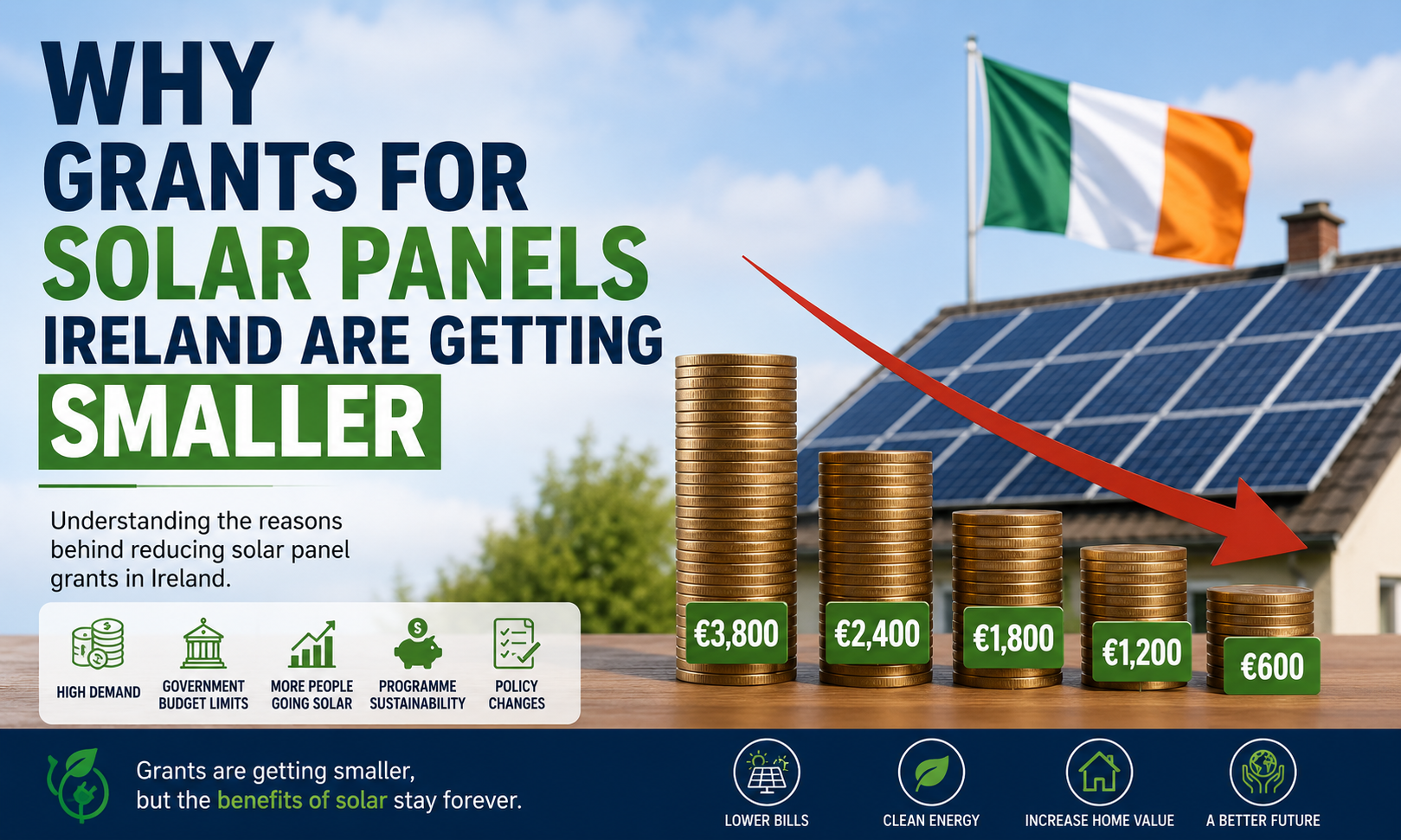

Solar energy has rapidly transitioned from a niche investment to a mainstream solution for Irish homeowners seeking to reduce their electricity bills and carbon footprint. A significant driver behind this surge in adoption has been the generous support offered through grants for solar panels Ireland. The Sustainable Energy Authority of Ireland (SEAI) has provided substantial financial incentives to make these installations accessible. However, homeowners who are planning to make the switch are increasingly asking a critical question: why are solar panels grants getting smaller, and should they wait for the situation to stabilize?
The reality is that government subsidies for emerging technologies rarely stay static forever. As the solar market matures and technology becomes more affordable, grant structures are naturally adjusted. Understanding the mechanics behind these reductions is essential for any homeowner looking to maximize their return on investment in renewable energy.
The History of SEAI Solar Grants
To understand the current trajectory of grants for solar panels Ireland, it is helpful to look at how the scheme has evolved. When the SEAI first introduced the solar photovoltaic (PV) grant in 2021, the maximum support available to homeowners was €1,800. This grant was designed to offset a significant portion of the upfront installation costs, making the transition to solar financially viable for a broader demographic.
Initially, the grant structure was quite attractive. Homeowners could receive €900 per kilowatt-peak (kWp) for the first 2 kWp of their system, and €300 per kWp for the subsequent 2 kWp. This meant that a standard 4 kWp system could be fully subsidized up to the €1,800 cap.
However, as the renewable energy sector in Ireland has grown, the government has periodically reviewed the effectiveness and necessity of these solar panels grants. While the maximum grant of €1,800 was maintained for several years, the government announced plans to gradually reduce this amount. The intended trajectory involved decreasing the grant by approximately €300 annually, eventually phasing it out entirely by 2029.
Despite these announced plans, the government has repeatedly delayed the reductions. For example, although cuts were scheduled for 2024 and 2025, the SEAI held the grant at €1,800 to ensure that the momentum of solar adoption was not lost amidst fluctuating electricity prices and geopolitical uncertainty.
Why Are Solar Panels Grants Getting Smaller?
The reduction of solar panels grants is not unique to Ireland; it is a global trend observed across Europe and North America as renewable energy markets develop. Several key factors contribute to why grants for solar panels Ireland are gradually being scaled back.
1. Falling Costs of Solar Technology
The primary reason for the decrease in grants for solar panels Ireland is the dramatic reduction in the cost of solar hardware. Over the past decade, the price of manufacturing and installing solar panels has dropped by more than 50%. As solar technology becomes a commodity, the initial capital expenditure required for a residential system decreases significantly.
When the SEAI first introduced the grant in 2021, a typical installation could easily cost upwards of €9,000 to €12,000. Today, thanks to competitive pricing and technological efficiencies, a high-quality 4 kWp system can be installed for considerably less. As the overall cost of the project drops, the necessity for a high-value government subsidy diminishes.
2. Market Maturity and Scalability
For any government subsidy program, the ultimate goal is to nurture an industry until it can stand on its own two feet. In the early stages of the Irish solar market, solar panels grants were a critical lifeline, encouraging installers to establish themselves and homeowners to take a risk on new technology.
Now, the Irish solar industry has reached a stage of maturity. There are hundreds of SEAI-registered installers across the country, supply chains are well-established, and consumer confidence is high. With over 170,000 installations completed and solar capacity tripling since 2023, the market no longer requires the same level of heavy-handed financial intervention to drive adoption.
3. Shifting Government Priorities
Ireland has ambitious climate targets to meet by 2030, including the installation of 8 gigawatts (GW) of solar capacity. The SEAI's funding is finite, and as the government pushes toward these targets, it must allocate its budget strategically.
While grants for solar panels Ireland remain a priority, the government must balance these funds against other critical home energy upgrades, such as insulation, heat pumps, and electric vehicle charging infrastructure. By reducing the solar grant over time, the SEAI can stretch its budget further, allowing it to support a wider range of energy efficiency measures across the country.
The Impact of Recent Policy Changes
Despite the narrative that solar panels grants are shrinking, the overall financial landscape for Irish homeowners installing solar has actually improved in recent years. The government has implemented complementary policies that offset the impact of any grant reductions.
The Introduction of 0% VAT
In May 2023, the Irish government introduced a 0% VAT rate on the supply and installation of solar panels. Previously, homeowners had to pay 13.5% VAT on their systems. For a €9,000 installation, this VAT reduction resulted in an immediate saving of approximately €1,070.
When you combine the introduction of 0% VAT with the initial €600 reduction in the SEAI grant, most homeowners found themselves in a better financial position than they were before the grant was adjusted. This strategic shift demonstrates that while grants for solar panels Ireland may appear to be getting smaller, the total cost of ownership has been effectively managed by the government.
Increased Electricity Prices and Payback Periods
Another factor mitigating the reduction in solar panels grants is the steady rise in electricity prices. As grid electricity becomes more expensive, the financial return on a solar installation becomes much more attractive.
In 2021, when the grant was at its highest, electricity prices were significantly lower. Today, with rates averaging around €0.40 per kilowatt-hour (kWh), the amount of money a homeowner saves by generating their own power is nearly double what it was a few years ago. Furthermore, the introduction of the Clean Export Guarantee (CEG) allows homeowners to earn money by exporting surplus energy back to the grid, typically between €0.185 and €0.25 per kWh.
These financial benefits mean that the payback period for a solar system—often around five to seven years—remains highly favorable, even if the initial SEAI grant is slightly reduced.
What This Means for Homeowners Planning an Installation
For homeowners considering grants for solar panels Ireland, the most important takeaway is to act sooner rather than later. While the government has committed to maintaining the current grant structure until at least 2029, the trajectory of any subsidy program is inevitably downward.
Secure the Current Grant Levels
As of 2026, the SEAI still offers a maximum grant of €1,800 for residential solar PV systems. This amount represents a substantial discount on the overall cost of installation. By applying now, homeowners can lock in this maximum level of support, providing a significant buffer against any potential future reductions.
Consider the Long-Term Value
While the size of solar panels grants is a crucial factor in the initial purchase, it is important to focus on the long-term value of the system. A well-installed solar array will generate clean, free electricity for 25 years or more. The cumulative savings over the lifespan of the system far outweigh the initial grant amount.
Furthermore, installing solar panels can increase the market value of a home and improve its Building Energy Rating (BER), making it a sound investment regardless of minor fluctuations in grant funding.
Conclusion
The reduction in grants for solar panels Ireland is a natural evolution of a maturing renewable energy market. As technology costs fall and the industry scales up, government subsidies are adjusted to reflect the changing landscape. However, the current financial environment for solar adoption in Ireland is exceptionally strong.
With the introduction of 0% VAT, rising electricity prices, and lucrative export payments, the overall return on investment remains highly attractive. While the narrative around shrinking solar panels grants may cause hesitation, the data suggests that now is an excellent time for Irish homeowners to make the switch to renewable energy. By acting promptly, you can secure the current level of SEAI support and start enjoying the financial and environmental benefits of solar power for decades to come.





Add Comment