











Introduction
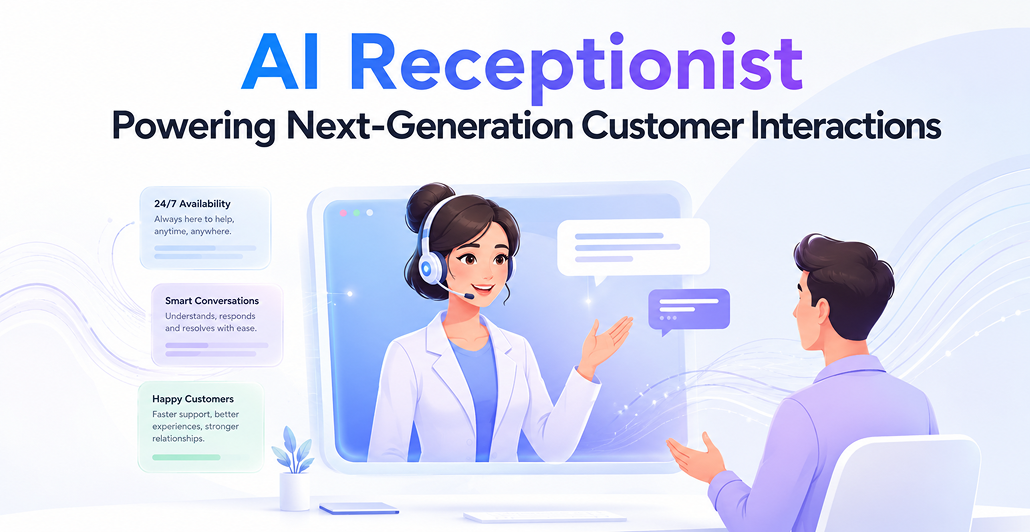
An AI Receptionist has emerged as one of the most effective solutions for managing customer interactions in today's business environment. By leveraging advanced technologies such as natural language processing, machine learning, and voice automation, AI receptionists can handle calls, answer questions, schedule appointments, and provide support with minimal human intervention.
Solutions powered by an AI Call Assistant and automated AI Phone Call management systems enable businesses to deliver exceptional service while reducing operational costs. According to many AI Receptionist Reviews, companies that implement AI-powered communication tools often experience significant improvements in efficiency, customer satisfaction, and overall business performance.
Understanding AI Receptionists
How AI Receptionists Work
An AI Receptionist is a virtual assistant designed to manage customer communications through artificial intelligence and automation.
When a customer initiates an AI Phone Call, the system listens to the conversation, interprets the caller's intent, and provides an appropriate response. Unlike traditional automated systems that rely on rigid menus, AI receptionists engage in natural conversations and adapt to various customer requests.
AI Call Assistant and Automated Voice Systems
The AI Call Assistant is basically the communication engine behind most AI receptionist platforms.
Automated voice systems help businesses deal with lots of incoming calls without needing to staff up even more. Customers get help faster, and companies can hold service quality fairly steady even when call volume spikes out of nowhere.
Core Technologies Behind Next-Generation Customer Interactions
Natural Language Processing (NLP)
Natural Language Processing (NLP) allows AI systems to understand and interpret human language.
NLP enables AI receptionists to analyze customer conversations, identify intent, recognize context, and generate meaningful responses. Instead of relying on predefined scripts, AI systems can engage in dynamic conversations that feel more natural and human-like.
Automatic Speech Recognition (ASR)
Automatic Speech Recognition (ASR) technology converts spoken language into text that AI systems can analyze.
ASR enables AI receptionists to accurately understand customer requests regardless of speech patterns, accents, or communication styles. Modern ASR systems process speech in real time, allowing AI assistants to respond quickly and effectively.
Key Features of AI Receptionist Systems
Intelligent Call Answering
The system responds immediately to incoming calls and begins assisting customers without requiring them to navigate complex menus. Customers can communicate naturally and receive direct support based on their specific needs.
This approach reduces frustration, improves satisfaction, and ensures that no customer inquiry goes unanswered.
Automated Call Routing
An AI receptionist type of thing helps sort out what the caller is really trying to reach, then it routes the call along itself, toward the correct department , the suitable specialist, or whoever seems to fit right then based on what’s going on during that call.
In normal everyday use, this usually cuts down the amount of needless back and forth transfers , and it can also reduce the time it takes to reach a genuine solution, not just getting stuck, bouncing between prompt choices, menu screens again and again.
AI Phone Call Management
AI phone call management is basically a blend of typical communication duties , sorta grouped together in one place, or at least that’s the plan.
The AI Call Assistant handles those tasks with steady follow through, at a calm consistent pace. It also lessens the paperwork burden, and it helps keep the service flow smoother too, so yeah it’s kind of a win all around.
Benefits of AI Receptionists for Businesses
Enhanced Customer Experience
AI receptionists provide immediate assistance, personalized support, and accurate information, helping businesses meet and exceed customer expectations. Faster response times and smoother interactions contribute to greater customer satisfaction.
Enhanced experiences strengthen customer relationships and encourage long-term loyalty.
Increased Productivity and Efficiency
AI-powered communication systems improve workplace productivity by automating repetitive tasks.
By handling routine inquiries and administrative responsibilities, AI receptionists allow employees to focus on more strategic activities. Organizations can manage higher communication volumes without proportionally increasing staffing costs.
Reduced Operational Costs
AI receptionists help reduce labor expenses by automating many communication processes. Businesses can maintain high service levels while lowering operational costs.
Cost savings can be reinvested into innovation, growth initiatives, and customer experience improvements.
24/7 Customer Communication Support
Unlike a lot of human roles, AI receptionists can stay online nonstop, no breaks , no pauses.
That means customers can get answers whenever they need them, across time zones too even if the office is closed.
Because help stays available all day every day, businesses don’t really miss chances to stay connected.
That nonstop support vibe usually increases satisfaction and builds trust. It’s especially useful for global organizations , coverage has to remain steady.
Scalability for Business Growth
AI receptionist systems can scale easily to accommodate larger customer bases and higher call volumes. Organizations can expand operations without dramatically increasing staffing requirements.
Industry Applications of AI Receptionists
Banking and Financial Services
Banks and financial services teams use AI receptionists for account questions, appointment scheduling, support linked to customer authentication, and help connected to transactions.
Automation keeps service running smoothly, while still respecting security rules and compliance requirements, clearly.
Healthcare and Medical Support
In healthcare orgs, they kind of roll out AI receptionists for appointment scheduling, patient questions, sending reminders, plus most of that daily admin drag and all the related stuff around it.
Retail and E-Commerce
Retailers usually lean on AI communication systems for product questions, order updates, returns handling, and processing customer support tickets or whatever comes.
Also, AI receptionists can absorb seasonal demand surges without messing up the service consistency. Like not even close.
Telecommunications
Telecommunications providers deal with a mountain of customer questions every day.
AI receptionists take on billing questions, account management, basic troubleshooting, and even notifications for service changes.
Customers get help sooner, and support teams can work more efficiently too. Once automation is actually in motion, the service quality plus overall outcomes often get better for both groups, most of the time.
Future Trends in AI Receptionist Technology
Advanced Conversational AI
In the coming years, AI receptionists are kinda bound to get a bit more “switched on” , like they really “get” what people mean even if someone is talking mid sentence, and yes it might feel messy too, like all over the place.
So conversational AI will keep pushing ahead, with a deeper sense of context, and honestly it makes those multi step chats easier to wrangle , the ones that tend to drift and wander a bit, in a more human-like way as well.
Emotion Recognition in Voice Systems
Emotion recognition in voice systems feels like a big leap for how customer communication lands , in everyday real life.
When the AI is listening closely for vocal tone , speech rhythms, and those small emotional signals , it can often figure out how someone is feeling, then tweak what it says while the call is still going.
Human-AI Collaboration
The AI receptionist handles the steady questions, while human reps jump in when empathy, creative judgment, or heavier troubleshooting shows up in the moment.
Hyper-Personalized Customer Communication
Next, AI systems will likely lean harder on analytics, plus customer related data, to shape conversations that feel almost tailor-made.
So customers might get carefully picked recommendations , help sooner than they even ask for, and support that matches what’s happening in their own specific situation.
This hyper personalization style tends to lift engagement, and it can also build loyalty, as well.
Autonomous AI Customer Interaction Systems
Then there’s the momentum toward more autonomous AI receptionists.
These systems will likely run full communication journeys , handling routine questions, clearing out common problems, doing follow ups, and coordinating contact points with minimal, or basically zero oversight.
Conclusion
The AI Receptionist is changing how customer communication gets handled , because it brings intelligent, efficient, and scalable options. With Natural Language Processing, Automatic Speech Recognition, and advanced automation working together, AI receptionists help companies deliver support that’s faster, more personal, and overall more effective.
Also, solutions like the AI Call Assistant plus automated AI phone call systems, can help organizations boost productivity, lower costs , and improve customer satisfaction. As you can see in many AI Receptionist Reviews , companies that deploy AI powered communication tools often point to real improvements across operational efficiency and service quality too.








Add Comment