











Introduction
DC-DC converters are important devices in power electronics that convert one DC voltage level into another DC voltage level. In simple terms, they help in increasing or decreasing voltage as required by different electronic devices. These converters are widely used in laptops, mobile phones, electric vehicles, and renewable energy systems.
For students, understanding DC-DC converters is very important because they are a basic concept in electronics and electrical engineering projects. Almost every modern electronic system uses some form of voltage conversion, so learning this topic helps students build a strong technical foundation.
Why DC-DC Converters are Important
Different electronic components require different voltage levels to work properly. For example, a battery may provide 12V, but a circuit may need only 5V or 3.3V. DC-DC converters solve this problem by regulating and converting voltage efficiently without damaging components.
They also help in:
- Protecting devices from overvoltage and voltage fluctuations
- Improving energy efficiency (many converters achieve very high efficiency)
- Reducing heat loss compared to traditional linear regulators
- Supporting portable and battery-powered systems like mobiles and IoT devices
- Providing stable and reliable power supply for sensitive circuits
Because of these advantages, DC-DC converters are widely used in both small electronic devices and large industrial systems.
Types of DC-DC Converters
1. Buck Converter (Step-Down)
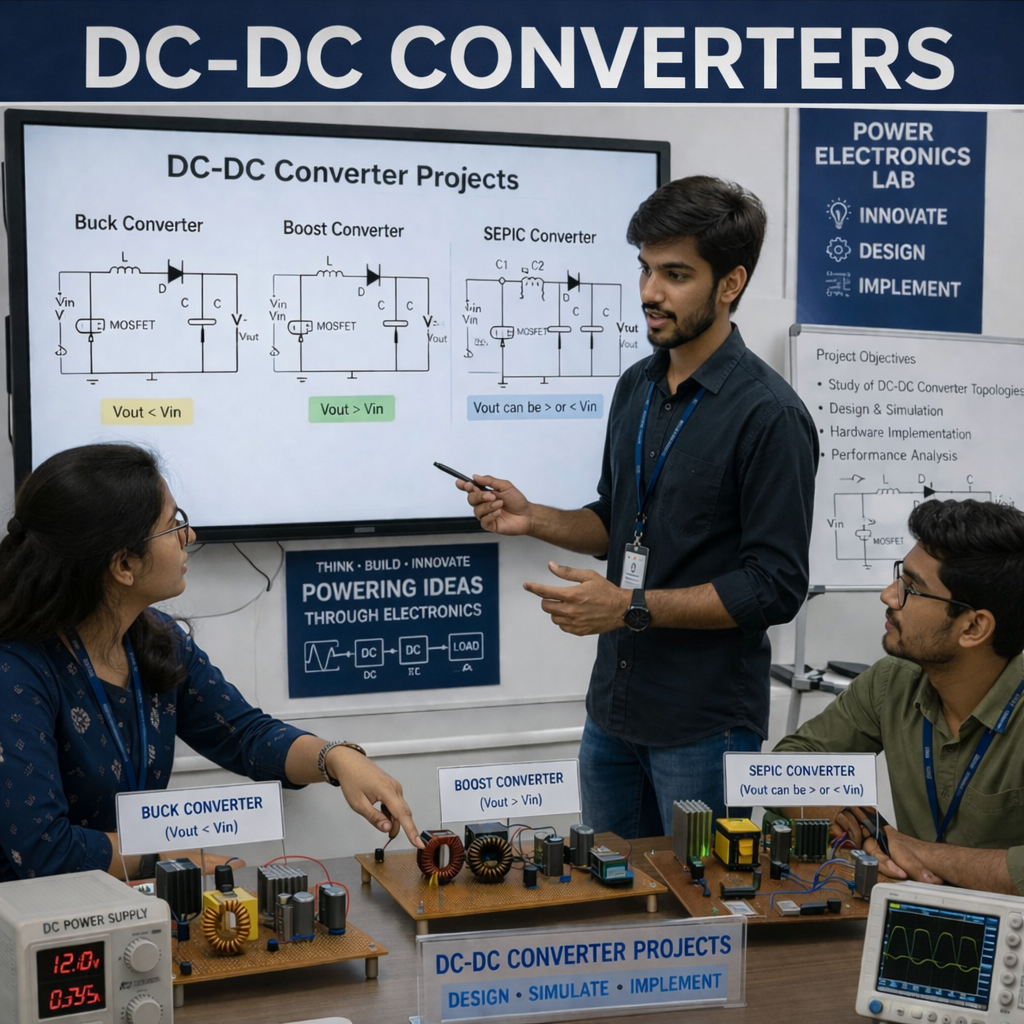
A buck converter is used to reduce voltage from a higher level to a lower level. For example, converting 12V to 5V. It is one of the most commonly used converters in electronic circuits.
It is widely used in mobile chargers, microcontroller circuits, and embedded systems where lower voltage is required for operation.
2. Boost Converter (Step-Up)
A boost converter increases voltage from a lower level to a higher level. For example, converting 5V to 12V.
This type of converter is mainly used in battery-powered devices where input voltage is low but output needs to be higher, such as in LED drivers and portable electronics.
3. Buck-Boost Converter
A buck boost converter can both increase and decrease voltage depending on the requirement. This makes it very flexible and useful in systems where input voltage keeps changing.
It is commonly used in advanced power supply systems and applications where stable output is required under varying conditions.
Working Principle
DC-DC converters work using high frequency switching techniques. They use components like inductors, capacitors, and switches (transistors) to store energy and release it at the required voltage level.
When the switch turns ON and OFF rapidly, energy is transferred and controlled efficiently. A feedback system continuously monitors the output voltage and adjusts the switching to maintain a constant and stable output even when input voltage or load conditions change.
Applications
- DC-DC converters are used in many real-world applications such as:
- Mobile phones and laptops for power management
- Solar power systems to regulate energy output
- Electric vehicles for battery and motor control
- Industrial automation systems
- IoT devices and embedded systems
These applications show how important DC-DC converters are in modern technology.
Student Projects on DC-DC Converters
Students can work on practical and innovative projects such as:
- Design of Buck Converter using PWM control
- Solar Powered DC-DC Converter System
- Battery Charging System using Boost Converter
- DC-DC Converter for Electric Vehicle Applications
Arduino based Smart Voltage Regulation System
These projects help students gain practical knowledge, improve problem solving skills, and understand real time applications.
Services for Students (Project Support)
Educational platforms provide useful services for students such as:
- Ready made IEEE based projects for academic use
- Simulation support using tools like MATLAB and Simulink
- Circuit design guidance and hardware implementation
- Complete project documentation and reports
- Internship programs and technical training support
These services are very helpful for students to successfully complete their academic projects and gain hands on experience.
Conclusion
DC-DC converters are essential components in modern electronics and power systems. They provide efficient and reliable voltage conversion and are widely used in many applications.
For students, learning DC-DC converters not only helps in academic studies but also improves practical knowledge and project development skills. It also opens career opportunities in industries like renewable energy, electric vehicles, and embedded systems.







Add Comment