












Think about putting in countless hours into making reports, answering customer questions, processing information, and crafting content to find out that your competition is doing all of this in just a few minutes. Every industry sees organizations struggling to offer fast solutions, lower expenses, and respond to increasingly high customer demands. Regular automation simply isn’t enough anymore.
And this is where Generative AI is bringing a tangible impact. Apart from automating monotonous jobs, Gen AI generates content, writes code, summarizes data, designs graphics, and makes decisions for businesses at an outstanding pace and level of precision. Businesses are not using AI to experiment with innovation anymore; they use it for a reason — to gain value.
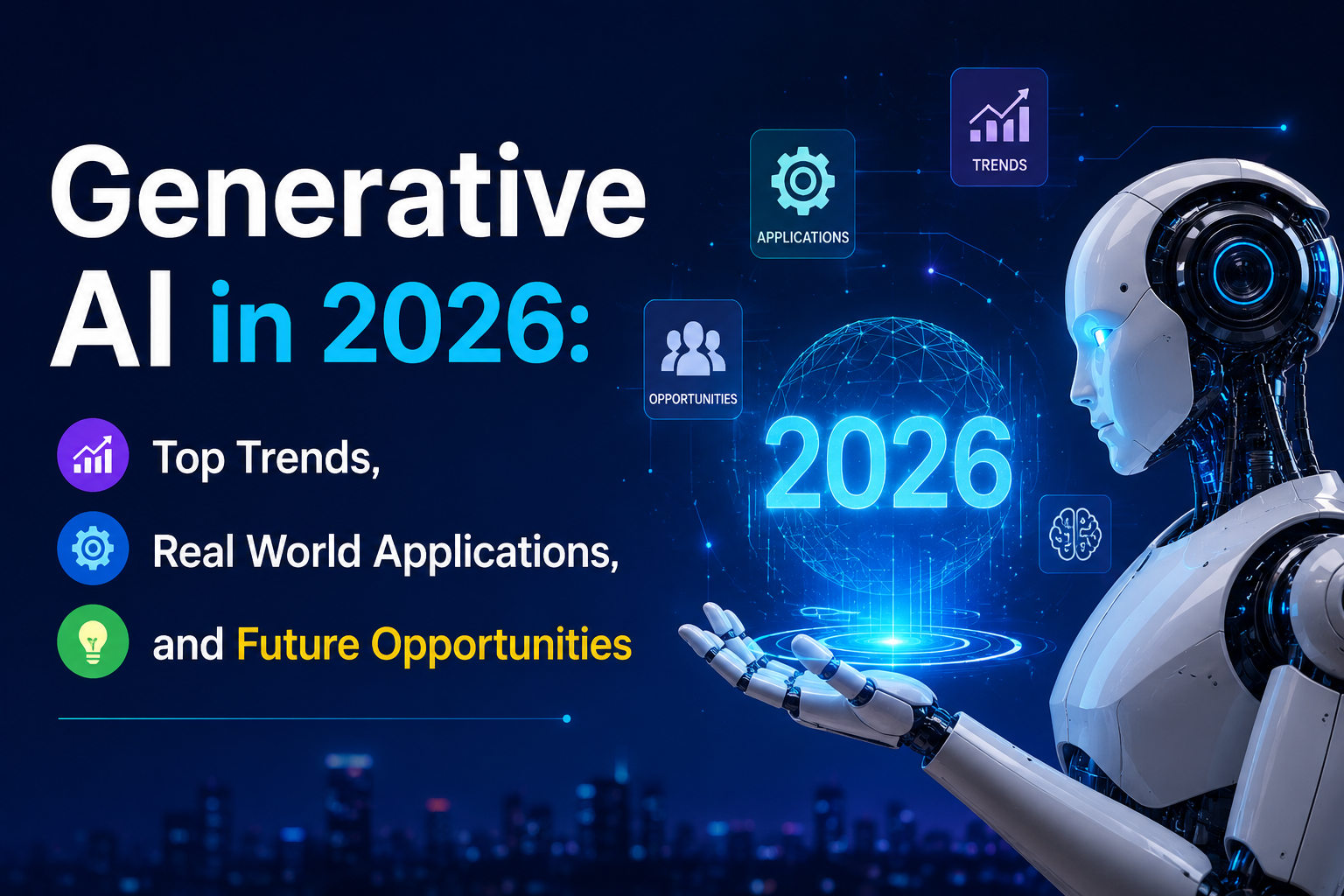
As we traverse through 2026, one topic of discussion for every firm is no longer if they should consider investment in AI. Rather, the key concern that is discussed is where this investment will bring significant impact without jeopardising security, compliance, and responsible utilisation. Here we will take a deep dive into the dominant trends driving the industry, use cases with real-time implications, and opportunity for the work of tomorrow.
What Is Generative AI?
In essence, Generative AI is concerned with AI technologies that produce new content after studying patterns from huge amounts of data. In contrast to typical automation technologies that are designed to execute specific commands, the former understands the context and provides responses accordingly.
They can write documents, generate images, create software code, design presentations, generate videos, design products, generate business insights and more! Using this technology, experts can focus less on routine tasks and more on solving hard problems in their respective fields of work.
As organizations continue their digital transformation journey, AI is becoming an essential productivity tool rather than an optional innovation.
Top Trends Shaping AI in 2026
1. AI Agents Are Becoming Digital Team Members
One of the most significant developments this year is the emergence of AI agents. Unlike traditional chatbots that answer simple questions, AI agents can complete end to end business tasks.
For example, an agent can analyze sales data, prepare reports, schedule meetings, respond to emails, and recommend business actions without constant human supervision. Companies are increasingly using these intelligent assistants to improve operational efficiency and reduce manual effort.
2. Enterprise AI Adoption Is Accelerating
Companies have moved from having standalone AI tools to integrating intelligence into their current business systems. CRM platforms, ERP applications, and intranet knowledge management systems currently possess AI-based tools that help in increasing productivity within various departments.
Instead of switching between multiple applications, employees can access intelligent assistance directly within their daily workflows.
3. Responsible AI Is Becoming a Business Priority
Now, that our capability on the AI front is expanding, the interest on the governance front and accountability is increasing. What they know is that the innovation and privacy, transparency, fairness have to go together.
Companies are investing in responsible AI frameworks to monitor model performance, protect sensitive information, reduce bias, and ensure compliance with evolving regulations.
4. Multimodal AI Is Changing Content Creation
Modern AI systems can understand text, voice, images, video, and documents within the same interaction.
It allows companies to prepare marketing campaigns, product information, presentations, training materials, and customer service material far more quickly than before. It enables people to work with different types of content without having to use different software programs for each one.
5. Industry Focused AI Solutions Are Expanding
Rather than depending on one general purpose model, businesses are adopting solutions designed for specific industries.
Healthcare providers need clinical documentation support. Financial institutions require compliance focused automation. Manufacturers rely on predictable maintenance, as well as on quality control. It turns out that, more accuracy will be achieved by means of the models specialized in a concrete industry, since it is familiar with the jargon and business processes of this field.
Real World Applications Across Industries
Healthcare
Doctors and healthcare practitioners spend a lot of time dealing with documentation from their patients. Systems powered by AI allow summarising medical histories, creating notes, aiding research, and facilitating the doctor – patient conversations.
While medical experts continue making final decisions, intelligent tools reduce administrative work and allow professionals to focus more on patient care.
Banking and Financial Services
“We are constantly trying to give customers better experiences with AI.” “In the Banking sector, intelligent virtual assistants that provide answers to questions on demand (24x7), can also perform document processing, detect suspicious activity, help with fraud prevention and even make sense of large financial datasets for analysts.
These improvements increase operational speed while strengthening risk management.
Education
Schools and Universities utilizing AI to provide custom learning programs AI is empowering teachers and education centers to teach each student individually. Students have custom lesson content and test practices, with real-time explanations based on where they are in the learning process.
Faculty members benefit from automated grading assistance, lesson planning support, and faster content development.
Manufacturing
Manufacturers use AI driven insights to improve production planning, monitor machinery, predict equipment failures, and optimize supply chains.
Predictive maintenance reduces downtime while improving productivity across production facilities.
Retail and Ecommerce
Retail businesses are transforming customer experiences through personalized product recommendations, virtual shopping assistants, and intelligent inventory management.
Businesses can better understand customer preferences while reducing inventory costs and improving sales performance.
Marketing and Business Communication
Marketing professionals are using intelligent tools to develop campaign ideas, create website content, write email campaigns, generate product descriptions, and analyze customer behavior.
Instead of replacing creativity, AI allows marketing teams to spend more time developing strategies and less time on repetitive content tasks.
Future Opportunities Businesses Should Watch
The next stage of AI adoption will focus on collaboration between people and intelligent systems rather than replacement.
Employees will increasingly work alongside AI assistants that handle routine activities while humans concentrate on innovation, leadership, relationship management, and strategic decision making.
Benefits of Cloud-Based AI platforms for small businesses, the cloud based AI platforms will also lower costs of using AI tools and will be easier to implement, such as by smaller organizations that could not take advantage of new technologies before and are competing with bigger corporations by intelligently automating business.
Another exciting opportunity lies in personalization. Businesses can deliver customized customer experiences across websites, mobile applications, customer support, and digital marketing based on individual preferences and behavior.
As AI continues to evolve, companies that combine technology with skilled human talent will be better positioned to innovate and adapt to changing market demands.
Challenges Organizations Must Address
Despite its rapid growth, AI adoption comes with important responsibilities.
Businesses must protect customer data, establish clear governance policies, monitor system performance, and ensure outputs remain accurate and unbiased.
Employee training is equally important. Organizations cannot achieve meaningful results by deploying technology alone. Success depends on helping employees understand how to use AI responsibly and effectively within their daily roles.
Building trust among customers, employees, and stakeholders will remain a defining factor for long-term success.
Conclusion
Artificial intelligence is no longer a future possibility. It has become a practical business capability that is reshaping industries across the world. From improving productivity and customer experiences to accelerating innovation and supporting better decision-making, Generative AI is creating measurable value for organizations of every size.
The businesses that succeed in 2026 will not simply adopt AI tools. They will integrate them thoughtfully, establish responsible governance, and empower their workforce with the skills needed to work alongside intelligent systems.
Whether you are a student preparing for your career, a business leader driving digital transformation, or a professional looking to stay competitive, understanding these developments today will help you make smarter decisions for the future.
Frequently Asked Questions
1. What is Generative AI?
Generative AI is a type of artificial intelligence that creates original content such as text, images, videos, software code, and audio by learning patterns from large datasets.
2. How is Generative AI used in businesses?
Businesses use it to automate documentation, create marketing content, assist software development, improve customer support, analyze data, and streamline everyday operations.
3. Which industries benefit the most from AI?
Healthcare, banking, education, manufacturing, retail, media, and information technology are among the industries seeing the greatest benefits from AI-driven solutions.
4. What are the biggest AI trends in 2026?
The major trends include AI agents, enterprise-wide adoption, responsible AI governance, multimodal capabilities, and industry-specific intelligent solutions.








Add Comment