











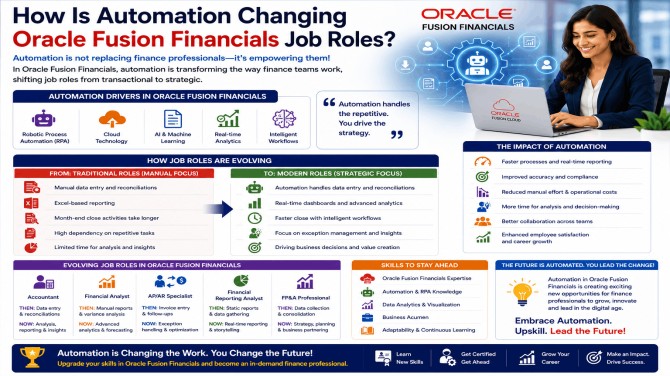


Introduction
Automation has quietly rewired how finance departments actually operate, accounting, reporting, the whole day-to-day grind. And as more companies lean into Oracle Cloud ERP, automation isn't just a side feature anymore, it's baked right into how these systems run. But here's the part that matters most for anyone building a career here: automation isn't pushing Oracle Fusion Financials professionals out the door. It's pushing them into more strategic, higher-value work instead.
Tech Leads IT built its Oracle Fusion Financials Training around exactly this reality, real Oracle Cloud ERP skills, exposure to automated workflows, and business scenarios that actually reflect how modern finance teams operate today.
If you're planning a career in this space, understanding how automation is reshaping these roles helps you focus your learning on what actually matters for the long haul.
What "Automation" Actually Means Here
In Oracle Fusion Financials, automation just means letting the system handle routine financial work with minimal manual involvement, things like invoice processing, payment approvals, bank reconciliation, journal creation, expense management, reporting, workflow approvals, and period-end closing. Less manual grind, more room for actual analysis.
Why Companies Keep Leaning Into This
Businesses are processing thousands of transactions daily, and doing all of that by hand is slow and error-prone. Automation helps by improving efficiency, cutting down manual entry, tightening accuracy, speeding up reporting, strengthening compliance, and generally making life easier for both employees and the customers and suppliers they deal with. It's become a core part of pretty much every serious Oracle Cloud ERP rollout at this point.
How This Is Actually Reshaping the Job
Manual data entry is fading out. Invoice capture, transaction matching, payment processing, and expense approvals are increasingly automated. Instead of burning hours typing numbers in, professionals now spend their time reviewing exceptions and improving processes.
Analysis is taking center stage. Reviewing financial performance, spotting trends, supporting strategic decisions, and recommending improvements, this is where the real value now lives, and it's making finance professionals genuinely more valuable to their organizations.
Functional consultants are in higher demand than ever. Companies still need people who understand both business processes and system configuration, gathering requirements, configuring modules, testing automated workflows, training users, and optimizing processes. Solid Oracle Fusion Financials Training is exactly what prepares you for this kind of work.
Reporting has gotten a lot faster. Balance sheets, profit and loss statements, cash flow reports, dashboards, budget reports, automation cranks these out quicker and more accurately, freeing professionals to actually interpret the numbers instead of just compiling them.
Financial controls have gotten smarter. Automated approval routing, payment validation, duplicate invoice detection, audit trails, compliance monitoring, professionals now oversee these systems rather than manually enforcing every rule themselves.
Will Automation Actually Replace These Jobs?
No, and this question comes up constantly. Automation replaces repetitive tasks, not skilled people. Organizations still need experts who understand financial regulations, can configure Oracle applications, interpret reports, solve real business problems, support implementations, and communicate with stakeholders. Automation boosts productivity, but human judgment is still what drives strategic decisions.
The Skills Worth Building Now
Focus on genuine business process knowledge, understanding how financial workflows actually run end to end. Sharpen your analytical thinking, since interpreting data and making recommendations is now central to the job. Keep your problem-solving sharp too, automation still throws up exceptions that need a human to sort out. Naturally, strong Oracle Cloud ERP knowledge remains non-negotiable, and communication skills matter more than ever since consultants are constantly working with finance teams and stakeholders. A well-rounded Oracle Fusion Financials Course combined with real hands-on practice is what builds all of this.
Where Automation Is Making the Biggest Difference
You'll see it across General Ledger, Accounts Payable, Accounts Receivable, Fixed Assets, Cash Management, Expense Management, Subledger Accounting, and Financial Reporting. Understanding exactly how automation supports each of these makes you genuinely valuable during any Oracle Cloud ERP implementation.
Career Opportunities Are Growing, Not Shrinking
Roles like Oracle Fusion Financial Functional Consultant, Oracle Cloud ERP Consultant, Financial Systems Analyst, ERP Functional Analyst, Finance Transformation Consultant, and Business Process Consultant are all seeing strong, steady demand as more organizations modernize their finance operations.
How Freshers Can Actually Get Ready
Start with the core modules, General Ledger, Accounts Payable, Accounts Receivable, Fixed Assets, and Cash Management. Understand why businesses actually use automated workflows, not just how they look on screen. Practice real scenarios until they feel natural. Keep your accounting fundamentals sharp. And stay current, Oracle keeps rolling out new automation features regularly.
Why Proper Training Actually Matters
A structured Oracle Fusion Financials Training program gives you expert-led instruction, real lab sessions, genuine business scenarios, exposure to automation-focused workflows, interview prep, resume help, and real placement support, the kind of preparation that actually closes the gap between theory and the job itself.
Where This Is All Headed
Automation isn't slowing down. Over the coming years, Oracle Fusion Financials professionals will keep shifting toward consulting, financial planning, business analysis, digital transformation, and process optimization. Those who keep building on accounting knowledge, Oracle Cloud expertise, and automation awareness are the ones who'll keep landing better roles and stronger pay.
Conclusion
Automation is genuinely reshaping Oracle Fusion Financials roles, cutting down manual work while opening up more strategic responsibilities. Routine tasks like invoice processing and reconciliation are increasingly automated, but demand for skilled professionals keeps climbing because human expertise still drives implementation, analysis, and real decision-making. Enrolling in Oracle Fusion Financials Training builds the practical foundation this automated environment demands, and a comprehensive Oracle Fusion Financials Course gives you the functional knowledge and hands-on confidence to build a genuinely rewarding career in Oracle Cloud ERP.








Add Comment