













Introduction
Professionals already familiar with Oracle's product ecosystem often wonder exactly how the newer cloud-based financial platform compares to Oracle E-Business Suite, the company's longstanding on-premise ERP solution. Tech Leads IT frequently addresses this exact comparison for learners and professionals trying to decide where to focus their efforts, since understanding these differences is essential before committing to Oracle Fusion Financials Training. While both products come from the same company and share some underlying financial logic, they differ significantly in architecture, user experience, and overall approach.
Understanding the Relationship Between These Two Products
Oracle E-Business Suite, often referred to as EBS, has been a widely used on-premise ERP solution for decades, while Oracle Fusion Financials represents Oracle's modern, cloud-native successor built with a fundamentally different architecture. Rather than being a simple upgrade, Fusion Financials was designed from the ground up as a cloud application, leading to meaningful differences between the two platforms.
1. Deployment Model and Infrastructure
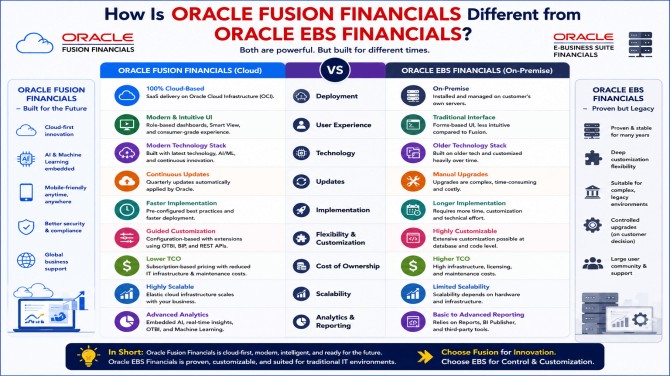
Oracle EBS is traditionally deployed on-premise, requiring organizations to manage their own servers, databases, and infrastructure, or in some cases host it through a managed cloud environment as a workaround. Oracle Fusion Financials, on the other hand, is natively cloud-based, meaning Oracle manages the underlying infrastructure directly, removing much of the maintenance burden from the organization itself.
2. User Interface and User Experience
EBS features a more traditional, form-based user interface that reflects its older technical foundation, often requiring more clicks and navigation steps to complete certain tasks. Oracle Fusion Financials offers a more modern, streamlined interface designed with contemporary user experience principles in mind, generally making it more intuitive for new users, particularly those without prior ERP exposure.
3. Update and Upgrade Approach
One of the most significant differences involves how each platform handles updates. EBS typically requires organizations to plan and execute periodic, often disruptive upgrade projects every few years. Oracle Fusion Financials instead receives regular, incremental updates delivered automatically through the cloud, eliminating the need for large, standalone upgrade projects.
4. Customization Versus Configuration
EBS implementations often involve heavy customization, sometimes modifying the underlying code to meet specific business requirements. This level of customization can make EBS systems highly tailored but also more difficult and costly to maintain over time. Oracle Fusion Financials generally emphasizes configuration over deep customization, offering flexible setup options within a more standardized framework, which simplifies long-term maintenance considerably.
5. Reporting and Analytics Capabilities
While EBS includes reporting tools, Oracle Fusion Financials offers more advanced, embedded analytics and real-time reporting capabilities as a core part of the platform. Professionals completing a comprehensive Oracle Fusion Financials Course often find these built-in analytics tools considerably more accessible and powerful compared to the reporting approach typically associated with EBS.
6. Integration With Modern Technologies
Oracle Fusion Financials is designed to integrate more naturally with modern technologies, including AI-driven automation, machine learning features, and contemporary API-based integrations. EBS, given its older architecture, generally requires more effort to connect with these newer technologies, sometimes requiring additional middleware or custom development work.
7. Total Cost of Ownership Considerations
Because EBS requires organizations to manage their own infrastructure and handle periodic upgrade projects, the total cost of ownership tends to be higher over time compared to Oracle Fusion Financials, where Oracle handles infrastructure management and updates as part of the cloud subscription model.
8. Talent Market and Career Trajectory Differences
From a career perspective, EBS expertise remains relevant for organizations that have not yet migrated away from the platform, but this segment of the job market continues to shrink gradually. Oracle Fusion Financials, being the newer and actively growing platform, offers a stronger long-term career trajectory for professionals investing in Oracle Fusion Financials Training today.
9. Skill Transferability Between the Two Platforms
Professionals with EBS experience do have some advantage when transitioning to Oracle Fusion Financials, since core accounting concepts remain consistent between the two systems. However, the underlying technical architecture, user interface, and configuration approach differ enough that dedicated training on the newer platform remains genuinely necessary rather than assuming prior EBS knowledge alone is sufficient.
Which Platform Should You Focus On
For professionals early in their careers or those specifically planning for long-term relevance, focusing primarily on Oracle Fusion Financials generally makes more strategic sense, given the platform's growth trajectory. Those already working extensively with EBS in their current roles may benefit from gradually adding Fusion Financials knowledge alongside their existing expertise, rather than abandoning their EBS background entirely.
Making an Informed Training Choice
Understanding these differences helps professionals choose the right starting point for their specific situation, whether that means enrolling in a comprehensive Oracle Fusion Financials Course focused entirely on the cloud platform, or supplementing existing EBS knowledge with targeted cloud-specific training.
Conclusion
While Oracle EBS Financials and Oracle Fusion Financials share the same corporate origin and some underlying financial logic, they differ substantially in architecture, user experience, update approach, and long-term career relevance. For professionals looking to align their skills with where the market is genuinely heading, investing in Oracle Fusion Financials Training or a comprehensive Oracle Fusion Financials Course offers a stronger, more future-focused path forward.








Add Comment