













Introduction
Every fresher eventually asks the same question, usually right before deciding whether to actually enroll in something: "Okay, but how much will I actually make?" It's a fair question. And with more companies ditching their old ERP systems for Oracle Cloud, Oracle Fusion Financials has genuinely become one of the more promising skills for someone just starting out. Pay does swing based on things like your skills, your location, whether you're certified, and who you end up working for, but the short version is: the starting packages are competitive, and the growth from there is real.
Tech Leads IT built its Oracle Fusion Financials Training specifically with freshers in mind, real project work, practical skills, and interview prep, all aimed at actually launching a career, not just handing out a certificate.
If you're on the fence about enrolling in an Oracle Fusion Financials Course, understanding what you can realistically expect to earn, and where that number can go over time, makes the decision a whole lot easier.
Why Has This Skill Suddenly Become So In-Demand?
Oracle Fusion Financials is a cloud ERP platform that handles the heavy lifting of a company's finance operations, accounting, reporting, payables, receivables, fixed assets, cash management, budgeting, all of it. As more businesses walk away from clunky, outdated ERP systems and move to Oracle Cloud, they need people who actually understand both the finance side and the Oracle side. That combination isn't as common as you'd think, which is exactly why freshers who pick this up early are finding real opportunity right now.
So, What Can Freshers Actually Expect to Earn?
If you complete an Oracle Fusion Financials Course and genuinely build strong functional knowledge, not just surface-level familiarity, you're looking at some pretty attractive entry-level numbers.
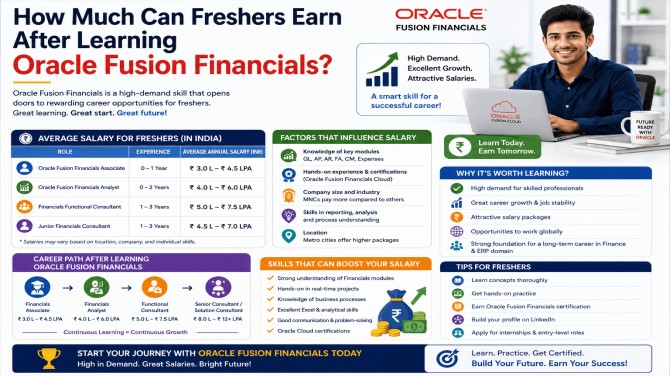
Here's a rough picture of what salaries in India tend to look like:
| Experience | Estimated Annual Salary |
| Fresher (0–1 Year) | ₹3.5 LPA – ₹6 LPA |
| 1–2 Years | ₹5 LPA – ₹8 LPA |
| 2–4 Years | ₹8 LPA – ₹12 LPA |
| Experienced Consultants | ₹12 LPA – ₹20+ LPA |
Keep in mind these are approximate ranges, and real numbers shift depending on things like:
- The size of the company
- Where you're located
- Which industry you land in
- How strong your technical skills actually are
- Whether you hold a certification
- How well you communicate
- How much real, hands-on project experience you already have
Worth noting, professionals who land roles with multinational corporations or Oracle implementation partners tend to see noticeably higher packages than average.
What Actually Moves the Needle on a Fresher's Salary
1. What You Studied Before This
If you've got a background in B.Com, M.Com, MBA Finance, BBA, Chartered Accountancy, or general Commerce, you're honestly starting a step ahead, you already speak the language of accounting.
That said, plenty of people from completely different educational backgrounds have built solid careers here too, as long as they take the training seriously.
2. How Practical Your Skills Actually Are
Here's something worth internalizing early: employers care a lot more about what you can actually do than what you can recite. Candidates who feel genuinely comfortable working inside modules like:
- General Ledger (GL)
- Accounts Payable (AP)
- Accounts Receivable (AR)
- Cash Management
- Fixed Assets
- Expense Management
tend to walk into better-paying roles than those who only understand the theory. This is exactly why the hands-on side of Oracle Fusion Financials Training matters so much, it's what actually makes you stand out when you're sitting across from an interviewer.
3. Certifications, Nice to Have, Not Mandatory
Certification won't make or break every application, but it does strengthen your resume and signals to employers that you took the learning seriously. In a competitive hiring pool, that small edge can genuinely matter.
4. How You Actually Communicate
Functional consultants aren't sitting alone coding all day, they're constantly talking to finance teams, clients, analysts, and implementation teams. Strong communication shows up in:
- How you handle client conversations
- How well you gather requirements
- The quality of your documentation
- How smoothly you work with a team
- How you come across in an interview
Employers genuinely weigh this alongside your technical knowledge, sometimes more than people expect.
5. Where You're Actually Based
Location plays a bigger role than people assume. Major IT hubs like Hyderabad, Bengaluru, Chennai, Pune, Mumbai, Noida, and Gurugram tend to offer stronger packages, largely because that's where most of the Oracle implementation partners, consulting firms, and multinational companies are concentrated.
Entry-Level Roles Freshers Actually Land
Once you've finished an Oracle Fusion Financials Course, a handful of roles open up right away:
- Oracle Fusion Financial Functional Consultant
- Oracle Cloud Financial Analyst
- ERP Functional Associate
- Oracle Financial Support Consultant
- Finance Process Associate
- Oracle Cloud Support Executive
- Junior Functional Consultant
- Financial Systems Analyst
These aren't just "starter jobs" either, they build the exact experience you'll need to move up later.
Who's Actually Hiring for This
It's not just tech companies chasing this skill. You'll find demand across:
- Information Technology
- Banking and Financial Services
- Manufacturing
- Retail
- Healthcare
- Logistics
- Telecommunications
- Education
- Consulting Services
- Government Organizations
Basically, every industry needs financial management, which is exactly why this skill stays relevant no matter where you end up working.
Skills Worth Sharpening If You Want a Higher Starting Salary
If you want to push your starting number closer to the higher end of the range, focus on building:
- Solid accounting fundamentals
- Financial reporting ability
- Comfort navigating Oracle Cloud ERP
- General Ledger
- Accounts Payable
- Accounts Receivable
- Fixed Assets
- Cash Management
- Real business process understanding
- Strong Excel skills
- Problem-solving instincts
- Analytical thinking
The wider your skill set, the more useful you look to a potential employer, plain and simple.
What Actually Improves Your Odds of a Better Offer
Actually Do the Hands-On Work
Don't just watch tutorials, work through real scenarios yourself. That difference shows up clearly in interviews.
Build a Resume That Says Something
Make sure it clearly shows the modules you've learned, real assignments you've completed, any projects, and certifications you hold.
Practice for the Interview, For Real
Run through common Oracle Fusion Financials interview questions until you can explain business processes confidently, not just recite definitions.
Stay Current
Oracle keeps rolling out new features. Staying updated shows employers you're serious, not just checking a box.
Where This Career Can Actually Take You
Oracle Fusion Financials offers a genuinely strong long-term path. A typical progression tends to look something like this:
Junior Functional Consultant → Oracle Financial Consultant → Senior Functional Consultant → Oracle Cloud ERP Consultant → Lead Consultant → Solution Architect → ERP Project Manager
As you build experience, you'll naturally move toward implementation leadership, consulting, solution design, or project management, and the pay tends to climb meaningfully at each step.
Why Proper Training Actually Makes a Difference
A good training institute doesn't just teach you the software, it makes you job-ready. That usually means:
- Trainers who've actually worked real Oracle projects
- A curriculum that reflects what's happening in the industry right now
- Practical, hands-on assignments
- Real project exposure
- Mock interviews
- Resume help
- Placement support
- Ongoing career guidance
Solid Oracle Fusion Financials Training closes the gap between what you learn in a classroom and what actually happens on a real project, and that gap is exactly what gives freshers real confidence walking into interviews and, later, into the job itself.
Conclusion
Oracle Fusion Financials has become one of the more genuinely promising paths for fresh graduates interested in finance and cloud ERP. Starting salaries will shift depending on your skills, education, location, and employer, but overall, freshers can expect solid compensation and real room to grow from there. As more businesses keep adopting Oracle Cloud ERP, the need for skilled functional consultants isn't slowing down anytime soon.
Enrolling in a comprehensive Oracle Fusion Financials Training program is a genuinely smart way to build practical skills and get comfortable with real business scenarios before you ever step into a job. And a well-structured Oracle Fusion Financials Course gives you the technical knowledge, functional skills, and confidence you'll need to land a rewarding role and start building a real career in Oracle Cloud Financials.








Add Comment