











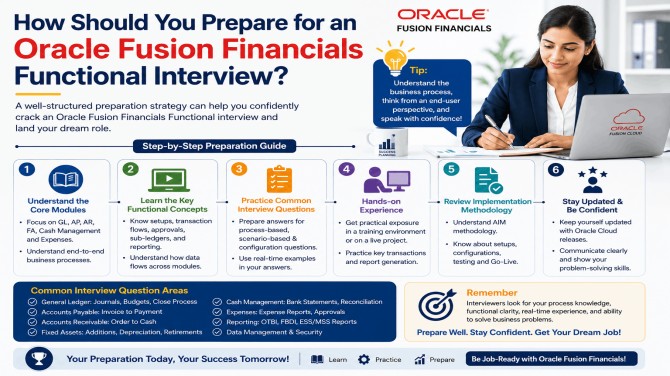


Introduction
Here's something a lot of candidates don't realize until they're already sitting in the interview: knowing the software isn't actually the hard part. What trips people up is everything around it, understanding business processes, being able to configure modules on the fly, thinking through real problems instead of textbook ones, and actually communicating like someone a client would want to work with. And with more companies adopting Oracle Cloud ERP every year, the competition for functional consultant roles has gotten noticeably tougher, which means winging it just isn't really an option anymore.
Soft Online Training built its Oracle Fusion Financials Online Training around exactly this reality, real implementation scenarios, hands-on practice, and interview prep that actually reflects what hiring managers are asking in 2026, not generic questions pulled from a decade-old question bank.
Whether you're fresh out of college, an accountant looking to pivot, or someone who's already worked ERP projects before, going in with a real strategy makes a bigger difference than most people expect.
First, Get Clear on What a Functional Consultant Actually Does
Before you even think about specific questions, make sure you genuinely understand the job. Functional consultants aren't the ones writing code, that's the technical side. Your job is sitting across the table from business users, figuring out what they actually need, and then shaping Oracle Fusion Financials to fit that need.
Day to day, that usually looks like:
- Sitting down with stakeholders to gather requirements
- Configuring the relevant financial modules
- Supporting the broader implementation effort
- Running through test scenarios
- Writing up functional documentation
- Helping users get comfortable once the system goes live
- Troubleshooting functional issues as they pop up
- Sticking around for post-go-live support
Once you can talk through this naturally, role-based interview questions stop feeling like a pop quiz.
Know the Core Modules Cold, Not Just the Definitions
Interviewers aren't usually looking for a textbook definition. They want to know you understand how these modules actually work together in a real system.
Make sure you're comfortable with:
- General Ledger (GL)
- Accounts Payable (AP)
- Accounts Receivable (AR)
- Cash Management (CM)
- Fixed Assets (FA)
- Expense Management
- Tax Management
- Financial Reporting
Skip the memorization. Focus on why each module matters in the flow of a normal business day.
Don't Skip the Accounting Fundamentals
This platform is built on top of real accounting logic, and interviewers know it. A lot of candidates get tripped up not because they don't know Oracle, but because their accounting basics are a little rusty.
Brush up on:
- Journal entries
- Chart of Accounts
- Accounting periods
- Financial statements
- Trial balance
- Debits and credits
- The invoice lifecycle
- Payment processing
- Asset depreciation
- Revenue recognition
If your accounting foundation is solid, the functional questions become a lot easier to answer with real confidence instead of guesswork.
Learn the Actual Business Processes, Not Just Module Names
This is where a lot of interviews really separate candidates. It's one thing to know what Accounts Payable does. It's another to walk someone through the entire process end to end.
Get comfortable explaining:
- Procure-to-Pay (P2P)
- Order-to-Cash (O2C)
- Record-to-Report (R2R)
- Asset Lifecycle Management
- Expense Reimbursement Process
- Cash Reconciliation
Being able to talk through these workflows naturally shows you understand how a business actually runs, not just how a screen in Oracle looks.
Get Your Hands Dirty Before the Interview, Not After
Honestly, this is probably the single biggest advantage you can walk in with. A comprehensive Oracle Fusion Financials Course that includes real hands-on labs means you've actually clicked through the screens, processed real transactions, and generated reports, rather than just watching someone else do it in a video.
Try practicing things like:
- Creating journals
- Managing supplier records
- Processing invoices
- Generating payments
- Setting up customer transactions
- Managing fixed assets
- Running financial reports
When a scenario-based question comes up, and it will, this is the practice that lets you answer with a real example instead of a vague guess.
Actually Prepare for the Questions You'll Likely Get
Interviewers tend to mix theoretical, functional, and scenario-based questions together. Expect things like:
- What is Oracle Fusion Financials?
- Walk me through the General Ledger module.
- How does Accounts Payable actually work?
- What is the Chart of Accounts, and why does it matter?
- Explain the Procure-to-Pay process from start to finish.
- What's the real difference between Payables and Receivables?
- How do you close an accounting period?
- Which reports do you rely on most in Oracle Fusion Financials?
- How would you handle a tricky client requirement?
- Tell me about a business scenario you've actually worked on.
Practice these out loud, not just in your head. It genuinely changes how confident you sound.
Understand Configuration Basics, Even as a Fresher
Nobody expects you to know every single configuration detail, especially if you're just starting out. But having a working understanding of common setup areas makes a real impression.
Get familiar with:
- Business Units
- Ledgers
- Legal Entities
- Chart of Accounts
- Calendars
- Accounting Methods
- Payment Terms
- Approval Workflows
Even a basic grasp of how these pieces fit together signals that you understand implementation, not just navigation.
Sharpen Your Communication, Not Just Your Technical Knowledge
Functional consultants spend a lot of time talking, to finance teams, project managers, business stakeholders, sometimes all in the same afternoon.
Interviewers are quietly evaluating:
- How clearly you communicate
- Whether you actually listen
- How you approach problem-solving
- How well you understand the business side, not just the tool
- How you'd handle yourself in front of a client
Practice explaining technical ideas in plain, everyday language. It's a small thing that leaves a bigger impression than people expect.
Build a Resume That Actually Holds Up Under Questioning
Your resume should clearly show:
- Which Oracle Fusion Financials modules you've learned
- Any real, hands-on projects you've worked on
- Certifications you hold
- Your finance background
- General ERP knowledge
- Both technical and functional skills
- Internship experience, if you have it
One piece of advice worth repeating: don't put anything on your resume you can't comfortably explain if asked. Interviewers will notice, and it never goes well.
Run Through Mock Interviews, Seriously
This step gets skipped more often than it should. Mock interviews are where you find the gaps before a real interviewer does.
Practice through:
- Your self-introduction
- Technical questions
- Functional, scenario-based questions
- Typical HR questions
- Walking through your problem-solving approach
- Explaining how you'd handle client communication
The more you rehearse this out loud, the less nervous you'll actually feel when it counts.
Why This Skill Set Keeps Paying Off
Companies everywhere are still pouring money into Oracle Cloud ERP to modernize how they manage finances, and that trend hasn't slowed down heading into 2026. That steady investment keeps creating real demand for people who genuinely understand Oracle Fusion Financials implementation and support.
With solid Oracle Fusion Financials Online Training behind you, roles worth targeting include:
- Oracle Fusion Financials Functional Consultant
- ERP Functional Consultant
- Oracle Cloud Financials Analyst
- Finance Systems Consultant
- Oracle ERP Support Consultant
- Business Analyst
- Implementation Consultant
The combination of real finance knowledge and cloud ERP skill is exactly what makes candidates stand out right now.
Why Learners Choose Soft Online Training
Interview prep goes a lot smoother when you've got people guiding you who've actually done this work. Soft Online Training focuses on real implementation knowledge rather than just theory you'll forget the next week.
Here's what learners get:
- Live, instructor-led sessions
- Genuine hands-on practice inside Oracle Cloud
- Real-time business scenarios instead of made-up examples
- Practical, project-based assignments
- Mock interview sessions
- Help polishing your resume
- Ongoing career guidance
- Placement support that doesn't disappear the moment class ends
The whole point is to make sure you leave with both the technical know-how and the confidence to actually use it in an interview.
Conclusion
Getting ready for an Oracle Fusion Financials Functional interview isn't about memorizing a list of answers. It's about genuinely understanding how accounting logic, ERP concepts, business processes, and hands-on system experience all fit together. Focus less on what you think they'll ask, and more on truly understanding how Oracle Fusion Financials supports real, everyday business operations.
Enrolling in Oracle Fusion Financials Online Training gives you the hands-on experience employers actually notice, while a well-structured Oracle Fusion Financials Course builds the functional foundation you'll need for implementation and consulting roles. With real guidance, practical projects, and interview-focused prep from Soft Online Training, you can walk into your next Oracle Fusion Financials interview genuinely ready, and take a real step toward a lasting Cloud ERP career.








Add Comment