











Artificial intelligence has changed the way businesses build and deliver software. Unlike traditional SaaS products that incur relatively stable operating costs, AI-powered applications generate expenses every time users interact with them. Every prompt, API request, generated image, or processed document consumes computing resources, making operating costs directly proportional to customer usage. As a result, many AI companies are replacing flat-rate subscriptions with usage-based billing models that better align revenue with actual product consumption.
Why Traditional Subscription Pricing Doesn't Work for AI
Conventional subscription pricing assumes that most customers consume similar levels of service. This approach works well when the cost of serving each customer remains fairly consistent. However, AI platforms operate differently. One customer may generate only a few thousand tokens each month, while another may process millions through automated workflows. Charging both customers the same subscription fee creates significant profitability challenges.
Usage-based pricing solves this imbalance by ensuring that customers pay according to the resources they consume. This creates a fair pricing structure for users while protecting AI providers from rapidly increasing infrastructure costs.
Understanding Usage-Based Billing
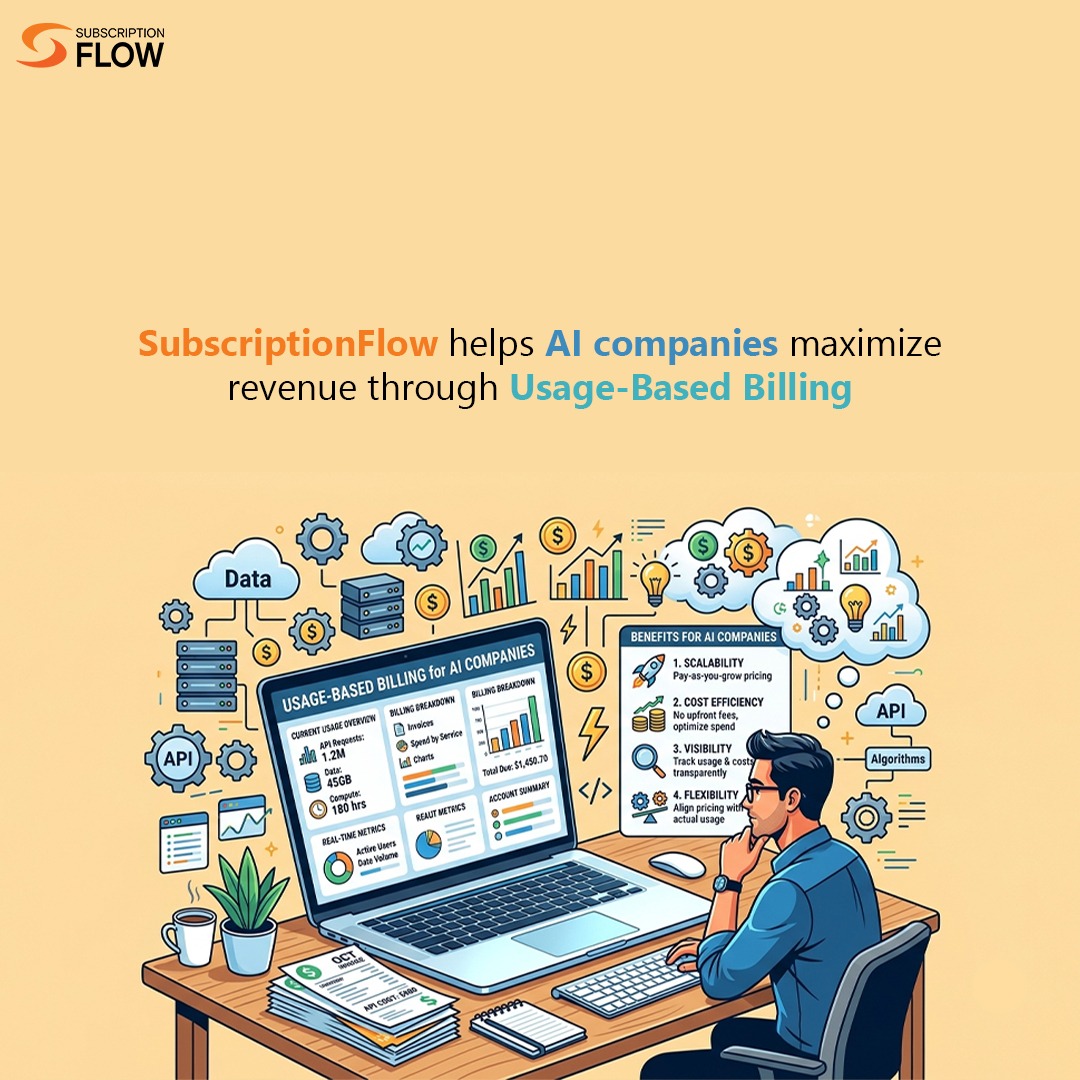
Usage-based billing calculates charges based on measurable customer activity rather than fixed monthly subscriptions. AI companies typically monitor metrics such as processed tokens, API requests, compute time, generated images, audio transcription minutes, vector database storage, or retrieval requests.
Instead of paying for access alone, customers pay for actual consumption. This allows businesses to scale costs alongside customer growth while giving users greater flexibility over their spending.
The Technology Behind Usage-Based Billing
Successful usage-based billing depends on three essential processes. The first is metering, where every customer interaction is recorded in real time. These usage events may include API calls, token counts, compute seconds, or generated outputs.
The second stage is rating, where the collected usage data is converted into billable charges according to pricing rules. Businesses can apply per-unit pricing, tiered discounts, prepaid credits, or hybrid pricing structures depending on their business model.
The final stage is invoicing, where all usage data is consolidated into customer invoices. This process also manages prepaid balances, overage fees, credits, plan changes, and billing adjustments. Together, these systems create accurate, transparent, and scalable billing operations.
Benefits of Usage-Based Billing for AI Companies
One of the greatest advantages of usage-based billing is margin protection. Since customer payments increase alongside resource consumption, businesses can better manage fluctuating infrastructure costs, including GPU expenses and model inference fees.
Usage-based pricing also lowers the barrier to entry for new customers. Instead of committing to expensive subscriptions upfront, users can begin with minimal investment and expand their usage as they experience value from the product.
Revenue growth becomes more natural as well. As customers rely more heavily on AI services, their monthly usage increases, leading to higher recurring revenue without requiring frequent pricing negotiations or subscription upgrades.
Another significant benefit is the visibility gained through detailed usage analytics. Companies can understand which features generate the highest engagement, identify expansion opportunities, and proactively address customer behavior that may lead to churn.
Finally, usage-based pricing prevents heavy users from consuming excessive computing resources while paying the same amount as light users. This creates a healthier and more sustainable revenue model.
Popular Pricing Models Used by AI Companies
Many AI businesses combine usage-based billing with predictable subscription models. One common approach includes a monthly subscription that covers a predefined usage allowance, with additional consumption billed separately as overages.
Others implement prepaid credit systems where customers purchase credits in advance and redeem them as they use AI services. Credits may apply to token generation, image creation, document processing, or other AI capabilities.
Tiered pricing is another widely adopted model. Customers receive lower per-unit pricing as their usage volume increases, encouraging long-term growth and higher customer retention.
Many enterprise AI platforms also use hybrid pricing models that combine user-seat subscriptions with usage-based billing for advanced AI features. This approach balances predictable recurring revenue with flexible customer expansion.
Why Billing Infrastructure Matters
Implementing usage-based pricing requires much more than simply measuring customer activity. AI companies need robust billing infrastructure capable of collecting usage data, calculating complex pricing rules, generating invoices, processing payments, and integrating with accounting systems.
Without reliable billing automation, businesses risk inaccurate invoices, lost revenue, customer disputes, and significant operational overhead. As AI adoption accelerates, billing infrastructure has become a strategic competitive advantage rather than simply an administrative necessity.
Supporting AI Monetization with SubscriptionFlow
SubscriptionFlow helps AI businesses implement sophisticated usage-based billing without building complex billing systems from scratch. The platform supports real-time usage metering, flexible pricing models, automated invoicing, payment collection, and revenue recognition.
Organizations can accurately bill customers based on tokens, API requests, GPU processing time, generated outputs, storage usage, or any custom metric while maintaining complete pricing transparency through customer billing portals and automated reporting.
By combining flexible pricing capabilities with enterprise-grade billing automation, SubscriptionFlow enables AI companies to align customer value, infrastructure costs, and long-term revenue growth.
Conclusion
As artificial intelligence continues reshaping software delivery, pricing strategies must evolve alongside technological innovation. Usage-based billing offers AI companies a practical way to match revenue with actual customer consumption while improving profitability, customer satisfaction, and business scalability. Organizations that invest in flexible billing infrastructure today will be better positioned to support sustainable growth as AI usage continues to expand.








Add Comment