













Introduction
Anyone who's been in finance long enough has watched at least one "essential" system get replaced within a decade, taking a chunk of specialized expertise down with it. Soft Online Training has spoken with countless finance professionals who ask some version of the same question before committing to new skills: will this still matter in five years, or am I about to specialize in something that quietly disappears? With Oracle Fusion Financials Online Training showing up in more enterprise environments every year, it's worth actually digging into whether the platform and the skills built around it have real staying power.
What "Future-Proof" Actually Means in This Context
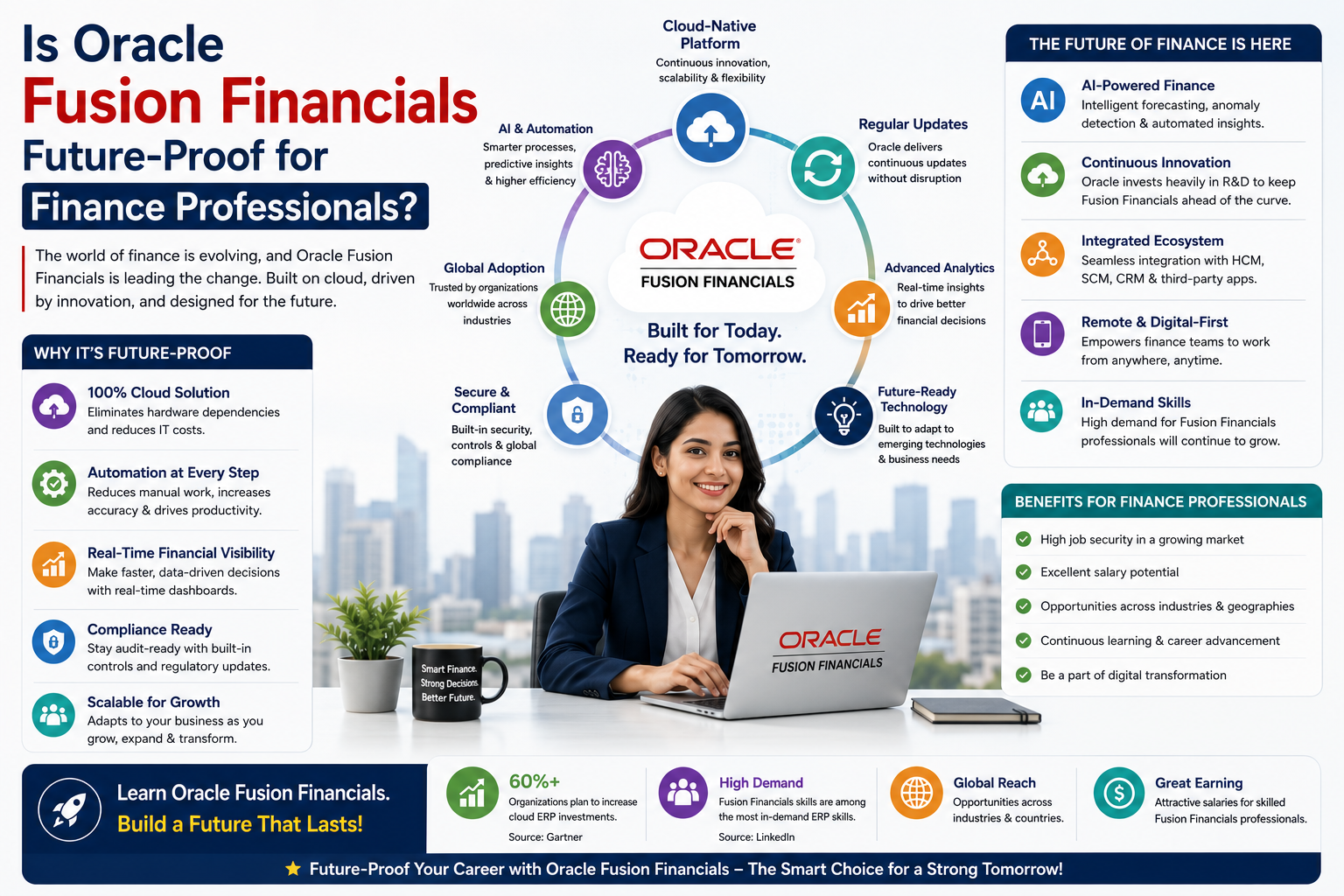
No software platform lasts forever in its exact current form, so future-proof doesn't mean permanent. It means the underlying skills and concepts stay valuable even as the interface, features, and integrations evolve around them. Oracle Fusion Financials was built as a cloud-native platform from the start, which already puts it ahead of the legacy systems it's replacing, since Oracle pushes continuous updates rather than forcing customers through disruptive, multi-year upgrade projects.
That update model matters more than people realize. When a platform evolves gradually instead of getting replaced wholesale, the people who understand its architecture, configuration logic, and reporting structure tend to stay relevant across each update cycle, rather than having to relearn an entirely new system every few years.
Why Enterprise Adoption Keeps Growing
Large organizations don't switch core financial systems casually the migration cost, risk, and disruption are significant, which means once a company commits to Oracle Fusion Financials, it tends to stay on that platform for a long time. As more enterprises retire aging on-premise ERP systems and move toward unified cloud platforms, Fusion Financials keeps showing up as one of the leading choices, particularly for organizations already using other Oracle products.
This steady, sustained adoption is exactly why the demand for skilled professionals hasn't leveled off. It's not a short burst tied to one migration wave it's an ongoing need for people who can implement, support, and continuously optimize these systems as they mature.
The Professionals Who Benefit Most
Finance professionals who understand both accounting principles and system configuration are in a genuinely small pool right now. Plenty of accountants know the numbers cold but have never touched the configuration side of an ERP. Plenty of IT consultants know cloud platforms broadly but lack real financial process knowledge. The overlap between those two skill sets is where the real opportunity sits.
Building that overlap is exactly what a structured Oracle Fusion Financials Course is designed to do. Rather than treating the platform as a black box, good training walks through ledger design, tax setup, intercompany transactions, and period-close workflows in enough depth that professionals can actually troubleshoot and optimize the system, not just click through familiar screens.
Learning at a Pace That Matches Real Careers
Most finance professionals considering this path aren't free to drop everything and attend a classroom program for weeks at a time. This is where a well-designed Oracle Fusion Financials Online Training program becomes genuinely practical rather than just convenient. It allows someone to build real expertise around an existing job, applying new concepts in real time if they're already working with financial systems, and progressing at a pace that fits their actual schedule instead of an artificial one.
This matters because skill-building that happens gradually and consistently tends to stick better than information crammed into a short, intense course. Career changes rarely happen in one clean block of free time they happen in the margins of an already busy life, and training built around that reality tends to produce professionals who genuinely retain what they learned.
Where This Expertise Leads
Professionals who commit to learning Fusion Financials properly tend to move into roles like financial systems analyst, ERP functional consultant, finance transformation specialist, or implementation lead. Some stay within one organization and grow alongside the system as it's upgraded and expanded over the years. Others move into consulting, gaining exposure to a wider range of implementations and industries at a faster pace.
Consulting firms in particular look for candidates who've completed a real Oracle Fusion Financials Course, since clients expect consultants to be productive almost immediately, not spend the first few months learning on the client's dime. The professionals who stand out combine formal training with genuine hands-on practice rather than relying on theoretical knowledge alone.
The Honest Caveat
None of this guarantees an easy path. Oracle Fusion Financials is a complex platform, and shallow, surface-level knowledge won't hold up under real project pressure. Interviewers and project leads can usually tell within minutes whether someone has actually configured a system or just watched a few demo videos.
That's precisely why the depth of training matters. A rushed course might look fine on a resume, but a properly structured Oracle Fusion Financials Online Training program that includes hands-on scenarios tends to produce far more capable, far more employable professionals.
Conclusion
No platform comes with a lifetime guarantee, but Oracle Fusion Financials is built on a model cloud-native architecture, continuous updates, and growing enterprise adoption that's genuinely aligned with where finance technology is heading. For professionals willing to invest the time, completing a solid Oracle Fusion Financials Course or a flexible Oracle Fusion Financials Online Training program isn't a bet on a passing trend. It's a reasonable, well-grounded move toward where the demand is clearly going.








Add Comment