













Introduction
Given how crowded the ERP space has become, it's reasonable to wonder whether Oracle Fusion Financials actually deserves its current reputation, or whether it's just riding a temporary wave of attention. Tech Leads IT fields this question repeatedly from people trying to decide where their time and effort are best spent, and it deserves a genuine, honest answer rather than a promotional one. This article takes a clear-eyed look at whether Oracle Fusion Financials Course truly stands up as a long-term ERP skill, or whether the current momentum is more short-lived than it seems.
There's no easy one-line answer here. It really comes down to how the platform continues developing, where cloud ERP adoption is trending next, and whether the fundamentals taught today will still carry weight five or ten years from now. Let's go through the signals that actually matter.
Cloud ERP Adoption Is a Permanent Shift, Not a Trial Run
One of the strongest signs pointing toward Oracle Fusion Financials' lasting relevance is simply how committed businesses already are to cloud-based ERP overall. Companies that moved off legacy systems like Oracle EBS or SAP ECC show no interest in going back to on-premise setups. Cloud-first has settled in as the standard way of operating, not a phase companies are testing out, and Oracle Fusion sits among the platforms leading that push.
This kind of long-term, structural commitment is exactly why structured Oracle Fusion Financials Training keeps drawing in new learners rather than fizzling out like a passing fad. Unlike quick-moving tech trends, ERP adoption ties companies to a platform for years, often decades, once the migration is finished.
The Platform Is Maturing, Not Just Growing
Oracle isn't adding features to Fusion Financials purely to look up-to-date. Recent development has leaned heavily into AI-supported reconciliation, predictive cash flow forecasting, and automated period-close processes real improvements that meaningfully reduce manual work for finance teams. This kind of deliberate, functional evolution suggests the platform is actively maturing rather than sitting idle, which matters a great deal when judging whether a skill will still hold value years down the road.
That's exactly why a solid Oracle Fusion Financials Course built today looks noticeably different from one designed even three or four years ago. Training providers are actively incorporating these newer capabilities into their material, which keeps learners aligned with where the platform is genuinely going rather than where it used to stand.
Core Financial Skills Don't Really Expire
Unlike niche technical skills tied to one particular tool or short-lived trend, financial operations are a permanent part of running any business. General Ledger, Payables, Receivables, Fixed Assets, and Cash Management aren't going anywhere, regardless of which ERP platform a company ends up choosing. That gives Oracle Fusion Financials a kind of durability that purely technical or highly specialized ERP skills simply don't share.
Because the underlying financial concepts hold steady even as Oracle updates its interface and feature set, professionals who commit to real Oracle Fusion Financials Training end up with knowledge that transfers well, even if they later move to different systems or newer platform versions.
Competing ERP Systems Aren't Really an Existential Risk
There's a common concern that platforms like Workday, NetSuite, or SAP S/4HANA could eventually push Oracle Fusion aside entirely. In reality, the ERP market is large enough to comfortably support multiple major players at once, with each platform generally dominating particular industries or company sizes rather than competing head-to-head for every single account.
Oracle Fusion continues to hold strong ground with large enterprises and mid-market businesses specifically transitioning away from EBS, which keeps demand for Oracle Fusion Financials Course graduates fairly well insulated from broader shifts happening elsewhere in the ERP world. Rather than one system dominating everything, several ecosystems are likely to keep operating side by side well into the future, each needing its own supply of trained professionals.
The Skills Shortage Isn't Closing Anytime Soon
Even with growing interest in Oracle Fusion Financials, the pool of genuinely qualified professionals still falls short of what employers actually need in most regions. Some of this gap comes from how often the platform updates, requiring even experienced professionals to keep refreshing their skills, and some of it comes from training quality lagging behind how quickly the platform itself moves forward.
That persistent shortage is genuinely encouraging for anyone currently weighing Oracle Fusion Financials Training rather than delaying it further. Professionals who get in early and learn the platform properly tend to land in a much stronger competitive position than those who wait until the field becomes more saturated.
What Separates a Truly Future-Ready Course
Given how much the platform keeps shifting, not every training program equips learners equally well for what's coming next. A genuinely future-focused Oracle Fusion Financials Course should ideally include:
- Regular coverage of Oracle's quarterly updates instead of stale, outdated content
- Practical, hands-on exposure to newer AI and automation tools
- A curriculum connecting Financials to adjacent modules for broader career flexibility
- Scenario-based, applied learning rather than theory alone
Programs designed with these priorities in mind tend to produce professionals who remain relevant long after their initial certification, instead of needing to relearn the platform from scratch every couple of years.
Final Verdict
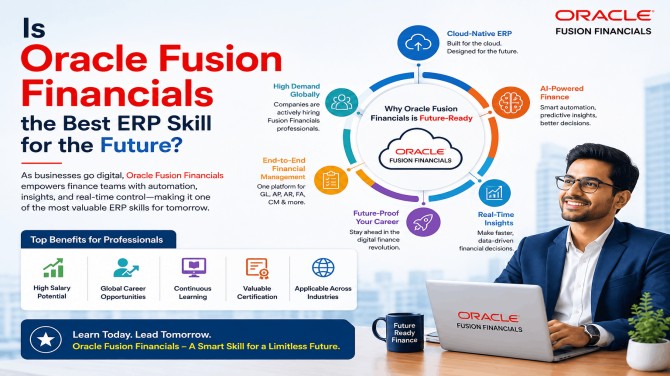
So, is Oracle Fusion Financials truly the best ERP skill for the future? All signs point toward yes as long as learners commit to staying current rather than treating certification as a one-time milestone. Cloud ERP adoption shows no signs of slowing down, the platform keeps genuinely advancing rather than standing still, and core financial skills stay permanently relevant regardless of which specific system a company eventually runs.
For anyone trying to decide where to focus their learning efforts, a strong Oracle Fusion Financials Training program, supported by a well-structured Oracle Fusion Financials Course, remains one of the more future-secure investments available in today's ERP landscape.








Add Comment