











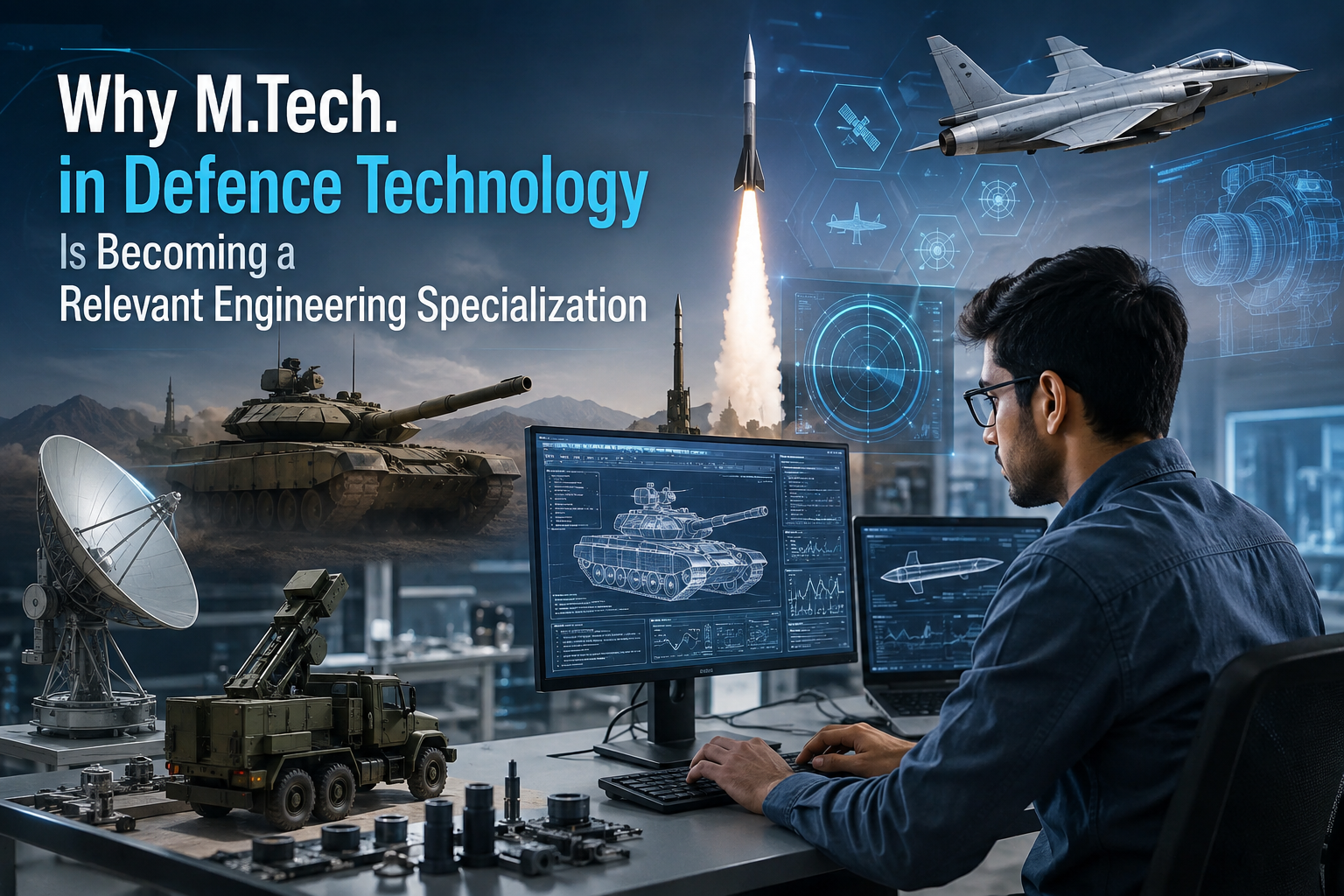


Defence technology is becoming increasingly dependent on advanced engineering. Modern defence systems bring together aerospace, mechanical engineering, electronics, communication systems, sensors, materials and other specialized technologies. As India strengthens its domestic defence and aerospace capabilities, engineers with advanced technical and research skills are becoming increasingly important.
An M.Tech. in Defence Technology provides engineering graduates with an opportunity to specialize in technologies related to defence systems while gaining exposure to research, experimentation and industry-oriented projects.
The Growing Importance of Defence Engineering
The defence sector has changed significantly with the development of advanced aerospace platforms, intelligent sensors, sophisticated communication systems and modern combat vehicles. These systems require engineers who can understand complex technologies and contribute to their design, development, testing and improvement.
India is also strengthening its indigenous defence manufacturing and research ecosystem. Government organizations, research laboratories, public-sector organizations, academic institutions and private companies are increasingly involved in defence technology development.
This environment creates opportunities for engineering graduates who want to build specialized expertise in defence-related technologies.
What Is an M.Tech. in Defence Technology?
An M.Tech. in Defence Technology is a postgraduate engineering programme that focuses on advanced technologies and their applications in defence and aerospace.
The programme at Kumaraguru College of Technology (KCT) is a joint initiative associated with AICTE and DRDO and supports the development of engineers for defence research, public-sector organizations and private defence and aerospace industries. The programme is structured as a two-year, four-semester postgraduate course with a combination of academic learning, laboratory work, dissertation and industrial training.
The programme provides students with an opportunity to move beyond general engineering knowledge and develop expertise in specific defence technology areas.
Specializations Available
Defence technology covers multiple engineering disciplines. At KCT, the programme currently lists specializations in Combat Vehicle Engineering, Aerospace Technology, and Communication Systems and Sensors.
Combat Vehicle Engineering
Combat vehicles require advanced knowledge of mechanical systems, vehicle dynamics, structures, materials and related engineering technologies.
This specialization can be relevant for engineers interested in the development and analysis of advanced defence vehicle systems. It brings together engineering concepts that can be applied to mobility, structural performance and vehicle-related defence applications.
Aerospace Technology
Aerospace technology is closely connected with modern defence systems. Aircraft and other aerospace platforms require expertise in areas such as aerospace system design, propulsion, guidance and control, structures and simulation.
Students interested in aerospace and defence research can use this specialization to build deeper technical knowledge and develop research capabilities in aerospace-related applications.
Communication Systems and Sensors
Communication and sensor technologies play an important role in modern defence systems.
Communication systems enable information exchange, while sensors support functions such as detection, monitoring and data collection. Engineers working in this area need knowledge of electronics, communication technologies, instrumentation and signal-related systems.
This specialization can therefore be relevant to graduates from electronics, communication, electrical and instrumentation backgrounds.
Learning Through Research and Practical Exposure
Postgraduate engineering education can become more meaningful when students have opportunities to apply theoretical concepts to practical engineering problems.
According to KCT, the M.Tech. in Defence Technology curriculum and syllabi are designed by DRDO in collaboration with AICTE. Courses are also handled jointly by working and superannuated DRDO scientists, while laboratory courses are conducted in coordination with relevant DRDO laboratories and industries.
The programme also includes dissertation and industrial training during the later semesters. Project phases can be carried out at selected DRDO laboratories, DRDO-established Centres of Excellence, DIAT Pune, PSUs and private defence industries depending on the dissertation topic.
This type of exposure can help students understand the practical challenges involved in defence technology development.
Skills Students Can Develop
A specialized postgraduate programme can help students develop both technical and research-oriented capabilities.
Advanced Technical Knowledge
Students can gain deeper knowledge in their chosen specialization and understand how engineering principles are applied to defence systems.
Research Skills
Dissertation work provides an opportunity to identify technical problems, study existing solutions, conduct experiments and analyze results.
Systems Thinking
Defence platforms are rarely based on a single technology. Multiple subsystems often need to operate together. Understanding these relationships can help engineers approach complex problems from a system-level perspective.
Practical Problem-Solving
Laboratory courses and project work provide opportunities to apply engineering theory to practical situations.
Technical Documentation
Research projects require students to prepare reports, presentations and technical documentation, strengthening their ability to communicate engineering findings.
Who Can Consider M.Tech. in Defence Technology?
Defence technology is multidisciplinary, which means graduates from several engineering backgrounds may be eligible to pursue the programme.
The KCT programme information lists disciplines including Aerospace Engineering, Aeronautical Engineering, Mechanical Engineering, Mechatronics Engineering, Electrical and Electronics Engineering, Electronics and Communication Engineering, Computer Science and Engineering, Instrumentation Engineering, Metallurgical and Materials Engineering, Telecommunication Engineering and several other related disciplines.
Students should check the latest official admission and eligibility requirements before applying, as programme regulations may be updated.
Career Opportunities
An M.Tech. in Defence Technology can provide a foundation for careers across different areas of the defence and aerospace ecosystem.
Possible career areas include:
- Defence research and development
- Aerospace engineering
- Combat vehicle engineering
- Communication systems
- Sensor technology
- Defence manufacturing
- Systems engineering
- Product development
- Testing and validation
- Defence public-sector organizations
- Private aerospace and defence industries
- Research institutions
- Higher education and doctoral research
Career opportunities will depend on the candidate's specialization, technical skills, project experience and the eligibility requirements of individual organizations.
India's Defence Technology Ecosystem
India's defence sector includes a combination of government research organizations, defence laboratories, public-sector companies, private industries, startups and academic institutions.
The focus on domestic research and manufacturing is also increasing the need for engineering capabilities within the country. The KCT programme notes that India's aerospace and defence ecosystem is being supported by initiatives such as Defence Industrial Corridors in Tamil Nadu and Uttar Pradesh.
For engineering graduates, this creates a broader environment in which specialized knowledge can be applied to research, manufacturing, product development and technology deployment.
Why Specialized Postgraduate Education Matters
A bachelor's degree provides fundamental engineering knowledge, while postgraduate education allows students to develop deeper expertise in a particular area.
For students interested in defence applications, an M.Tech. in Defence Technology can provide a structured pathway into specialized areas such as aerospace systems, combat vehicles, communication technologies and sensors.
The combination of classroom learning, laboratory activities, research projects and industrial exposure can help students build a stronger understanding of advanced engineering applications.
Conclusion
Defence technology is becoming increasingly multidisciplinary and technology-driven. Engineers working in this sector need to understand complex systems and apply their technical knowledge to challenging problems.
An M.Tech. in Defence Technology can help engineering graduates develop specialized knowledge while gaining research and practical exposure relevant to defence and aerospace applications.
For students interested in advanced engineering, research and technology development, defence technology offers a specialized postgraduate pathway that connects academic learning with the evolving needs of India's defence and aerospace ecosystem.








Add Comment