











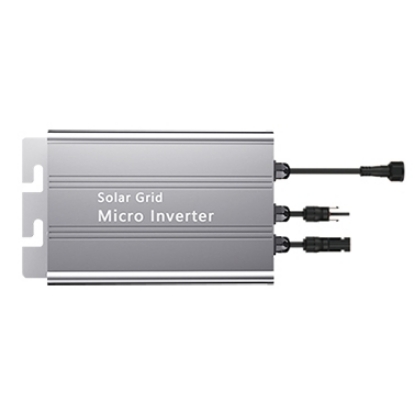


A micro inverter is a device used in photovoltaic power generation systems that converts direct current generated by a single solar module to alternating current, with power ratings generally below 1500W and featuring module-level maximum power point tracking .
Unlike traditional centralized inverters, micro inverters are relatively small and invert each component individually. Its advantage is that each component can be independently controlled by MPPT, which can greatly improve the overall efficiency. At the same time, micro inverter can also avoid the DC high voltage, poor light effect, and wooden barrel effect of the centralized inverter .
The power conversion process involves four key steps. The process begins with the DC-DC converter. The voltage output from a solar panel can vary widely depending on the amount of sunlight and the load connected to the panel. The DC-DC converter stabilizes this voltage to a level suitable for the inverter circuit. This stabilization is achieved through techniques such as buck (step-down) or boost (step-up) conversion. The goal is to ensure that the inverter receives a consistent input voltage, which is crucial for efficient operation .
Once the DC voltage is stabilized, the inverter circuit converts it to AC. This conversion is typically performed using a full-bridge or half-bridge inverter topology, where semiconductor switches are rapidly turned on and off to create an AC waveform. The switching frequency is often several kilohertz, and the resultant waveform is a series of pulses that approximate a sine wave .
The raw AC output from the inverter circuit is not suitable for direct use because it contains high-frequency components due to the switching process. A filter composed of inductors and capacitors smooths out these components, resulting in a clean sine wave that can be used by AC appliances or fed into the grid .
The final step involves synchronization and control. The inverter must synchronize its output with the frequency and phase of the grid to ensure seamless integration. The controller manages this process, adjusting the phase and frequency of the inverter's output as necessary. Additionally, the controller implements MPPT algorithms to maximize the power harvested from each solar panel, adapting to changing environmental conditions to optimize performance .
For the design of micro inverters, forward and flyback converters are still the most commonly used DC/DC conversion topologies. Silicon controlled rectifiers (SCR) or MOSFET full bridges are used to generate AC waveforms at the required grid frequency. The interleaved active clamp flyback inverter can increase the low-voltage DC voltage of the solar panel and the high-voltage AC waveform required by the power grid .
In terms of safety, in the traditional PV system, the PV cell at DC side is connected in series and can form a high-voltage DC bus of 200V-600V or even higher voltage. The workers are faced with high electricity shock risk in the installation process. In addition, due to the insulation damage or poor contact of related connectors, the DC arc may be caused, which may cause fire disaster or personal injury because the arc temperature can reach thousands of degree .
In the micro inverter system, each PV module is connected with the inverter separately. In this way, the highest DC voltage of the system is the open circuit open of the PV cell, which is about 40V. The installation and application are both safe and there is no electricity shock, current arc and fire risk. It essentially solves the problems caused by the high-voltage DC of the traditional system .
The micro grid inverter is equipped with high-frequency isolation transformer, which can effectively separate the power grid and PV side when system failure occurs. When checking the power grid failures, the PV side is in low voltage status and is isolated. When checking the PV side failures, the AC voltage will not lead to DC electrification .
Regarding system efficiency, in the microinverter system, each module is connected with the inverter separately, which can avoid the PV cell coupling and thus avoid the short board effect. When some PV modules are blocked or damaged, the power generation function of left system modules will not be affected. It can greatly improve the shadow resistance ability and the environment adaptability of the system. Based on the American research results, it can be seen that compared with traditional system, the efficiency of micro inverter system can improve 15% or even higher in the shadow condition .
Due to the small component MPPT, the control speed and response speed of the system can reach 10 millisecond, which is tens or even hundreds of times of traditional inverter. Therefore, in cloudy weather or other situations with fast sunlight change, the efficiency of the micro inverter is 1-2% higher than the traditional inverter. The work efficiency of the micro inverter system can reach 90% and it is difficult for the traditional system to reach this level .
Micro inverters offer greater flexibility in the design and expansion of solar power systems. Since each panel operates independently, system designers can mix and match panels of different sizes and types without worrying about compatibility issues that typically arise in string inverter systems. This flexibility also extends to system expansion. Homeowners can start with a smaller system and easily add more panels and micro inverters as their energy needs grow or as their budget allows, without the need to replace the existing inverter .
The distributed nature of solar power micro inverter systems contributes to higher overall reliability. In a string inverter system, the failure of the inverter can bring down the entire system's production. However, in a micro inverter system, the failure of a single inverter only affects the output of the associated panel, leaving the rest of the system intact and operational. This distributed architecture not only improves reliability but also simplifies repair processes, as only the faulty inverter needs replacement rather than a central unit .
The data collector can collect the micro inverter data through wireless method and can upload to the server so that operation and maintenance staff as well as the owner can monitor the network situation. The solar micro inverter allows to monitor the situation of each component so as to know about the PV panel property. When the PV battery damage is found, it can be located accurately and can be changed in time. The problems that component damage and failure cannot be found out and located in time in traditional system can be solved, which makes the system operation and maintenance easier and can decrease the cost by 50% .
While solar micro inverters typically have a higher initial cost compared to string inverters, the long-term benefits can outweigh this upfront investment. The improved energy harvest, lower maintenance costs, enhanced safety, and increased system reliability contribute to a lower total cost of ownership over the system's lifespan .
Recent advancements have further enhanced the capabilities and efficiency of micro inverters. Modern micro inverters employ sophisticated MPPT algorithms that can rapidly and accurately track the optimal operating point of each panel, even under rapidly changing environmental conditions. Micro inverters are increasingly being designed to integrate with smart grid technologies, allowing for more efficient energy distribution and better grid stability. Advances in wireless communication technologies have enhanced the ability of smart micro inverters to transmit data, enabling more efficient monitoring and control of solar power systems .








Add Comment