











Overview
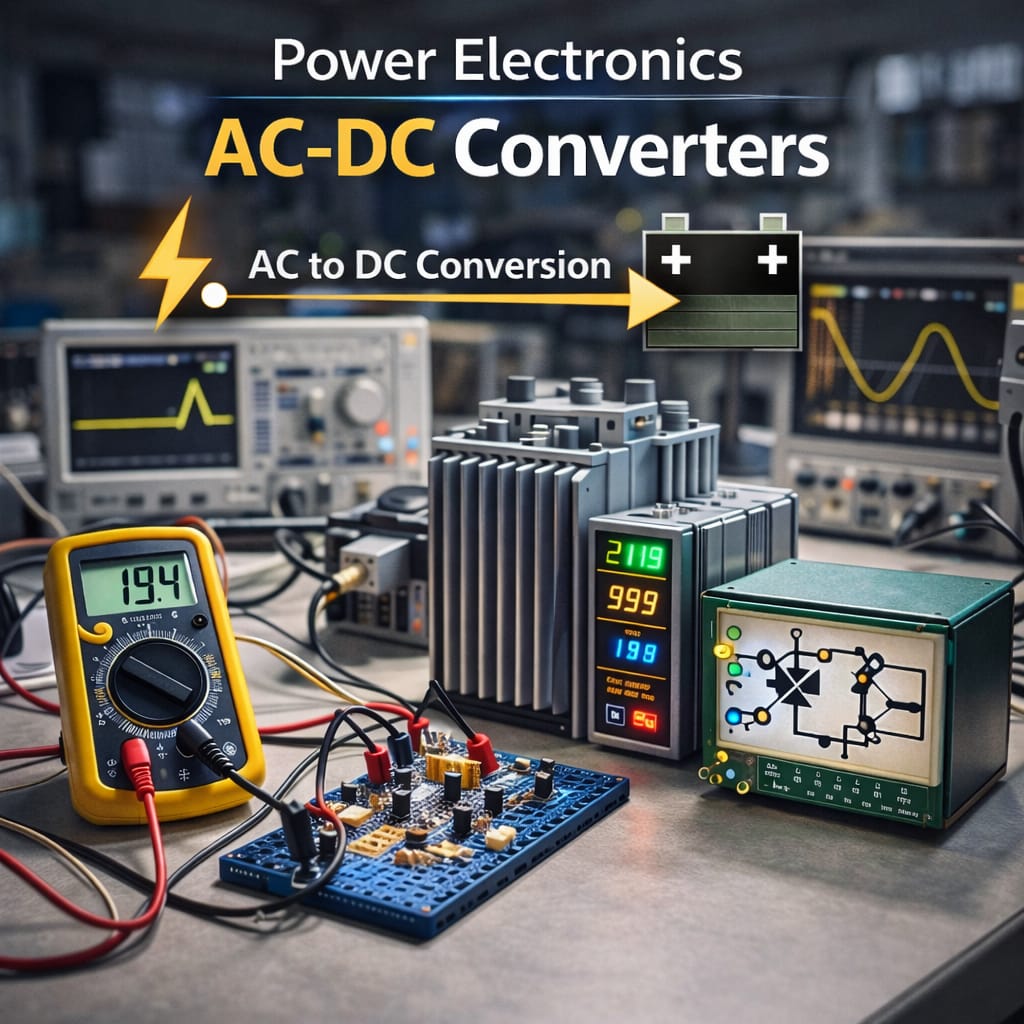
Power conversion is an essential part of modern electrical and electronic systems. One of the most important conversion techniques is transforming alternating current (AC) into direct current (DC). This is achieved using Power Electronics AC-DC Converters, which are widely used in both small electronic devices and large industrial applications.
For engineering students, understanding these converters is important not only for academics but also for real time project development and industry knowledge.
Understanding AC-DC Conversion
AC-DC converters, also known as rectifiers, are circuits that convert AC input into DC output. Since most electronic systems operate on DC power, these converters are widely used in power supplies, battery charging systems, and motor control applications. The output can be either fixed or controllable based on the converter design.
Types of AC-DC Converters
Diode-Based Rectifiers
These converters use diodes and do not provide control over the output voltage. They are simple, reliable, and mainly used in basic applications. Full wave and bridge rectifiers offer better efficiency compared to half wave rectifiers.
Thyristor-Based Converters
These use SCRs to control output voltage by adjusting the firing angle. They are widely used in industrial applications where controlled power is required.
Hybrid Converters
These combine diodes and thyristors to provide partial control while maintaining cost efficiency. They are suitable for moderate-level applications.
Working Principle
AC input is applied to the converter, and semiconductor devices allow current to flow in only one direction. This results in pulsating DC output. Filters such as capacitors and inductors are used to smooth the output and provide stable DC power.
Importance for Students
This topic is a core concept in power electronics and is frequently asked in exams and interviews. It also helps students understand advanced topics like inverters and SMPS. Learning AC-DC converters enables students to develop practical skills and work on real-time projects, improving career opportunities.
Applications
- Used in power supply units to convert AC into stable DC for operating electronic devices like computers and communication systems
- Used in battery charging systems to ensure safe and efficient conversion for charging batteries
- Used in electric vehicles for charging and energy management applications
- Used in industrial motor drives to control speed and performance of DC motors
- Used in renewable energy systems like solar power for efficient energy conversion and storage
- Used in telecommunication systems to provide reliable and continuous DC power
Project Opportunities
- Designing rectifier circuits to understand AC-DC conversion practically
- Developing battery charging systems with improved efficiency
- Implementing power factor correction techniques
- Creating microcontroller-based smart converters
- Building renewable energy-based conversion systems
Conclusion
Power Electronics AC-DC Converters are essential in modern electrical systems. They play a key role in converting AC into usable DC power for various applications. For students, mastering this topic helps in academics, project development, and building a strong career in electrical and electronics engineering.








Add Comment