












Introduction
Emails are becoming one of the most crucial ways that people and businesses can communicate. Users frequently move email platforms over time in order to enhance mailbox management, security, and efficiency. Emails are stored in EML format by numerous email clients, including Outlook Express, Thunderbird, Windows Live Mail and eM Client. But because Outlook stores mailbox data in PST files, EML to PST conversion is required.
Users can view their previous emails immediately in Outlook by exporting EML files into PST format, preserving important data. Attachments, formatting, metadata, and folder hierarchy are all preserved during the conversion process, which guarantees seamless Outlook email administration.
Even if there are various manual migration techniques, they can be difficult and time-consuming, particularly for users who have big email databases. Automated solutions streamline the procedure and assist users in safely and effectively completing the migration.
This article shows the benefits of using an automated solution for exporting EML files into PST format, explains the rationale behind EML to PST conversion, and addresses the drawbacks of manual techniques.
Understanding EML and PST File Formats
It's important to understand the fundamentals of EML and PST file formats before beginning the migration process.
An EML file is what?
One file format for storing individual emails is EML. It includes comprehensive email details, such as:
The subject line
Sender and recipient information
The attachments
The hyperlinks
Time and date
The body of an email
EML files are supported by a number of email programs, including:
Live Mail on Windows
Thunderbird Mozilla
The Outlook Express
eM Customer
The SeaMonkey
Managing thousands of EML files can be challenging because each email is saved independently.
What is a PST File?
PST stands for Personal Storage Table. It is the primary file format used by Microsoft Outlook to store mailbox data such as:
- Emails
- Contacts
- Calendars
- Notes
- Tasks
- Journals
Unlike EML files, PST stores all mailbox information in a single organized database, making email management easier and more efficient.
Why Users Require Converting EML to PST?
Users may need to export EML files into PST format in a number of scenarios.
Using Microsoft Outlook instead
Because of its advanced features, enhanced security and compatibility with Microsoft Office programs, Outlook is preferred by many professionals and businesses. To view their emails in Outlook, users switching from email programs that support EML must have PST files.
Improved Email Management
Managing thousands of separate EML files might be challenging. Users may handle all mailbox data in a single, central file thanks to the PST format.
Extended-Term Email Storage
PST files are frequently used for backup and email archiving. They provide a dependable method of keeping crucial communication documents.
Needs for Business Migration
Employee mailboxes are frequently moved to Outlook by organizations when platforms or systems are upgraded. In these situations, converting EML to PST becomes crucial.
Enhanced Accessibility
Instead of using different email programs, PST files enable users to open and manage emails directly in Outlook.
How to Export EML Files to PST Manually
Some users try migrating from EML to PST manually. These methods typically entail using a different email client to import EML files into Outlook.
Method of Drag-and-Drop
Dragging EML files straight into Outlook folders is a popular technique. For a limited number of files, this method might be effective but for huge migrations, it becomes unfeasible.
Using Live Mail on Windows
EML files can also be manually imported into Windows Live Mail and then exported to Microsoft Outlook.
Despite their seeming simplicity, these techniques have a number of disadvantages and hazards.
Difficulties in Manually Converting EML to PST
Large email databases are particularly inappropriate for manual migration techniques.
Process That Takes Time
Manually importing EML files takes a lot of time and work, especially when dealing with thousands of emails.
Bulk conversion is not supported.
The majority of manual techniques necessitate that people handle emails one at a time, which adds to the workload and slows down migration.
Risk of Data Loss
During manual conversion, attachments, formatting, information and folder structure can be changed or lost.
Technical Intricacy
Technical expertise and properly configured numerous email programs are frequently necessary for manual techniques.
Maintaining Folder Hierarchy Can Be Difficult
It can be challenging to maintain the original email folder structure when using manual migrating techniques.
Reliance on External Programs
Certain manual methods rely on installing Outlook or Windows Live Mail, which could lead to compatibility problems.
For a safer and more effective migration process, many users opt for automatic conversion software due to these constraints.
Automated EML to PST Conversion Solution
One of the simplest and most dependable ways to export EML files into PST format is to use a professional conversion program. Automated program keeps all email data while making migration easier.
The SameTools EML to PST Converter is a reliable tool that enables users to easily and safely convert EML files into Outlook PST format.
Features of an Automated Converter from EML to PST
A number of cutting-edge capabilities provided by professional migration tools streamline the conversion process.
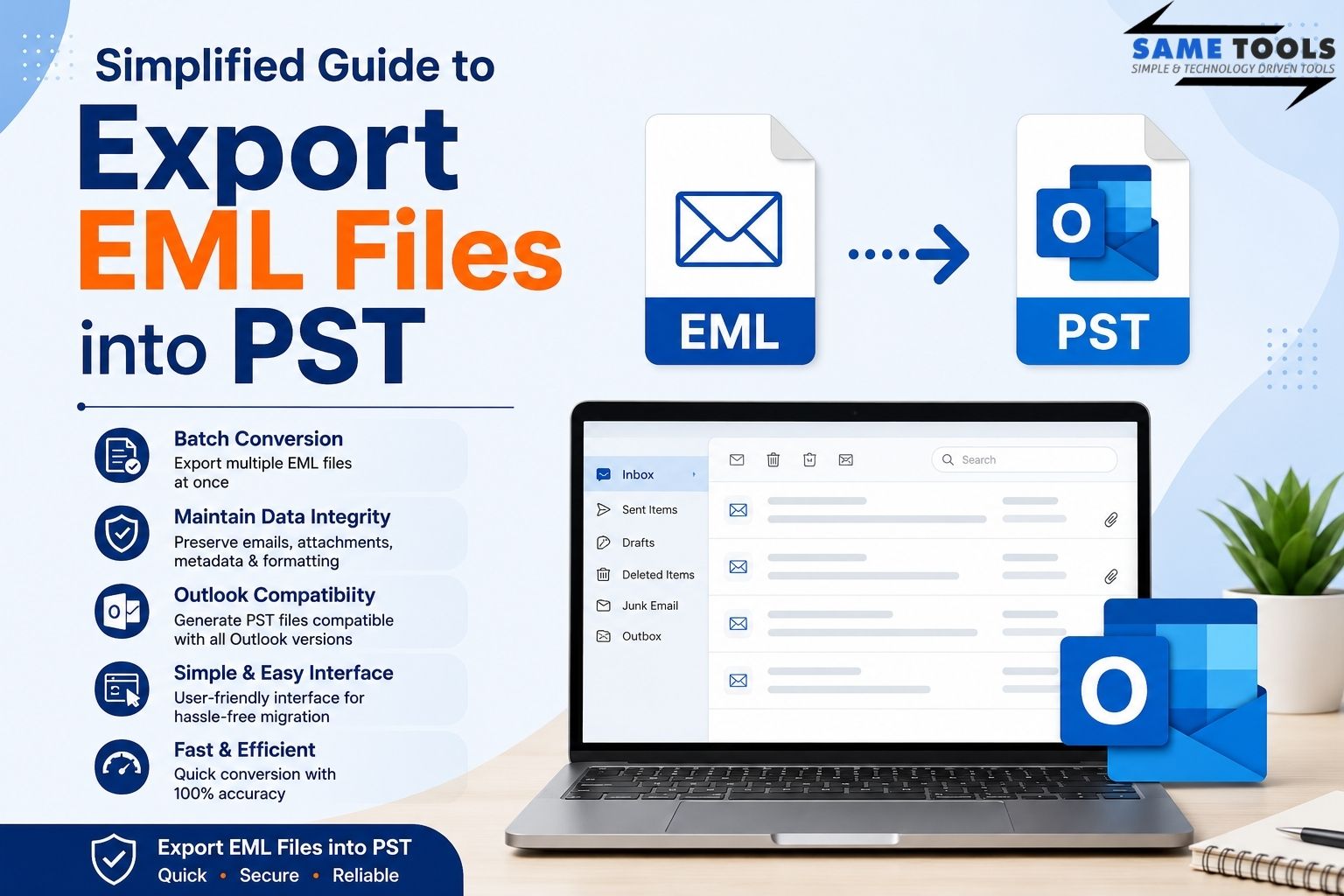
Batch Conversion Assistance
Users can export several EML files or folders at once using bulk conversion. This increases productivity and saves a lot of time.
Preserves Data Integrity
During migration, a dependable converter maintains all email attributes, such as:
The attachments
The hyperlinks
Visuals
Details of the sender and recipient
The format of emails
Metadata
This guarantees that emails stay the same after conversion.
Maintains Folder Organization
After transfer, users can appropriately organize emails by using an automated programs that preserve the original folder organization.
Outlook Interoperability
The produced PST files are compatible with different versions of Outlook, guaranteeing seamless accessibility free from compatibility issues.
Easy to Use Interface
Both expert and non-technical users can migrate with ease.
Rapid Conversion Rate
Large email databases can be handled swiftly and effectively with professional tools.
Selective Migration of Emails
Rather of moving the entire database, users can select particular EML files or folders for conversion.
Large PST File Support
Large PST files can be created by sophisticated software without damage or performance problems.
Detailed Instructions for Exporting EML Files to PST
With automated software, the migration process is simple and only involves a few easy steps.
Step 1: Install the program.
Install the EML to PST conversion program on your Windows computer after downloading it.
Step 2: Add EML Files
To choose which EML files or folders to migrate, launch the program and explore your system.
Step 3: Email Data Preview
Before converting an email, users can confirm its content using a preview feature offered by many applications.
Step 4: Select PST for the output format.
For Outlook migration, choose PST as the output format.
Step 5: Commence the Conversion
To start the migration procedure, click the conversion button.
Step 6: Open Outlook and import PST.
After conversion, open Outlook and import the converted PST file.
Exporting EML Files into PST has advantages.
There are numerous benefits to converting EML files to PST for both people and businesses.
Consolidated Email Storage
Email management is made easier by the fact that all mailbox data is kept in a single PST file.
Outlook's Simple Access
Outlook allows users to access all emails directly, eliminating the need for outdated email programs.
Enhanced Functionality for Search
Users can easily find crucial emails with Outlook's advanced search features.
Enhanced Efficiency
For a more efficient workflow, Outlook integrates contacts, calendars, emails and tasks onto a single platform.
Advice for a Smooth EML to PST Transfer
A successful migration process can be ensured by using the best practices.
Make a backup.
EML files should always be backed up before the conversion process begins.
Employ Trusted Software
Select reliable migration software to reduce the possibility of data loss or damage.
Prevent Disruptions While Converting
While the migration is underway, do not shut off the software or switch off the system.
Check the converted PST files.
Verify that every email was successfully transferred by opening the PST file in Outlook after conversion.
Make Sure There's Enough Storage
Adequate system storage capacity is necessary for large PST files.
Conclusion
EML files must be exported into PST format if users are moving to Outlook. PST files provide centralized email storage, improved organization, improved accessibility and efficient mailbox management in comparison to individual EML files.
Manual approaches are frequently slow, challenging and risky for large email collections, but they can be successful for modest conversions. Automated software makes the procedure easier by offering bulk conversion, folder structure preservation, Outlook compatibility, and complete data integrity.
Frequently Asked Questions
1. What is the purpose of converting EML to PST?
Users can transfer emails from EML-compatible email applications to Outlook with the aid of EML to PST conversion.
2. Can I simultaneously convert several EML files?
Yes, batch conversion for several EML files and folders is supported by expert migration software.
3. Will attachments hold up during the converting process?
During a migration, dependable conversion software maintains attachments, formatting, information and folder hierarchy.
4. Does converting PST files require Outlook?
While many sophisticated programs can generate PST files on their own, some tools require the installation of Outlook.
5. Can PST files be used with every version of Outlook?
The majority of expert converters produce PST files that work with several Outlook versions..








Add Comment