













Body-in-White (BIW)
If you’ve ever watched a time-lapse of a car being built, you’ve likely noticed the mesmerizing stage where sparks fly as robotic arms piece together a bare metal shell. This unpainted, skeletal structure is known in the automotive industry as the Body-in-White (BIW).
Before a vehicle gets its paint job, engine, or interior, the BIW serves as its foundation. It dictates the car's structural integrity, crash safety ratings, and overall weight.
Let's take an in-depth look at the entire body-in-white manufacturing process, from raw sheet metal to the highly engineered frames the world's top car manufacturers depend on.
What Exactly is "Body in White"?
“Body-in-white” refers to the stage in automobile manufacturing where the vehicle's sheet metal components are welded together to form the structural frame. The term originated decades ago when car bodies were painted white prior to final assembly.
Today, a modern BIW is an incredibly complex piece of engineering. To achieve the perfect balance of lightweight efficiency and high-strength safety, the process requires world-class precision.
The 4 Crucial Steps of BIW Production
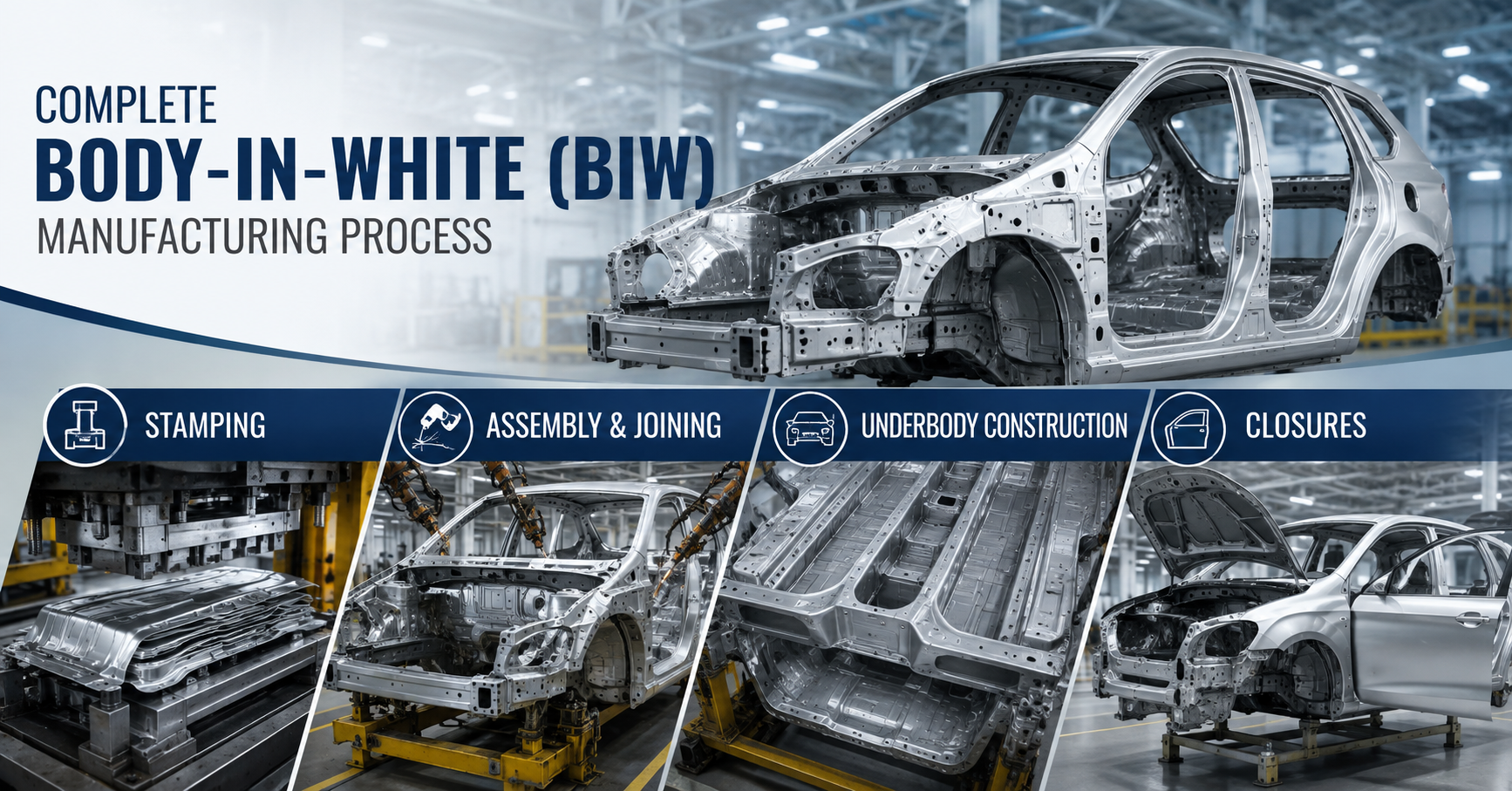
The journey from raw steel and aluminum to a finished BIW involves four primary stages: stamping, assembly, underbody construction, and closures.
1. Stamping (Forming the Pieces)
The process begins in the press shop. Huge rolls of sheet metal are cut into "blanks" and fed into massive stamping presses. These presses use thousands of tons of force to mold flat metal into complex, three-dimensional shapes—from large side panels to intricate brackets.
- The Goal: High precision with minimal waste.
- The Tech: Advanced stamping machinery is utilized to ensure that every curve and crease meets exact aerodynamic and structural specifications.
2. Assembly & Joining (Putting it Together)
Once the parts are stamped, they move to the body shop where the true magic happens. This is where individual components are joined together to create the car's structural framework.
Industry leaders like HIROTEC have revolutionised this stage through flexible automation and multispot positioning. Rather than relying solely on traditional methods, modern assembly lines use a combination of:
- Spot Welding: The backbone of BIW assembly, utilizing electric currents to fuse metal sheets.
- Laser Brazing: Used for visible seams (like roof joints) because it leaves a clean, smooth finish.
- Adhesive Bonding: High-strength industrial glues are applied between metal sheets to improve stiffness and reduce noise and vibration.

3. Underbody Construction (The Foundation)
The underbody is arguably the most critical structural segment of the BIW. It will be the foundation that will support the chassis, powertrain, and engine down the road.” The front, middle, and rear floors have to join with absolute perfection, as they are bearing the brunt of the weight and impact forces of the vehicle. They mainly rely on heavy spot welding and structural adhesives.
4. Closures (The "Class A" Surfaces)
"Closures" refer to the moving parts of the car's exterior: the doors, hoods, fenders, and tailgates. Because these are the surfaces customers interact with directly (Class A surfaces), their quality is paramount.
Achieving the "perfect close" requires specialized techniques like hemming—where the edge of an outer sheet metal panel is folded over the edge of an inner panel. Companies like HIROTEC specialize in these tailored solutions, producing millions of flawless closure panels a year that ensure doors shut with that satisfying, solid sound.
The Future of BIW: Flexible & Sustainable
The automotive industry is shifting rapidly toward electric vehicles (EVs), and BIW production is evolving right alongside it. Battery packs require completely different structural supports than traditional combustion engines, forcing manufacturers to rethink underbody designs.
Also, modern BIW production is becoming greener. Through advanced design and highly efficient robotic integration, manufacturers are successfully reducing emissions and minimizing scrap metal waste. That’s just a taste; the future of mobility begins long before the car ever hits the road.








Add Comment