











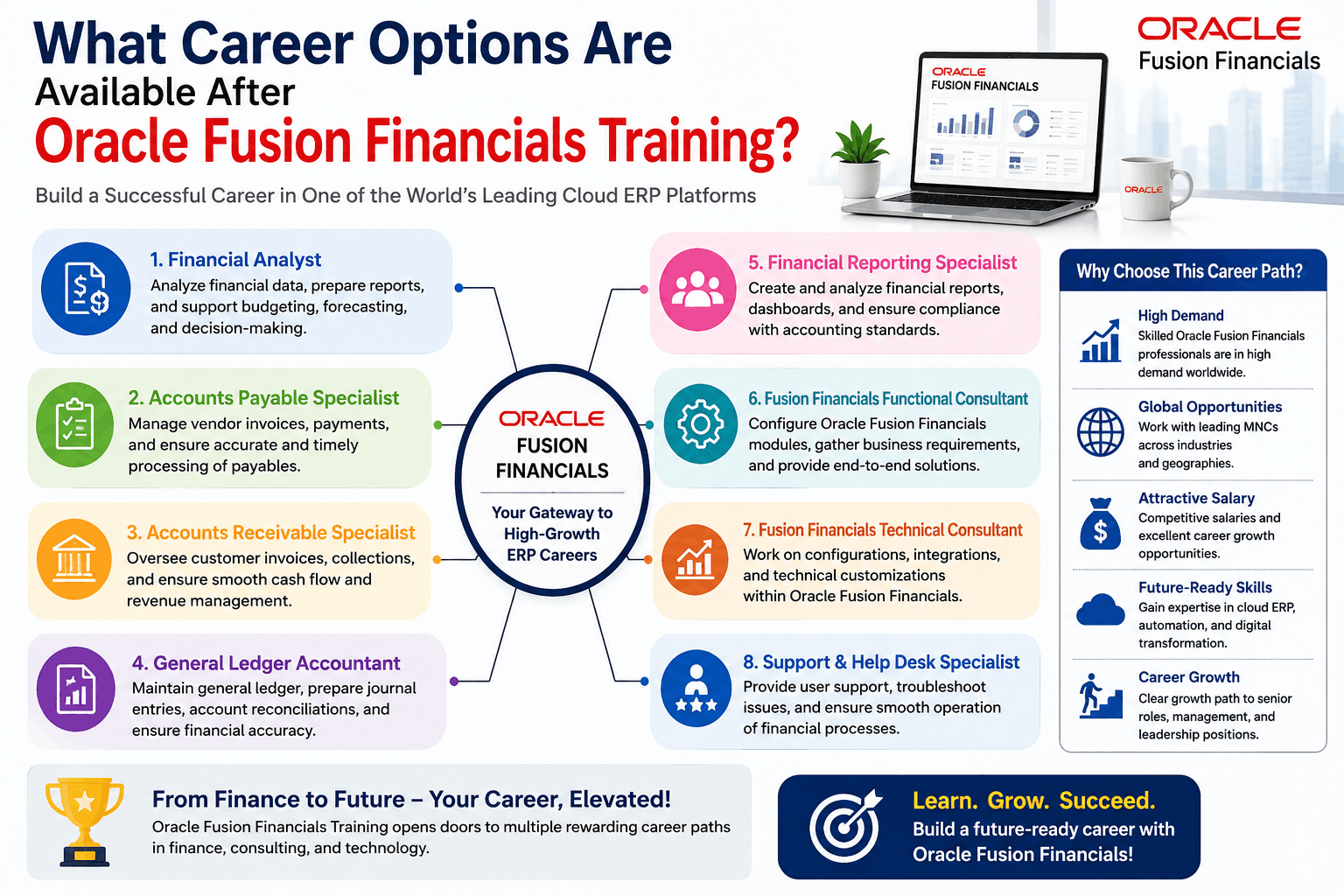


Introduction
It's easy to picture the training itself modules, practice exercises, maybe a few late nights before an assessment. What's harder to picture is the actual day-to-day work waiting on the other side. At Soft Online Training, we've found that showing learners what these roles genuinely look like day to day helps far more than just listing job titles. Oracle Fusion Financials leads to a surprisingly varied set of careers, and whether you got there through Oracle Fusion Financials Online Training at your own pace or a more structured Oracle Fusion Financials Course, it helps to know what you're actually signing up for.
Here's a closer look at what a typical day looks like across the most common career paths this training leads to.
The Functional Consultant's Day
Mornings often start with client calls, understanding what a finance team needs from their system. The rest of the day gets split between configuring Oracle Fusion Financials General Ledger, Payables, Receivables, Fixed Assets and documenting decisions so nothing gets lost between meetings. It's a role with constant context-switching, which some people thrive on and others find draining by the end of the week.
The Techno-Functional Consultant's Day
Expect a mix of configuration work and genuinely technical problem-solving maybe debugging why a custom report isn't pulling the right data, or fixing an integration that's silently failing between systems. This role tends to attract people who enjoy digging into the "why" behind a technical issue rather than just following a standard setup checklist.
The Support Analyst's Day
Far less unpredictable than implementation work. Most of the day revolves around ticket queues, resolving user issues, applying system patches, and keeping already-live systems stable. It's steady, methodical work ideal for people who prefer routine over the intensity of new project rollouts.
The Financial Systems Administrator's Day
A lot of time goes into managing access permissions, adjusting security roles, and running data integrity checks across the platform. This role stays close to the technical backend of Oracle Fusion Financials, with far less client-facing interaction than consulting roles.
The Business Process Analyst's Day
Expect fewer hours inside the software itself and more time mapping out workflows, interviewing stakeholders about how processes currently work, and identifying where Oracle Fusion Financials can automate or simplify things. This role blends analytical thinking with a fair amount of change management conversation.
The Implementation Project Lead's Day
Less hands-on configuration, more coordination checking in with consultants, tracking project milestones, updating stakeholders, and making sure the rollout stays within budget. It's a role built around keeping many moving parts aligned rather than doing the technical work directly.
The Reporting and Compliance Specialist's Day
A good chunk of the day goes into building and refining reports using tools like OTBI and BI Publisher, along with reviewing whether financial data stays aligned with relevant compliance standards. It's detail-heavy work that rewards precision over speed.
The Independent Consultant's Day
This varies more than any other role on this list, since it depends entirely on whatever project you're working on at the time. Some days look like functional consulting, others lean more technical the appeal here is really about choosing your own projects and schedule rather than a fixed day-to-day structure.
Which Day Sounds Like Yours?
None of these are locked-in choices. Plenty of professionals start in one role and gradually shift toward another as their interests change moving from functional consulting into project leadership, or from support work into reporting and compliance. A well-structured Oracle Fusion Financials Course prepares you for any of these directions; from there, it's really about noticing which day-to-day rhythm suits you best.
Final Thoughts
Oracle Fusion Financials training doesn't lead to one fixed job it opens up a genuinely wide set of career paths, each with a noticeably different day-to-day rhythm across consulting, technical support, compliance, and leadership. Whether your foundation came from flexible Oracle Fusion Financials Course or a more traditional classroom setup, these skills stay relevant as long as organizations keep depending on cloud ERP platforms, and that dependency isn't fading anytime soon.
If you're still deciding which direction fits you, start with the fundamentals and pay attention to which day-to-day pace actually feels right once you're in the field.








Add Comment