













Introduction
Almost everyone weighing a move into Cloud ERP hits the same doubt before they even start: is this actually something I can learn, or is it reserved for people who've already spent a decade in finance? Soft Online Training fields this exact worry regularly, from students still finishing their degrees to working professionals eyeing a shift and career switchers coming from entirely different fields and the honest answer tends to surprise people. Oracle Fusion Financials was never built as a closed club for seasoned specialists.
As organizations keep shifting finance operations onto Oracle Cloud ERP, the demand for trained people keeps climbing, and that's pulled in a genuinely broad range of learners wondering if they can realistically catch up. They usually can a structured path, real hands-on practice, and steady effort tend to get beginners to a confident place faster than they expect, and that's precisely the gap solid Oracle Fusion Financials Online Training is designed to close.
What the Platform Is Actually Built to Do
Oracle Fusion Financials is a cloud-based financial management system that pulls accounting, reporting, supplier payments, customer transactions, budgeting, and asset management into one connected platform. Because its modules General Ledger, Accounts Payable, Accounts Receivable, Cash Management, Fixed Assets, Expense Management, Tax Management, and Financial Reporting are designed to work together rather than in isolation, learners end up with a genuinely holistic view of how business finance operates, not a fragmented one.
Why the Learning Curve Isn't as Steep as People Assume
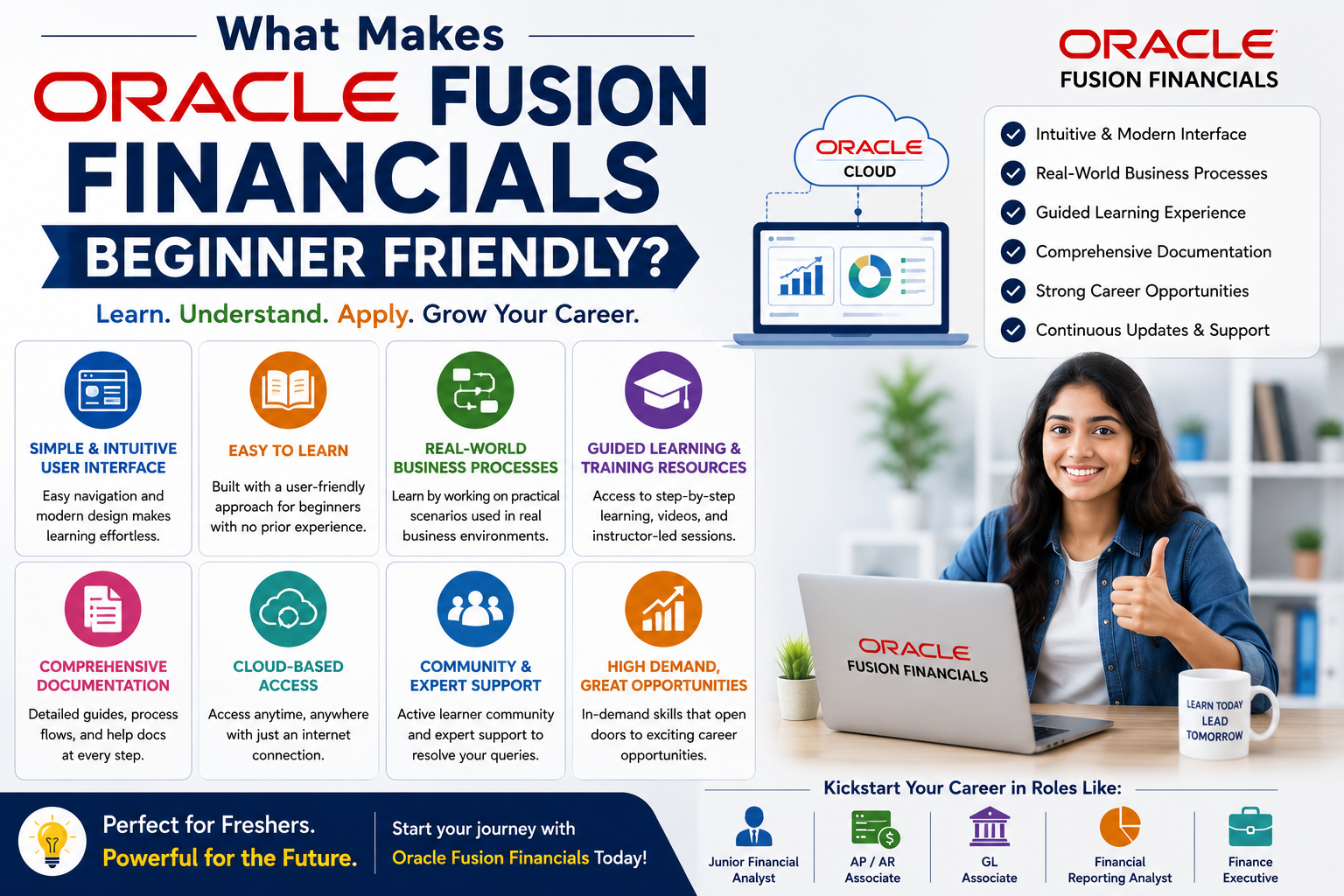
There's a persistent assumption floating around that ERP software is only approachable for people already deep in finance. In reality, Oracle Fusion Financials was designed around a logical module structure, cloud-based access from anywhere, integrated workflows, and a genuinely usable interface none of which require finance expertise just to get oriented. Combine that with the strong learning resources available today and the steady industry demand keeping people motivated, and a beginner with a systematic approach tends to make real progress rather than getting stuck.
Prior Experience Isn't the Barrier People Think It Is
This is where a lot of hesitation quietly dissolves. Commerce graduates, MBA Finance students, fresh graduates, banking professionals, accountants, IT professionals, career switchers, and business administration graduates all essentially start from the same line. Some accounting background helps, sure, but most well-designed training explains financial concepts plainly enough that not having years of prior exposure isn't actually disqualifying.
Why a Gradual Approach Beats Cramming Everything In
A properly built Oracle Fusion Financials Course doesn't throw everything at learners in week one. It typically opens with ERP fundamentals what Enterprise Resource Planning is solving for, and why cloud has replaced on-premise systems before moving into accounting basics like debits and credits, journal entries, the general ledger, trial balance, balance sheets, and profit and loss statements. Only once that groundwork is solid does it move into individual Oracle Financials modules, then how those modules connect. That pacing is exactly what keeps beginners from feeling buried early on.
The Modules Worth Learning First
Most beginner-friendly paths focus on five essentials: General Ledger (GL) covering ledgers, journals, chart of accounts, and reporting; Accounts Payable (AP) covering supplier setup, invoice processing, and approvals; Accounts Receivable (AR) covering customer invoicing, receipts, and revenue tracking; Cash Management (CM) covering bank reconciliation and cash positioning; and Fixed Assets (FA) covering asset lifecycle management and depreciation. Get solid footing here, and the rest of the platform stops feeling like a maze.
The Role Practice Plays in Actually Learning This
Beginners who succeed with Oracle Fusion Financials usually aren't the ones who studied the most theory they're the ones who practiced the most. Real Oracle Cloud exercises, genuine implementation scenarios, business case studies, and workflow practice show learners how the platform actually behaves inside a real company, in a way slides simply can't replicate.
Supporting Skills Worth Developing Alongside It
Beyond the modules, beginners benefit from strengthening accounting fundamentals, general business process understanding, Oracle Cloud navigation, Excel proficiency, analytical thinking, clear communication, problem-solving, and functional documentation skills the connective tissue that turns module knowledge into actual workplace competence.
What Quality Online Training Actually Looks Like
Solid Oracle Fusion Financials Online Training should offer real flexibility to learn from anywhere, genuine mentorship from professionals who've worked live projects, interactive sessions rather than passive lectures, and built-in career preparation resume help, mock interviews, and placement support included, not optional extras.
Where Beginners Typically Land
After training, common entry points include Functional Associate, ERP Support Executive, Cloud Financials Analyst, ERP Functional Trainee, Finance Systems Associate, and Business Process Associate with realistic progression toward Functional Consultant, Business Analyst, and Implementation Consultant roles over time.
Why Soft Online Training
The program is built around live instructor-led classes, experienced Oracle Cloud trainers, hands-on practice, real implementation projects, practical assignments, flexible scheduling, recorded sessions, resume support, mock interviews, and placement guidance aimed squarely at building genuine confidence, not just a certificate.
A Few Practical Tips for Starting Out
Get accounting basics down before chasing advanced topics, practice consistently rather than in occasional bursts, focus on understanding whole business processes instead of memorizing isolated terms, take real notes during hands-on sessions, treat mock interviews seriously, and keep an eye on Oracle Cloud updates as they roll out. Steady, small effort beats last-minute cramming almost every time.
Conclusion
Oracle Fusion Financial earns its beginner-friendly reputation through structured learning, real business processes, and a cloud platform widely enough adopted that support and resources are never hard to find. With the right guidance, even complete beginners can build genuine, lasting competence. Enrolling in Oracle Fusion Financials Online Training gives learners practical exposure and expert mentorship that smooth out the early learning curve, while a well-rounded Oracle Fusion Financials Course builds a solid foundation in Oracle Cloud Financials, accounting principles, and ERP processes. With hands-on projects, flexible learning, and career-focused guidance from Soft Online Training, beginners can confidently start building a genuinely rewarding career in Oracle Fusion Financials.








Add Comment