













Introduction
An Oracle Fusion Financials interview is an excellent opportunity to showcase your technical knowledge, accounting fundamentals, and problem-solving skills. However, many freshers lose valuable opportunities not because they lack knowledge, but because they make avoidable mistakes during the interview process. Employers look for candidates who are confident, prepared, and eager to learn, especially for entry-level Oracle ERP roles.
Completing Oracle Fusion Financials Training gives you the technical foundation required for interviews, but your overall preparation and professional behaviour also play a significant role. A comprehensive Oracle Fusion Financials Course not only teaches the software but also helps candidates understand how to approach interviews with confidence.
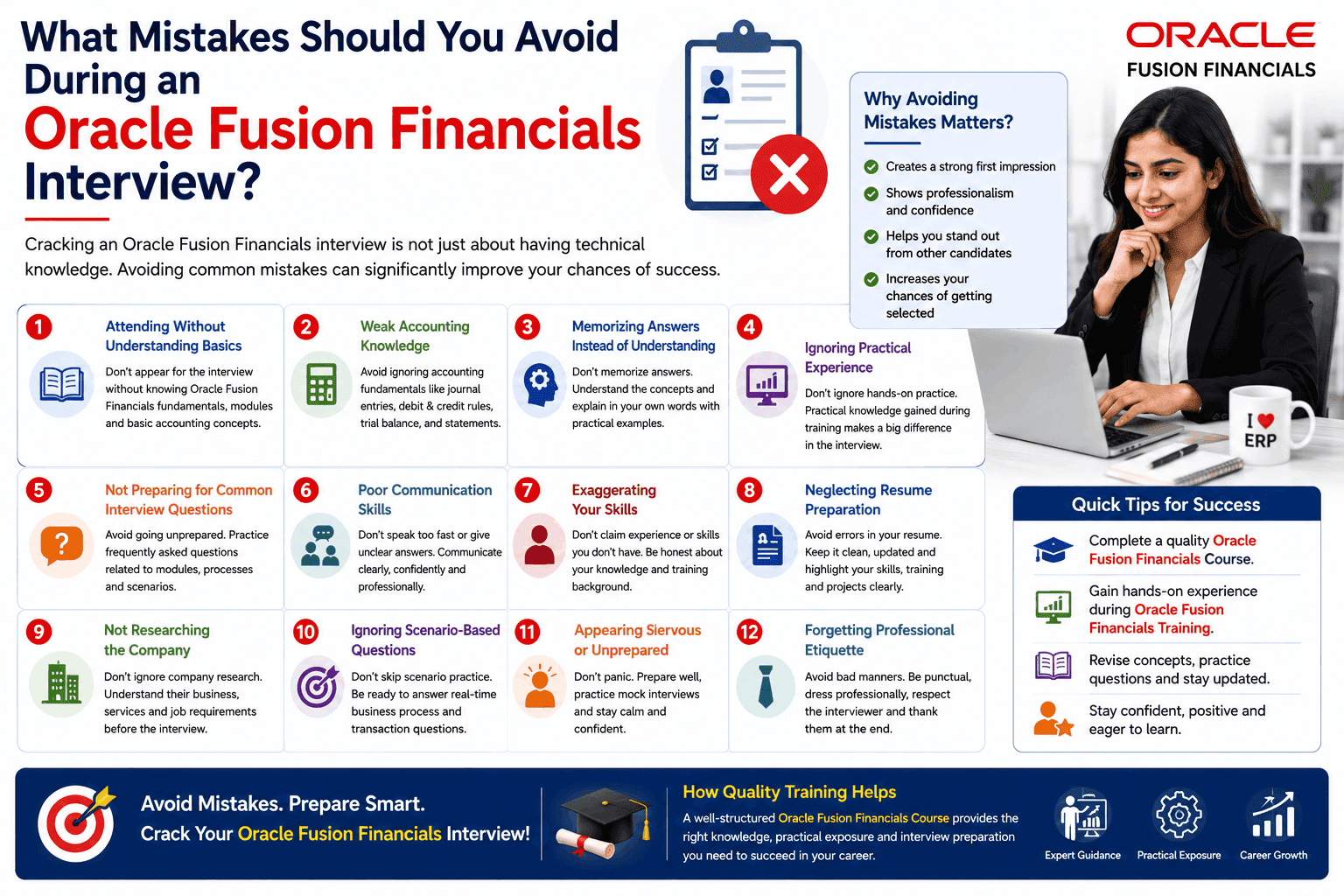
Let's explore the most common mistakes freshers should avoid during an Oracle Fusion Financials interview.
1. Attending the Interview Without Understanding the Basics
One of the biggest mistakes freshers make is appearing for interviews without mastering Oracle Fusion Financials fundamentals.
Before attending the interview, make sure you understand:
- Oracle Fusion Cloud ERP overview
- Core financial modules
- Financial workflows
- Basic accounting concepts
- Cloud ERP terminology
Interviewers usually begin with simple questions to assess your foundation before moving to more detailed topics.
2. Weak Accounting Knowledge
Oracle Fusion Financials is built around accounting processes. Even if you understand the software interface, weak accounting knowledge can negatively affect your interview performance.
Revise topics such as:
- Debit and credit rules
- Journal entries
- Trial balance
- Balance Sheet
- Profit and Loss statement
- Accounts Payable
- Accounts Receivable
Strong accounting fundamentals make it easier to explain business transactions confidently.
3. Memorizing Answers Instead of Understanding Concepts
Many freshers try to memorize interview answers from websites or videos. Unfortunately, experienced interviewers can easily recognize memorized responses.
Instead:
- Understand the concept.
- Explain it in your own words.
- Use practical examples whenever possible.
Candidates who demonstrate genuine understanding leave a stronger impression than those who simply recite definitions.
4. Ignoring Practical Experience
Even freshers are expected to have some practical exposure through training projects.
A quality Oracle Fusion Financials Training program should include:
- Hands-on exercises
- Business scenarios
- Live demonstrations
- Transaction processing
- Financial reporting
During interviews, mention any practical projects or simulations you completed. This shows that you can apply your knowledge in real-world situations.
5. Not Preparing for Common Interview Questions
Many candidates focus only on learning Oracle Financials and forget to practice interview questions.
Prepare answers for topics like:
- What is Oracle Fusion Financials?
- Explain General Ledger.
- What is Accounts Payable?
- What is Accounts Receivable?
- What is a Chart of Accounts?
- What is a Ledger?
- Explain invoice processing.
- What is bank reconciliation?
Practicing these questions helps improve confidence and fluency.
6. Poor Communication Skills
Communication is just as important as technical knowledge.
Avoid:
- Speaking too quickly.
- Giving unclear explanations.
- Interrupting the interviewer.
- Using overly technical language without context.
Instead:
- Listen carefully.
- Organize your thoughts.
- Speak confidently.
- Keep your answers simple and relevant.
Strong communication demonstrates professionalism and teamwork.
7. Exaggerating Your Skills
Some candidates claim experience or knowledge they do not actually possess.
This can backfire when interviewers ask follow-up questions.
Be honest about:
- Your training experience
- Projects you completed
- Skills you have learned
- Areas you are still improving
Recruiters appreciate honesty and a willingness to learn more than exaggerated claims.
8. Neglecting Resume Preparation
Your resume is often the first thing an interviewer reviews.
Common resume mistakes include:
- Spelling errors
- Outdated information
- Irrelevant skills
- Poor formatting
- Missing project details
Your resume should clearly highlight:
- Educational qualifications
- Oracle Fusion Financials skills
- Certifications
- Academic projects
- Technical knowledge
- Soft skills
A well-prepared resume creates a positive first impression.
9. Not Researching the Company
Candidates often focus entirely on technical preparation and ignore company research.
Before the interview:
- Visit the company's website.
- Learn about its services.
- Understand its business domain.
- Review the job description carefully.
This preparation helps you answer questions more confidently and shows genuine interest in the role.
10. Ignoring Scenario-Based Questions
Many Oracle Fusion Financials interviews include practical business scenarios.
For example:
- How would you process a supplier invoice?
- What happens after journal creation?
- How do customer receipts work?
- How is bank reconciliation performed?
A good Oracle Fusion Financials Course includes real-time business scenarios that help candidates answer these questions effectively.
11. Appearing Nervous or Unprepared
Feeling nervous is normal, but poor preparation often increases anxiety.
To build confidence:
- Practice mock interviews.
- Revise important concepts.
- Prepare examples from your training.
- Sleep well before the interview.
- Arrive early or test your internet connection for virtual interviews.
Confidence comes from consistent preparation.
12. Forgetting Professional Etiquette
Your behavior throughout the interview matters.
Avoid:
- Arriving late.
- Dressing casually.
- Checking your phone.
- Speaking negatively about previous experiences.
- Leaving without thanking the interviewer.
Professional etiquette demonstrates maturity and respect.
Conclusion
Avoiding common interview mistakes can significantly improve your chances of securing your first Oracle ERP role. Employers understand that freshers may not have extensive work experience, but they expect candidates to demonstrate strong fundamentals, practical knowledge, and a willingness to learn.
By enrolling in Oracle Fusion Financials Training, you can gain hands-on experience that prepares you for both technical and scenario-based interview questions. A structured Oracle Fusion Financials Course also helps you build confidence, improve communication, and understand real-world financial processes. With thorough preparation, honest communication, and a professional attitude, you can avoid common interview pitfalls and take the first step toward a successful career in Oracle Fusion Financials.








Add Comment