













Introduction
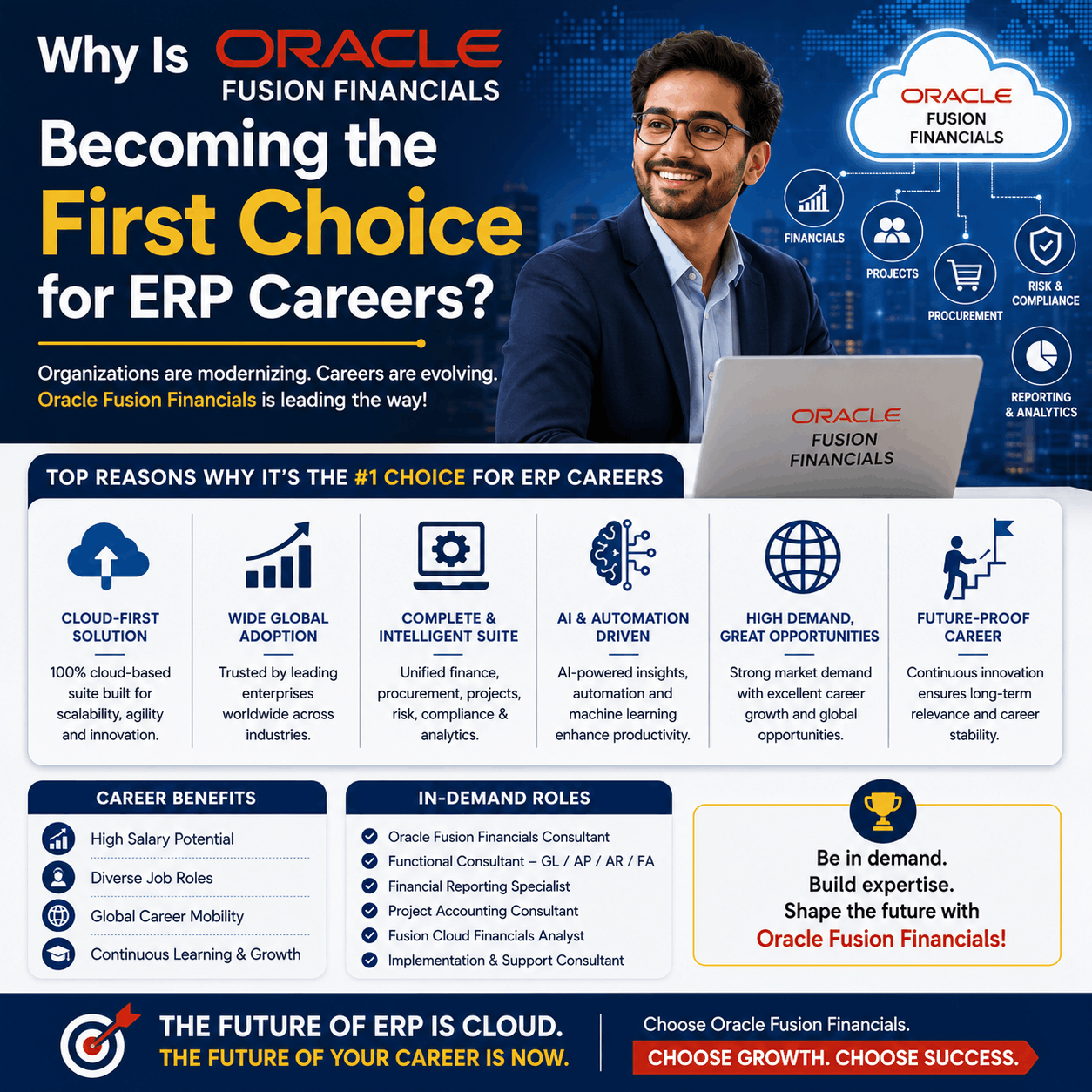
Sit in on enough career conversations about ERP these days, and one thing becomes obvious fast: Oracle Fusion Financials keeps coming up as the preferred starting point, far more than it did just a few years back. Soft Online Training works with a steady mix of finance graduates, career changers, and IT professionals every week, and this pattern has become too consistent to call a coincidence. This piece breaks down why Financials has pulled ahead of other ERP modules as the default choice, and what's actually behind that momentum.
None of this is happening randomly. A combination of stronger job stability, a friendlier learning curve, and a career path that opens up in more directions than most other modules is driving the shift. Let's unpack why so many people entering ERP are choosing Financials as their launchpad.
The One Module No Business Can Operate Without
Regardless of industry, every ERP system ultimately circles back to financial data. A logistics company managing multiple currencies and a healthcare provider tracking asset depreciation both rely on the same underlying financial framework. This universal need gives professionals skilled in General Ledger, Payables, Receivables, and Fixed Assets a level of job security that narrower, industry-specific modules rarely match.
Because financial processes touch virtually every part of a business, companies almost never operate without someone who genuinely understands this module. That baseline demand is a major reason candidates are gravitating toward a well-rounded Oracle Fusion Financials Course, rather than betting their career on a module that only applies to one type of industry.
A Smoother Starting Point for Beginners
Compared to modules such as Supply Chain Management or Human Capital Management, Financials tends to feel far less overwhelming for people just starting out particularly those with a background in commerce or accounting. Much of the vocabulary already lines up with what accounting students learn early on, which shortens the adjustment period noticeably.
That ease of entry is a big driver behind the growing popularity of Oracle Fusion Financials Online Training. Learners don't need a deep technical background before enrolling; a well-built course starts from familiar accounting concepts and works up gradually into cloud configuration, reporting structures, and system navigation. That progression makes the whole experience feel far less intimidating than jumping straight into a heavily technical module.
A Career Path With Room to Grow
Something that doesn't get discussed nearly enough is how many directions a strong Financials background can take you. One solid certification can lead toward functional consulting, financial reporting and analytics, implementation support, or eventually managing ERP projects altogether. Very few other modules give beginners this much flexibility this early on.
That's exactly why more learners are signing up for a complete Oracle Fusion Financials Course instead of locking themselves into a narrow niche right out of the gate. Starting with Financials keeps the door open for whatever comes next deeper specialization in reporting, a move into consulting, or branching into a related module like Procurement further down the line.
How Online Learning Reshaped Access
A large part of this shift comes down to how ERP education itself has transformed. Not too long ago, decent Oracle training was mostly limited to physical classrooms in a small number of cities, which excluded a lot of talented people simply due to location. That's no longer the case. Oracle Fusion Financials Online Training now provides the same live instructor sessions, practical labs, and certification prep that used to require showing up in person.
This matters more than people initially realize. It means someone based in a small town, or even a completely different country, can access instruction just as strong as what's offered in a major ERP hiring center, without having to relocate or restructure their entire schedule around a classroom.
Why Demand Keeps Rising Across Sectors
Recruiters in finance, manufacturing, retail, and IT consistently point to Oracle Fusion Financials as one of the harder skill sets to fill. Businesses still migrating away from legacy platforms need implementation specialists, while companies already running Fusion need support consultants who can handle the platform's everyday quirks. Since both hiring needs run in parallel, overall demand stays notably steadier than many other, more cyclical ERP skills.
That steady pull is a big reason more professionals are choosing to enroll in a proper Oracle Fusion Financials Course, rather than treating ERP knowledge as something to pick up later, almost as an afterthought to a finance degree.
What a Good Program Should Actually Offer
With so many training options available now, it pays to be selective before enrolling. A worthwhile program should include:
- Genuine hands-on time inside a live Oracle Fusion system
- Live instructor-led sessions, not just recorded video content
- Updated material reflecting Oracle's recent quarterly changes
- A curriculum closely mapped to current certification exam patterns
- Career support, including resume feedback and interview prep
Programs from providers like Soft Online Training are built around exactly these priorities, which explains why so many beginners are choosing structured Oracle Fusion Financials Online Training instead of trying to piece together scattered free resources on their own.
Conclusion
Oracle Fusion Financials hasn't become the top ERP career choice by luck. It combines steady cross-industry demand, a more manageable learning curve for newcomers, and a career path that branches in multiple directions once the basics are in place.
For anyone deciding where to begin in ERP, investing in a solid Oracle Fusion Financials Course, paired with flexible Oracle Fusion Financials Online Training, remains one of the more reliable ways to enter the field and build genuine career momentum. Demand for these fundamentals shows no signs of slowing every indicator suggests this trend has real staying power.








Add Comment